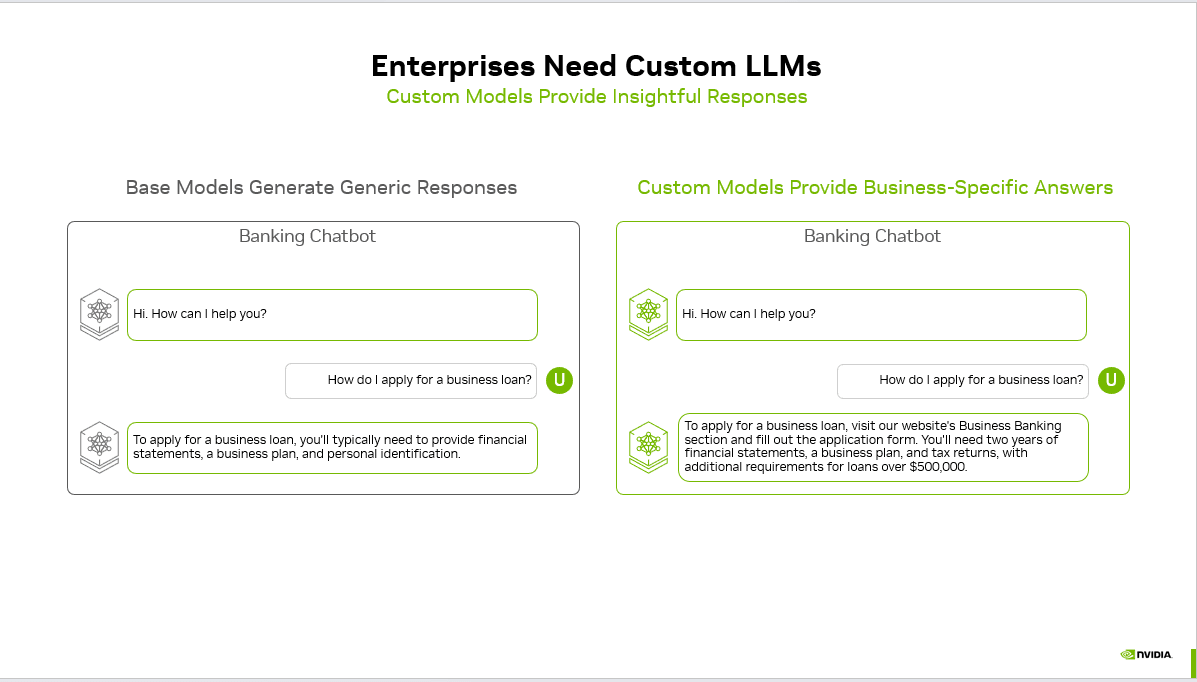
Why Enterprises Need Custom LLMs: Base vs Fine-Tuned Models in 2026
Custom LLMs outperform base models for enterprise use cases by 40-65%. Learn when to fine-tune, RAG, or build custom models — with architecture patterns and ROI data.
Explore large language model architectures, fine-tuning strategies, prompt engineering, and how LLMs power modern AI applications.
9 of 55 articles

Custom LLMs outperform base models for enterprise use cases by 40-65%. Learn when to fine-tune, RAG, or build custom models — with architecture patterns and ROI data.
The gap between open-weight and proprietary LLMs has narrowed dramatically. Compare licensing, customization, performance, and total cost of ownership to choose the right model strategy for your organization.
Academic benchmarks do not predict production performance. Learn which evaluation metrics actually matter for deploying LLMs, how to build task-specific evaluation suites, and why human evaluation remains essential.
Foundation models are the core infrastructure layer behind modern AI applications. Learn what they are, how pre-training and fine-tuning work, and how to select the right foundation model for your use case.
Million-token context windows enable entire codebase analysis, full document processing, and multi-session reasoning. Explore the technical advances and practical applications of extended context in LLMs.
Quantization enables deploying large language models on constrained hardware by reducing numerical precision. Learn about FP4, FP8, INT8, and GPTQ techniques with practical accuracy trade-off analysis.
RLHF is the training methodology that transforms raw language models into helpful, harmless assistants. Understand how it works, its variants like DPO and RLAIF, and the alignment challenges it addresses.
Mixture of Experts has become the dominant architecture for large-scale open-source models. Learn how MoE works, why 60% of recent open releases adopt it, and what efficiency gains it delivers.