
NVIDIA NeMo Microservices: Building Scalable AI Agent Platforms
NVIDIA NeMo Microservices: Building Scalable AI Agent Platforms
Artificial Intelligence is rapidly evolving from simple models to autonomous AI agents capable of reasoning, retrieving knowledge, and interacting with enterprise systems. However, deploying these agents at scale requires more than just a powerful language model—it requires an end‑to‑end platform.
This is where NVIDIA NeMo Microservices comes in.
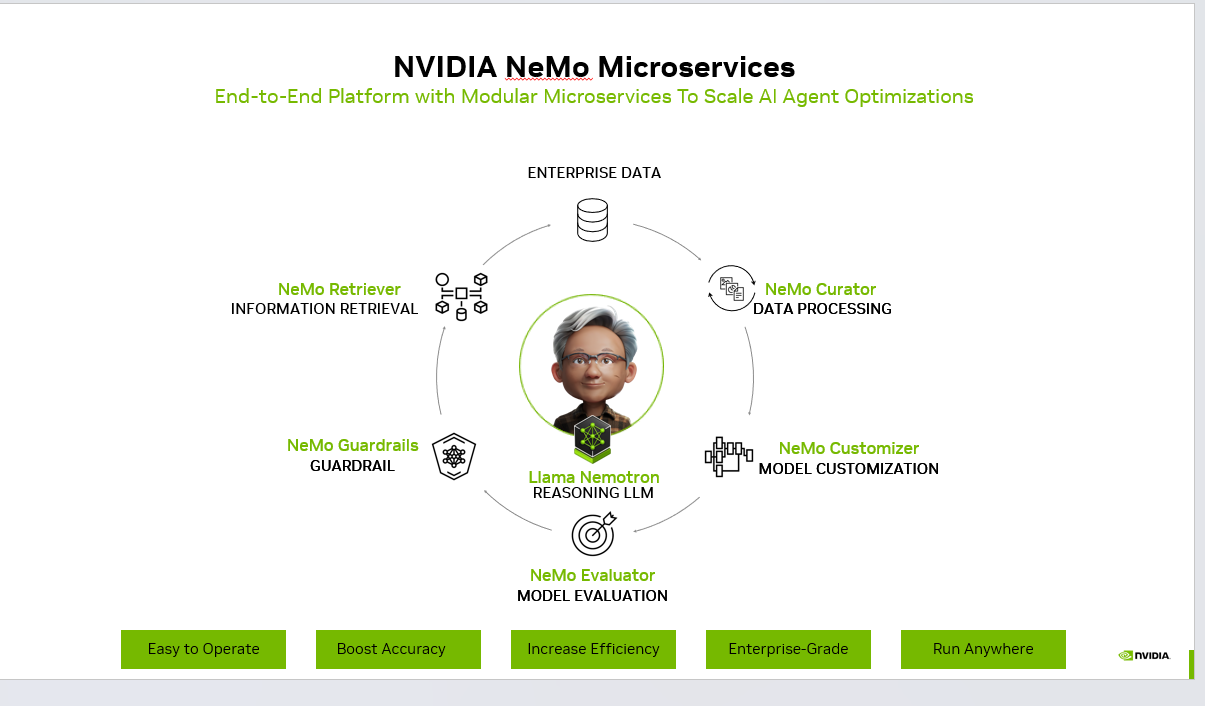
NVIDIA designed NeMo as a modular microservices architecture that helps organizations build, customize, evaluate, and deploy AI agents efficiently across enterprise environments.
Core Components of NVIDIA NeMo Microservices
1. NeMo Retriever – Information Retrieval
Helps AI agents access enterprise knowledge by retrieving relevant information from large datasets, documents, and databases. This enables Retrieval‑Augmented Generation (RAG) workflows for more accurate responses.
Hear it before you finish reading
Talk to a live CallSphere AI voice agent in your browser — 60 seconds, no signup.
2. NeMo Curator – Data Processing
Prepares and processes enterprise data before it is used by AI models. It handles data cleaning, filtering, and structuring so models learn from high‑quality datasets.
3. NeMo Customizer – Model Customization
Allows enterprises to fine‑tune and adapt foundation models to their specific domain, improving performance for specialized tasks.
4. NeMo Evaluator – Model Evaluation
Ensures models meet performance and safety standards through systematic benchmarking, testing, and evaluation.
5. NeMo Guardrails – Safety & Control
Adds policy enforcement and safeguards to ensure AI agents behave responsibly and follow enterprise rules.
The Role of the Reasoning Model
At the center of this architecture sits a reasoning LLM such as Llama Nemotron. This model interacts with each microservice to retrieve knowledge, process data, evaluate outputs, and enforce guardrails.
flowchart LR
    INPUT(["User intent"])
    PARSE["Parse plus<br/>classify"]
    PLAN["Plan and tool<br/>selection"]
    AGENT["Agent loop<br/>LLM plus tools"]
    GUARD{"Guardrails<br/>and policy"}
    EXEC["Execute and<br/>verify result"]
    OBS[("Trace and metrics")]
    OUT(["Outcome plus<br/>next action"])
    INPUT --> PARSE --> PLAN --> AGENT --> GUARD
    GUARD -->|Pass| EXEC --> OUT
    GUARD -->|Fail| AGENT
    AGENT --> OBS
    style AGENT fill:#4f46e5,stroke:#4338ca,color:#fff
    style GUARD fill:#f59e0b,stroke:#d97706,color:#1f2937
    style OBS fill:#ede9fe,stroke:#7c3aed,color:#1e1b4b
    style OUT fill:#059669,stroke:#047857,color:#fff
Why This Architecture Matters
Organizations building AI agents need platforms that are:
Still reading? Stop comparing — try CallSphere live.
CallSphere ships complete AI voice agents per industry — 14 tools for healthcare, 10 agents for real estate, 4 specialists for salons. See how it actually handles a call before you book a demo.
• Easy to operate
• Accurate and reliable
• Efficient and scalable
• Enterprise‑grade
• Deployable anywhere
NVIDIA NeMo Microservices provides exactly that by breaking complex AI systems into modular services that can scale independently.
The Future of Enterprise AI
The future of enterprise AI will not be just about bigger models—it will be about better systems. Platforms like NVIDIA NeMo enable companies to build reliable AI agents that integrate with real‑world data and enterprise workflows.
As organizations continue adopting AI, architectures built on modular microservices will become the foundation for scalable and trustworthy AI systems.
#AI #GenerativeAI #LLM #AIInfrastructure #NVIDIA #MachineLearning #AIEngineering
## NVIDIA NeMo Microservices: Building Scalable AI Agent Platforms — operator perspective Treat NVIDIA NeMo Microservices: Building Scalable AI Agent Platforms the way you'd treat any other dependency change: pin the version, run it through your eval suite, watch p95 latency for a week, and only then promote it from canary. On the CallSphere side, the practical filter is simple: would this make a 90-second appointment-booking call faster, cheaper, or more reliable? If the answer is "maybe in a benchmark," it doesn't ship to production. ## Where a junior engineer should actually start If you're new to agentic AI and want to be useful in three weeks, skip the framework war and start with one stack: the OpenAI Agents SDK. Build a single-agent app that does one thing well (book an appointment, qualify a lead, escalate a complaint). Then add a second specialist agent with an explicit handoff — the receiving agent gets a structured payload (intent, entities, prior tool results), not a transcript. That's the moment the abstractions click. From there, the next two skills that compound are evals (write the regression case the moment you find a bug, and refuse to merge anything that fails the suite) and observability (log the tool-call graph, not just the final answer). Frameworks come and go; those two habits transfer. Once you've shipped that first multi-agent app end-to-end, the rest of the agentic AI literature reads differently — you can tell which papers are solving real production problems and which are solving demo problems. ## FAQs **Q: Does nVIDIA NeMo Microservices actually move p95 latency or tool-call reliability?** A: Most of the time it doesn't, and that's the right starting assumption. The relevant test is whether it improves at least one of: p95 first-token latency, tool-call argument accuracy on noisy inputs, multi-turn handoff stability, or per-session cost. CallSphere ships in 57+ languages, is HIPAA and SOC 2 aligned, and runs voice, chat, SMS, and WhatsApp from the same agent stack. **Q: What would have to be true before nVIDIA NeMo Microservices ships into production?** A: The eval gate is unsentimental — a regression suite that simulates real call traffic (noisy ASR, partial inputs, tool-call timeouts) measures four numbers, and a candidate has to win on three of four without losing badly on the fourth. Anything else is treated as a blog post, not a stack change. **Q: Which CallSphere vertical would benefit from nVIDIA NeMo Microservices first?** A: In a CallSphere deployment, new model and API capabilities land first in the post-call analytics pipeline (lower stakes, async, easy to roll back) and only later in the live realtime path. Today the verticals most likely to absorb new capability first are IT Helpdesk, which already run the largest share of production traffic. ## See it live Want to see healthcare agents handle real traffic? Walk through https://healthcare.callsphere.tech or grab 20 minutes with the founder: https://calendly.com/sagar-callsphere/new-meeting.Try CallSphere AI Voice Agents
See how AI voice agents work for your industry. Live demo available -- no signup required.