
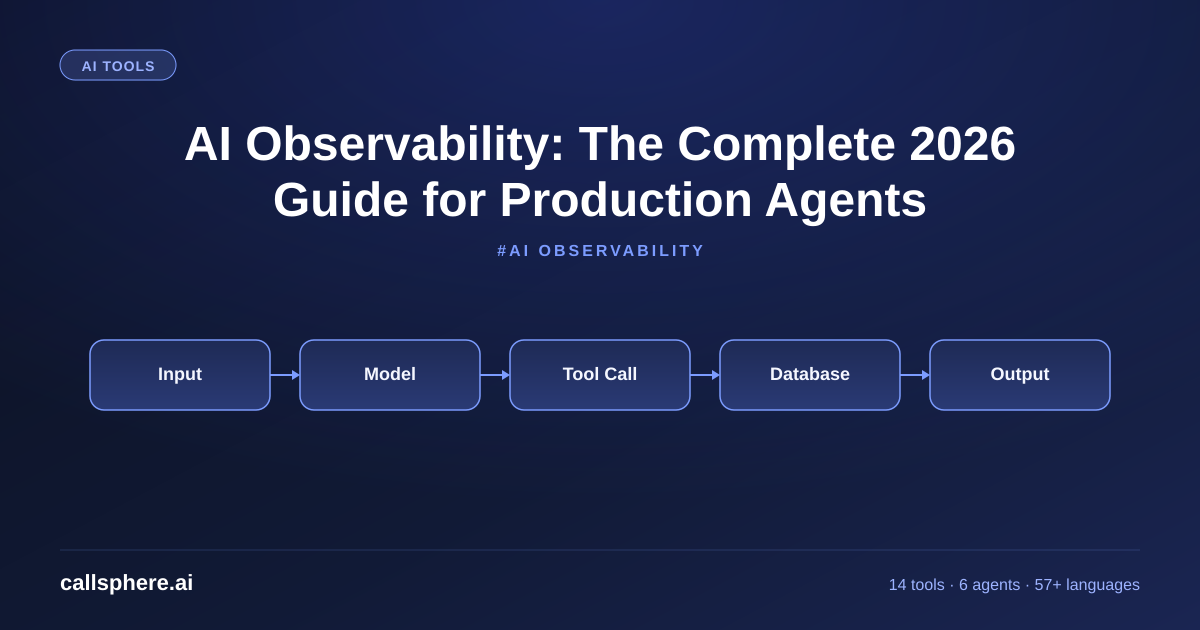
AI Observability: The Complete 2026 Guide for Production Agents
AI observability is how I keep production voice and chat agents reliable at scale. Here is the full stack — tools, metrics, platforms — for AI agents in 2026.
TL;DR
- AI observability is the discipline of measuring, tracing, and alerting on AI agent behavior in production — not just model accuracy.
- It is the difference between "the model is up" and "the agent is doing the right thing on real calls."
- I built CallSphere's observability layer to track per-call cost, latency, tool failures, and qualification quality across 6 live agents.
- The right stack combines tracing, evaluation, telemetry, and cost dashboards.
What is AI observability and why does it matter for production agents
Ai observability is the practice of instrumenting AI systems so you can answer real production questions: Why did this call go wrong? Which tool failed? How much did this interaction cost? Is the agent's qualification quality drifting week over week? Are we hitting our latency SLO?
It is the natural extension of software observability (metrics, logs, traces) into a world where the system's behavior is partially non-deterministic. Without it, AI agents look great in demo and fail silently in production. With it, you find the broken tool description on day three instead of week ten.
I built CallSphere's observability layer because I needed it for our own 6 live agents. We now expose it to every customer in /admin/gtm — per-call cost, per-tool latency, per-turn token usage, sentiment, qualification scoring, and customer satisfaction across 60,000+ monthly interactions.
Topics covered in depth
- AI observability tools comparison
- AI observability platforms in 2026
- AI agent observability for voice + chat
- LLM tracing fundamentals
- Agent evaluation frameworks
- Voice agent observability specifics
- Cost observability for AI agents
- Detecting drift in production agents
What are the best ai observability tools in 2026
Ai observability tools in 2026 fall into four buckets:
- Tracing tools: LangSmith, Langfuse, Helicone — capture every LLM call, tool call, and intermediate step in a single trace.
- Eval frameworks: Braintrust, Promptfoo, Inspect — run regression tests on prompt + model + tool combinations.
- Cost dashboards: Helicone, OpenMeter, vendor-native pricing pages — track spend per tenant, per route, per agent.
- Custom platforms: Internal builds like the one I run inside CallSphere — opinionated, vertical-aware, and integrated with the rest of the product surface.
For most teams, a combination of one tracing tool + one eval framework + a cost dashboard is the minimum viable observability stack. For platforms with multi-tenant agents and tight latency SLOs (like CallSphere), the right answer is usually to build a custom layer that ties traces to revenue, churn, and CSAT.
What are the leading ai observability platforms
Ai observability platforms are the higher-end of the category — they bundle tracing, eval, cost, and alerting into one product. The serious entrants:
- LangSmith (LangChain) — strongest tracing and eval combination for LangChain-native stacks.
- Langfuse — open-core, self-hostable, language-agnostic, popular with platforms that care about data residency.
- Arize Phoenix — strong on production ML monitoring, expanding into LLM space.
- Galileo — focused on enterprise evaluation and drift detection.
- WhyLabs — broader observability with LLM coverage.
For an agent platform like CallSphere, I picked a hybrid: Langfuse for tracing, our own Postgres-backed dashboards for cost and CSAT, and custom regression tests for prompt changes. Each customer gets a tenant-scoped view of their own data.
Hear it before you finish reading
Talk to a live CallSphere AI voice agent in your browser — 60 seconds, no signup.
What is ai agent observability specifically
Ai agent observability (and the closely related agent observability) is the subset of AI observability focused on agent-style systems — those that take multiple steps, call tools, and maintain state across turns. The questions it answers are different from base LLM observability:
- Which tools fail most often?
- What is the distribution of conversation lengths?
- Where do agents get stuck or loop?
- When do they correctly escalate to a human?
- Are tool descriptions causing wrong tool selection?
For voice agents specifically, there are additional dimensions: per-turn audio latency, interruption rate, language detection accuracy, and prosody quality on numbers and dates. Generic LLM observability tools miss most of these.
How does observability work for voice + multi-turn agents
Voice adds dimensions that text observability does not have to think about:
- Turn-by-turn latency. First-token latency is one number; user-perceived latency (audio start) is another. Both matter.
- Interruption handling. Did the agent clip cleanly when the user spoke? Did it cut in too early?
- Speech-to-text quality. If STT mishears, the model gets bad input. The right observability shows STT confidence per turn.
- Tool call timing relative to speech. Long tool calls leave dead air. Did the agent fill the silence appropriately?
- Per-language metrics. Some agents work great in English and fail subtly in Spanish. Roll up by language.
I built every one of these into CallSphere's observability dashboard. The result is that I can debug a single bad call in under 5 minutes instead of replaying the audio.
How CallSphere does this in production
CallSphere is both a managed voice + chat agent platform and the testbed for our own observability stack. Concrete:
- 6 live agents: healthcare (HIPAA + BAA-ready), real estate, sales, salon, after-hours escalation, hotel concierge.
- 14 function tools — every call logs tool name, arguments, latency, status, and cost.
- 20+ Postgres tables —
calls,turns,tool_calls,transcripts,cost_ledger,csat, and more. - GPT-Realtime-2 model layer with 128K context, $0.40/1M cached input, full token accounting per call.
- Latency dashboards: p50, p95, p99 first-token latency across 57+ languages.
- Cost dashboards: per-tenant, per-agent, per-route spend with daily and monthly views.
- Customer-facing observability: every tenant sees their own dashboard in /admin/gtm.
- Alerting: Slack + email on SLO breaches, cost spikes, or escalation-rate anomalies.
The team uses the same dashboards I do — there is no internal-only view that customers cannot see.
A real example walk-through
A mid-size telehealth practice on Scale tier ($1,499/mo, 50,000 interactions) noticed their CSAT had dipped from 4.5 to 4.1 over two weeks. Without observability, this would have been a vague "the AI feels worse" complaint. With CallSphere's dashboard, we traced it to a specific tool — the EHR lookup function had started returning empty results for patients whose phone number had recently changed format in the source system.
We caught it in 17 minutes from first alert. The fix was a tolerant phone-format normalizer in the tool wrapper. The patient experience never noticeably degraded. This is what observability is for — turning vague "something is wrong" into "this specific function call is failing for this specific reason."
Pricing and how to try it
CallSphere is $149/mo Starter (2,000 interactions, basic dashboards), $499/mo Growth (10,000 interactions, full observability), and $1,499/mo Scale (50,000 interactions, full observability + per-tenant cost ledger and custom alerts). Annual saves roughly 15 percent. 14-day free trial, no card. Setup is 3 to 5 business days.
Still reading? Stop comparing — try CallSphere live.
CallSphere ships complete AI voice agents per industry — 14 tools for healthcare, 10 agents for real estate, 4 specialists for salons. See how it actually handles a call before you book a demo.
Frequently asked questions
What is agent observability vs LLM observability? LLM observability tracks individual model calls (latency, tokens, cost, output). Agent observability tracks the full agent loop (multi-turn state, tool calls, retries, escalations, business outcomes). They share infrastructure but answer different questions. For a real agent platform, you need both.
Are open-source ai observability tools production-ready? Yes, several are. Langfuse is the most mature open-source option in 2026 and self-hostable for teams with data residency or compliance constraints. Arize Phoenix is also strong on the ML side. The tradeoff is operational — you run the database, the storage, and the upgrades yourself.
Can I use the same observability stack for voice and chat agents? Mostly. The core tracing and cost layers transfer cleanly. Voice-specific metrics (turn latency, interruption rate, STT confidence) need additional instrumentation. At CallSphere we use one logical schema with voice-only columns hydrated when applicable.
How much does ai observability cost as a percentage of model spend? Typically 5 to 15 percent of total AI spend. For a team spending $30,000/mo on GPT-Realtime-2 at scale, observability infrastructure (vendor or self-hosted) usually runs $1,500 to $4,500/mo. The ROI is dominated by catching one bad week of agent behavior before it churns customers.
What are the most important metrics for ai agent observability? Five I track personally on every CallSphere agent: p95 first-token latency, tool failure rate, escalation rate to human, qualification score, customer CSAT. If any one drifts more than 20 percent week over week, I dig in.
How is ai observability different from traditional APM (Datadog, New Relic)? Traditional APM measures system-level latency, errors, and throughput. AI observability adds non-deterministic dimensions — output quality, tool-selection correctness, conversation length, escalation appropriateness. They complement each other; you usually run both.
Can I detect prompt regressions automatically? Yes — that is what eval frameworks are for. Braintrust, Promptfoo, and Inspect each let you define a regression suite and run it on every prompt change. At CallSphere I gate every prompt edit through a 30-conversation regression set before it ships to production.
Do I need ai observability for a single-tenant agent? Yes, even at small scale. Single bad behaviors compound: a single tool failure that goes undetected for a week trains your customers to distrust the agent. Observability is cheaper than that distrust.
Related reading
Try CallSphere AI Voice Agents
See how AI voice agents work for your industry. Live demo available -- no signup required.