
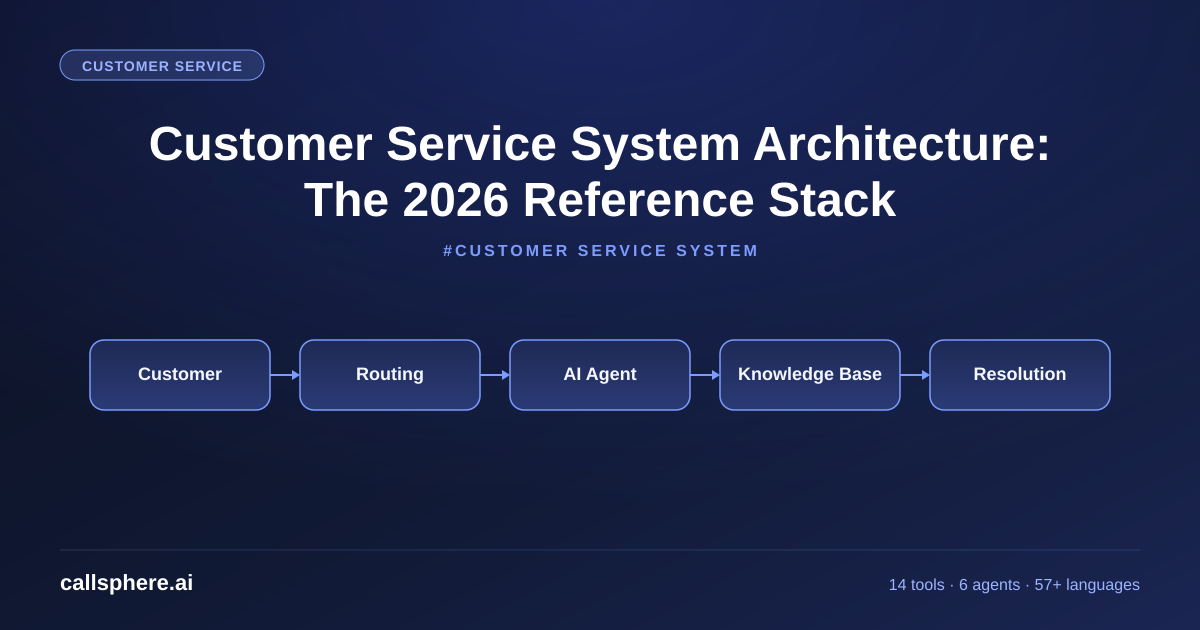
Customer Service System Architecture: The 2026 Reference Stack
A modern customer service system in 2026 is AI-first, multi-channel, and tool-using. Here is the reference architecture, scripts, and pricing.
TL;DR
- A modern customer service system in 2026 = AI agent + tool layer + structured data + small human team.
- The classic ticketing-tool-plus-human-rep model is now the exception, not the default.
- CallSphere ships the full stack: 6 agents, 14 tools, 20+ tables, 57+ languages.
- $149/mo Starter, 14-day free trial, 3–5 business day setup.
This is part of our Customer Service Representative guide.
What a customer service system means in 2026
A customer service system in 2026 is no longer a piece of ticketing software with a human queue. It is a layered architecture: a conversational AI agent at the front, a structured tool surface in the middle, a structured database underneath, and a small human team handling the residual that the AI cannot close.
I run CallSphere, and the customer service systems we deploy across 6 live verticals all share the same shape:
- Layer 1 (front door) — voice, chat, SMS, WhatsApp. One agent serving all four.
- Layer 2 (decisions) — GPT-Realtime-2 with 128K context, reading the full policy and FAQ inline.
- Layer 3 (actions) — 14 function tools: appointment booking, refund, escalation, CRM upsert, etc.
- Layer 4 (data) — 20+ Postgres tables capturing every interaction, outcome, and sentiment event.
- Layer 5 (humans) — a small team handling the 15–25% the AI cannot close, with live assist.
What this replaces: the seat-licensed ticketing model (Zendesk, Freshdesk classic), the per-call answering service ($1,200–$3,500/mo for a small team), and most of the human first-line labor. What it does not replace: judgment calls, complex retention conversations, and high-empathy moments.
How is this different from a classic customer service company setup?
A classic customer service company in 2018 looked like: 8 reps on a queue, a ticketing tool ($25–$80/seat), a hold-music IVR, and a 4-minute average pickup. The cost structure was 90% labor.
A 2026 customer service system looks like: 2 reps doing high-value escalations, an AI agent doing 70%+ of the volume, sub-second pickup, and the same multi-channel surface (voice, chat, SMS, WhatsApp) handled by one platform. Cost structure flips to 70% platform / 30% labor.
The three differences that matter most:
Hear it before you finish reading
Talk to a live CallSphere AI voice agent in your browser — 60 seconds, no signup.
- Pickup latency — from 4 minutes to 600ms.
- Coverage — from 9-to-5 to 24/7 in 57+ languages.
- Cost — from $25–$80/seat to $149–$1,499/mo total platform spend.
What does customer service efficiency look like in this stack?
Customer service efficiency in 2026 is measured by deflection rate, first-call resolution, time-to-resolution, and per-interaction cost. The targets I see hit consistently across CallSphere deployments:
- Deflection rate: 65–80% (AI closes without human handoff)
- First-call resolution: 80%+ on the AI portion
- Time-to-resolution: median 3–5 minutes on voice, 2–4 minutes on chat
- Per-interaction cost: $0.60–$0.90 in model spend; effective per-interaction price on the Growth tier is ~$0.05
These numbers come from real production data, not benchmarks. A clinic doing 800 inbound calls/month on Starter ($149/mo) hits deflection rates around 72%. A 50,000-call e-commerce brand on Scale ($1,499/mo) hits around 78% because their volume is more repetitive (order status, returns, tracking).
Is a customer service script template still relevant?
Yes — but the customer service script template in 2026 is structured for AI consumption, not human reading. Three structural differences:
- Tool annotations. "When the customer says 'I want a refund,' call
refund_request(amount, order_id, reason)." The script tells the AI which tool to call. - Branching by intent classification. Not "If they're upset, say X" — but "If sentiment < 0.3, escalate via
escalate_to_humanafter one empathy turn." - Multilingual by default. The script is written in English; the runtime translates to the caller's language with the right cultural register.
CallSphere ships starter scripts for each of our 6 verticals (healthcare, real estate, sales, salon/beauty, after-hours escalation, hotel concierge). You customize the policy specifics, we handle the structure.
How CallSphere does this in production
Concretely, here is the CallSphere customer service stack:
- 6 live agents specialized by vertical, all sharing the core engine
- 14 function tools including
order_lookup,refund_request,schedule_appointment,escalate_to_human,send_sms,crm_upsert,product_recommend,payment_handoff - 20+ Postgres tables — conversations, messages, function_calls, tickets, customers, appointments, leads, sentiment_events, escalations, outcomes, agents, channels, etc.
- pgvector RAG for policy docs, product catalogs, and historical resolutions
- 57+ languages with native accent voices
- GPT-Realtime-2 (128K context) under the hood; cached prompts at $0.40/1M tokens
- WebRTC + SIP/VoIP for browser and phone
- Admin dashboard with live transcripts, sentiment, KPI cards, and natural-language query
- Integrations — Salesforce, HubSpot, Stripe, Twilio, Calendly, Shopify, and ~20 others
A real example walk-through
A 5-location dental group in Westchester County, NY, was running on a $35/seat ticketing tool (6 seats = $210/mo) plus a $2,800/mo answering service that took voicemails after-hours. Average pickup: 3 minutes during business hours, voicemail after hours.
They moved to CallSphere's healthcare agent (Growth tier, $499/mo) in February 2026:
- Pickup time: 600ms, 24/7
- Booking automation: 84% of appointment requests booked without a human
- After-hours coverage: 100% (no more voicemail backlog)
- Bilingual support: English + Spanish added at no extra cost
- Net monthly cost: $499 (down from $3,010 combined)
- Net savings: $2,511/mo plus reception time freed for in-clinic patients
The two front-desk staff who used to do phone triage now do insurance verification and patient follow-up — higher-margin work.
Pricing & how to try it
CallSphere bundles the agent, tools, dashboards, and integrations in one platform:
Still reading? Stop comparing — try CallSphere live.
CallSphere ships complete AI voice agents per industry — 14 tools for healthcare, 10 agents for real estate, 4 specialists for salons. See how it actually handles a call before you book a demo.
- Starter — $149/mo — 2,000 interactions
- Growth — $499/mo — 10,000 interactions (most popular)
- Scale — $1,499/mo — 50,000 interactions
Annual saves ~15%. 14-day free trial, no card. Go-live: 3–5 business days.
Frequently asked questions
Q: What is a customer service system in 2026? A: A customer service system in 2026 is a multi-channel AI agent stack — voice, chat, SMS, WhatsApp — running on a 128K-context model with function tools, structured data storage, and a small human team for escalations. The 2018-era model (humans on a queue, ticketing UI) is now an antique pattern. CallSphere ships the full 2026 stack starting at $149/mo.
Q: How does a customer service company structure its team around AI? A: A modern customer service company has a smaller frontline team (handling escalations and complex retention), a larger ops team building playbooks and tuning the AI, and a data team measuring deflection and CSAT. The total headcount is usually 40–60% smaller than a 2018 equivalent for the same call volume.
Q: What metrics define customer service efficiency in this stack? A: Customer service efficiency is measured by deflection rate (65–80% target), first-call resolution (80%+), per-interaction cost ($0.60–$0.90 model spend), median time-to-resolution (3–5 minutes), and CSAT post-interaction. These are the five metrics every CallSphere dashboard tracks.
Q: Is a customer service script template still useful? A: Yes, but in AI-readable form. A modern customer service script template has tool annotations, sentiment branching, and multilingual cues. CallSphere ships starter templates for our 6 verticals; teams customize policy specifics.
Q: What does a customer service employee do in an AI-first system? A: A customer service employee in 2026 handles the 15–25% of interactions the AI cannot close — complex retention, high-empathy moments, regulated escalations. They also tune the AI's prompts and review failure modes. The work is more like product ops than queue handling.
Q: How do I switch from a legacy ticketing tool to an AI customer service system? A: Three steps: (1) export your historical tickets to inform the AI's RAG corpus, (2) point your inbound channels at CallSphere (3–5 business days), (3) run the AI in parallel with humans for 2 weeks before flipping the default. We support this migration with a dedicated success manager on Scale tier.
Q: Does this work for a small business with low call volume? A: Yes. The $149/mo Starter tier covers 2,000 interactions — fine for a 3-person clinic or a small ecommerce store. The economics break even fast because you replace not just software cost but most of the human first-line work.
Q: What about industries with strict compliance (healthcare, finance)? A: CallSphere's healthcare agent is HIPAA + BAA-ready. Finance and legal work on our standard agent with custom prompts and SOC 2 evidence available on request.
Related reading
Try CallSphere AI Voice Agents
See how AI voice agents work for your industry. Live demo available -- no signup required.