
Virtual Receptionist for Small Business: AI vs Human in 2026
A virtual receptionist for small business in 2026 is usually an AI voice agent. Here is the buyer's guide, the math, and how to set yours up in days.
TL;DR
- A virtual receptionist for small business in 2026 is almost always an AI voice agent — humans cost 8–15x more.
- The agent answers in under 600ms, books appointments, qualifies leads, and routes after-hours calls.
- CallSphere covers 57+ languages, integrates with most CRMs, and runs for $149/mo on the Starter tier.
- 14-day free trial, live in 3–5 business days, no engineer required.
This is part of our Business Phone Systems pillar guide.
What a virtual receptionist for small business actually does in 2026
A virtual receptionist for small business in 2026 is the always-on front door of your phone line. It answers every call within one ring, knows your hours and services, can book directly into your calendar, can text a follow-up, and can escalate to your cell when something matters. Eighteen months ago "virtual receptionist" meant a human answering service in a contact center. Today it almost always means an AI voice agent — because the math no longer works for human-only at small-business scale.
The real shift: a typical AI receptionist answers in under 600ms, never goes to lunch, costs $149/mo on the Starter tier, and speaks 57+ languages. A US-based human answering service at comparable hours runs $400–$1,400/mo with a queue, a transfer fee, and one language. For 90% of small businesses I talk to, the AI path is now the default and the human-only path is the exception.
What is the right small business telephone setup in 2026?
The small business telephone stack has three components and they are now separable: the phone number (a Twilio, Telnyx, or carrier number — usually $1–2/mo plus per-minute), the routing layer (an AI receptionist or PBX), and the destination (your cell, a calendar, a CRM, or a human after escalation).
The mistake I see weekly is small businesses buying a "business phone system" bundle that locks all three into one vendor at $200–$500/mo. The disaggregated stack — bring your own number, run an AI receptionist, route to the destination of your choice — typically lands at $150–$250/mo all-in with materially better functionality. For most one-to-twenty-person teams this is the right architecture in 2026.
How do telephone systems small business owners pick stack up against AI receptionists?
Traditional telephone systems for small business — RingCentral, 8x8, Vonage, Nextiva — are PBX-style: they give you extensions, voicemail, call queueing, and a softphone. They are not receptionists. They route calls to humans or to voicemail. A small-business owner who buys a PBX and no front-end agent still loses every call when no one picks up — which is most of the time.
Hear it before you finish reading
Talk to a live CallSphere AI voice agent in your browser — 60 seconds, no signup.
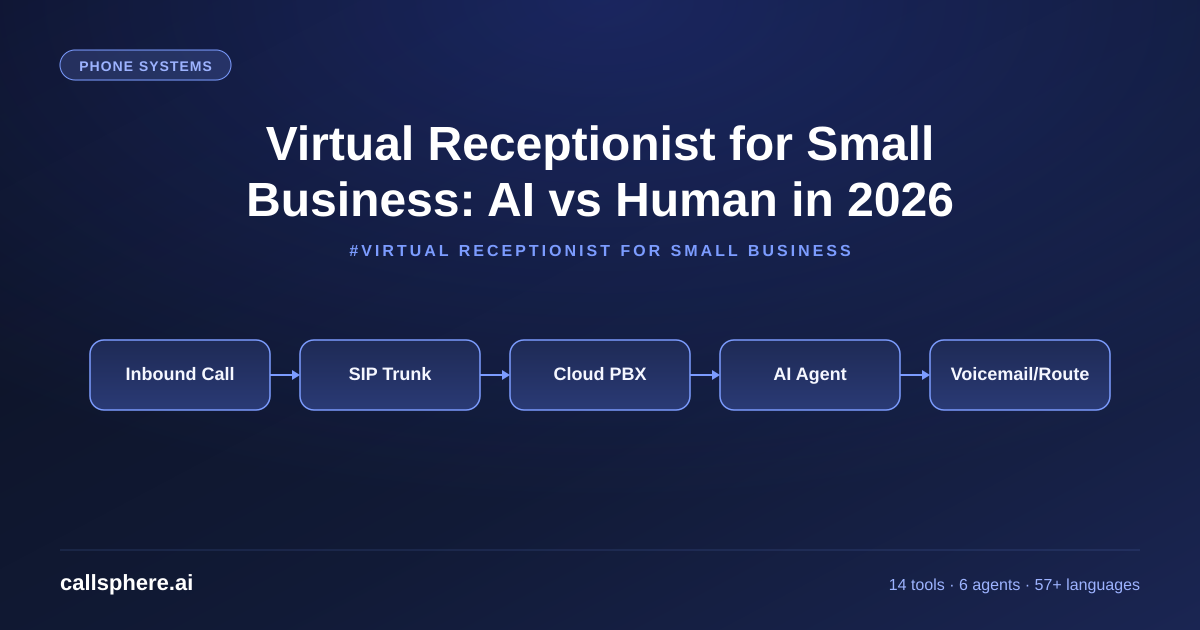
An AI virtual receptionist sits in front of the PBX (or replaces it for very small teams). Calls hit the agent first; the agent qualifies, books, or escalates; only the calls that need a human ever ring through. We see typical "missed-call-becomes-booked-customer" conversion go from 0% (voicemail) to 40–55% (AI receptionist booking directly) on the small businesses we run.
What about business telephone lines — do I still need them?
You need a number; you do not need a "line" in the old sense. Modern telephony is voice-over-IP — there is no physical line, just a SIP trunk or a hosted number. For a small business in 2026 the simplest setup is: one main number (your published business number) plus zero to two additional numbers for tracking or department routing. Three or more "business telephone lines" is usually legacy thinking.
The number itself costs about $1.15/mo on Twilio. Inbound minutes are $0.0085. A typical small-business receptionist load — 400 inbound minutes/month — runs roughly $4.55 in telephony cost. Everything beyond that is the agent platform and value-added integrations.
How CallSphere does this in production
CallSphere is a managed AI voice and chat agent platform. The virtual receptionist for small business runs on the same stack as our enterprise deployments — just at the right tier and complexity for one-to-twenty-person teams.
What you get on the Starter tier:
- One AI voice agent answering your main number in under 600ms
- 14 function tools available:
appointment_book,appointment_reschedule,send_sms,send_email,calendar_check,escalate_to_human,customer_lookup, and more - 57+ languages with natural accents — works on day one
- Calendar integrations (Google, Outlook, Calendly) and CRM integrations (HubSpot, Pipedrive, GoHighLevel)
- A dashboard with every transcript, recording, and outcome
- After-hours and overflow routing built in
The agent writes to our Conversation, Appointment, and Customer Postgres tables in real time. Setup is 3–5 business days — most accounts ship by day three.
A real example walk-through
A 4-stylist independent salon in upstate New York launched CallSphere on a Tuesday. By Friday the agent was answering their main number, handling booking via Google Calendar, sending SMS confirmations, and routing voicemails to the owner's cell during business hours.
Numbers from month one: 312 inbound calls (up from ~210 on a typical month — they were missing one in three previously), 187 appointments booked directly by the agent, 14 escalations to the owner, 0 missed calls. They had been paying $380/mo to a human answering service that booked through a manual portal. CallSphere Starter at $149/mo replaced it and added SMS confirmations, multilingual support, and zero missed calls. Payback was the first week.
Still reading? Stop comparing — try CallSphere live.
CallSphere ships complete AI voice agents per industry — 14 tools for healthcare, 10 agents for real estate, 4 specialists for salons. See how it actually handles a call before you book a demo.
Pricing & how to try it
Starter $149/mo — 2,000 interactions/mo, perfect for a small business with one main number and standard receptionist needs. Growth $499/mo — 10,000 interactions, multiple agents, all 6 verticals if you need both salon and after-hours, multi-channel (voice + SMS + chat + WhatsApp). Scale $1,499/mo — 50,000 interactions, dedicated onboarding, custom integrations.
Annual saves ~15%. 14-day free trial, no card. Live in 3–5 business days, no engineer needed on your side.
Start your 14-day free trial →
Frequently asked questions
What is the best virtual receptionist for small business in 2026? The honest answer depends on volume and vertical. For under 500 calls/month with simple booking, any of the major AI voice platforms work. For multilingual coverage, regulated verticals like healthcare, or cross-channel (voice + SMS + chat) needs, CallSphere is what we built — 57+ languages, 6 vertical-tuned agents, and a 3–5 business day launch. Try a few; the differences show up fast on your real call audio.
What are the best AI voice platforms for virtual receptionists? The landscape in 2026 is a handful of horizontal voice platforms (Vapi, Retell, Bland), vertical-tuned platforms (CallSphere for healthcare/real-estate/salon/etc.), and a few legacy answering services that have bolted AI on. The horizontal platforms are toolkits — fast for engineers, slow for non-technical small businesses. The vertical platforms ship working agents in days. Pick by your buyer profile, not by a benchmark.
Are AI virtual receptionists actually any good or do they sound robotic? The 2024 generation sounded robotic. The 2026 generation, built on GPT-Realtime-2 and similar models, is genuinely hard to distinguish from a human in the first 30 seconds of a call. Callers occasionally guess they are speaking with an AI; the more common reaction is "I appreciate that someone actually answered." Latency is the giveaway when it exists — under 600ms feels natural, over 1.2s feels off.
What are the best business phones for small business if I am using an AI receptionist? You usually do not need traditional desk phones. The AI receptionist answers the published business number; calls that need a human escalate to cell phones or a softphone app. If you do want a desk phone for routine outbound, an inexpensive SIP phone ($60–$150 hardware) plus a hosted SIP account works fine. Avoid bundled PBX systems for small teams — they are over-engineered for the modern stack.
Best rated AI virtual receptionist voice — how do I evaluate one? Three tests. First, call the demo number yourself from a noisy environment (in your car, in a coffee shop) and see if it understands you. Second, ask it three off-script questions — does it gracefully say "let me check on that and have someone call you back" or does it hallucinate? Third, time the latency. Anything over 1.5s first-token will feel awkward. CallSphere targets 600ms; most credible platforms now land between 400–900ms.
Can my virtual receptionist handle multilingual calls? On CallSphere, yes — 57+ languages with natural accents out of the box. The agent detects the caller's language from the first phrase and responds in kind. For small businesses in border states, tourist areas, or with diverse customer bases, this collapses a hiring constraint into a configuration option.
Related reading
Try CallSphere AI Voice Agents
See how AI voice agents work for your industry. Live demo available -- no signup required.