
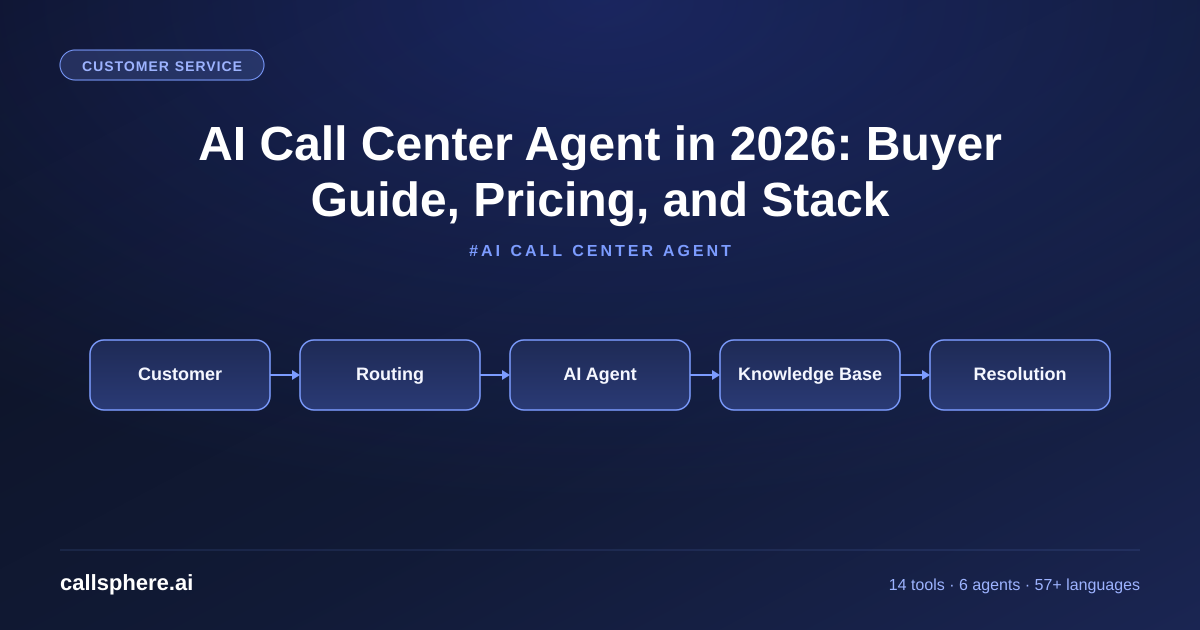
AI Call Center Agent in 2026: Buyer Guide, Pricing, and Stack
An AI call center agent in 2026 handles inbound and outbound calls end-to-end. Here is what it actually does, what it costs, and how CallSphere ships one.
TL;DR
- An AI call center agent in 2026 is a software agent that takes inbound and outbound calls end-to-end, using a realtime LLM, function tools, and a multi-channel front end.
- Virtual call center platforms now ship AI agents alongside human seats; the best ones let you mix freely.
- CallSphere ships 6 live AI call center agents across 57+ languages, with 14 function tools and 3-5 day setup.
- Plans start at $149/mo Starter with a 14-day free trial, no card.
This is part of our business-phone-systems guide.
What an AI call center agent actually does in 2026
I run CallSphere, and "ai call center agent" pulls 390 monthly searches because the category is now well-defined enough for buyers to ask for it by name. An AI call center agent in 2026 is a software agent that takes inbound and outbound calls end to end: it answers the phone, identifies the caller, qualifies the request, calls real APIs to resolve it (CRM, calendar, payments, ticketing), and routes to a human only when the situation requires it.
The old "call agent" (320 a month) job description was a human seat in a contact center. The new AI call center agent description is the same job done by software with sub-second response, 57+ language coverage, and 24/7 availability. The two categories now coexist in the same call center, with software handling tier-1 volume and humans handling escalations.
A working AI call center agent in 2026 is built on five layers: a realtime LLM (GPT-Realtime-2 with 128K context), a function-tool registry, persistent memory in a relational database, RAG over your knowledge base, and a telephony bridge over WebRTC + SIP. CallSphere ships all five as one platform. If a vendor is missing any of the five, they have a chatbot or a wrapped IVR, not an AI call center agent.
What is a virtual call center platform in 2026?
The "virtual call center platform" query (320 a month) maps to a buyer looking for an end-to-end software stack that runs a call center without on-prem hardware. In 2022, that meant Five9, Talkdesk, Genesys Cloud, NICE CXone, or similar. In 2026, the category has split:
- AI-first virtual call center platforms (CallSphere, Air, others): the AI agent is the default front line; humans plug in as escalation seats.
- Human-seat virtual call center platforms with AI bolt-ons (Five9, Talkdesk, etc.): the human seat is still the default; the AI is an add-on module.
- Hybrid platforms: a mix, usually weighted toward whichever category the vendor came from.
The right pick depends on call mix. If 70%+ of your call volume is resolvable by an AI agent (most SMB and mid-market customer service), the AI-first stack is materially cheaper and faster. If your volume is mostly complex escalations or regulated work, the human-seat stack with AI bolt-on is closer to the truth.
CallSphere is AI-first. Our customers typically run with 1-3 human escalation seats for every 10,000-50,000 monthly interactions handled by the AI agents.
Which virtual call center companies should I evaluate?
The "virtual call center companies" query (170 a month) usually maps to a buyer running a vendor RFP. A practical short-list in 2026:
Hear it before you finish reading
Talk to a live CallSphere AI voice agent in your browser — 60 seconds, no signup.
- AI-first: CallSphere (us, 6 verticals, 14 tools, 57+ languages), Air, Bland, others.
- Human-seat platforms: Five9, Talkdesk, Genesys Cloud, NICE CXone, Amazon Connect.
- BPO-led with platform: TaskUs, Concentrix, Teleperformance (humans plus their own platforms).
Asking each vendor three questions cuts through most of the marketing:
- What is your average response latency on inbound voice? (CallSphere: ~600ms)
- How many languages do you support natively, with quality acceptable for sustained conversation? (CallSphere: 57+)
- What is your time-to-launch for a new customer? (CallSphere: 3-5 business days)
If the vendor cannot give specific numbers, they are not yet ready for production.
Are call center outsourcing companies in the USA still competitive?
The "call center outsourcing companies in usa" query (140 a month) signals a buyer evaluating domestic BPOs. The honest answer in 2026 is that USA-based call center outsourcing companies remain competitive only for two segments:
- Regulated work (healthcare RCM, financial KYC, legal intake) where domestic compliance posture and US-based agents matter.
- High-touch B2B sales where in-language, in-culture rapport is the product.
Everywhere else, the math is moving against pure-USA BPO. AI agents take tier-1 volume, near-shore and offshore BPOs absorb the human tier at lower cost, and US-based seats are reserved for the work that genuinely requires them. The right 2026 model for most SMB and mid-market companies is AI-first front line plus a small US-based escalation team for the highest-stakes calls.
How CallSphere does this in production
A CallSphere AI call center agent deployment uses:
- One of 6 live agents (healthcare, real estate, sales, salon, after-hours, hotel) tuned for your vertical
- 14 function tools wired into your CRM, calendar, payments, and ticketing
- 20+ Postgres tables holding interactions, customers, transcripts, escalations, tool calls, and audit trails
- 57+ languages with natural accents including code-switching mid-call
- GPT-Realtime-2 (128K context) for the conversation layer with pgvector RAG over your knowledge base
- WebRTC + SIP/VoIP for inbound and outbound voice
- A dashboard with per-call cost, latency, deflection rate, and transcript review
Setup is 3 to 5 business days. Response latency is roughly 600ms. Deflection on tier-1 contacts averages 60-75% within the first 30 days.
A real example walk-through
A 60-person customer service operation for a mid-market e-commerce company in Ohio ran on Five9 with 22 inbound seats. Monthly volume was 18,000 calls. Average handle time was 7 minutes. Cost per call landed around $4.20 fully loaded.
They moved tier-1 volume to CallSphere's sales-tuned agent (the closest fit for their post-purchase support flow) in 5 business days. The agent handled order tracking, returns initiation, shipping questions, and refund processing autonomously. Escalations routed to 6 remaining human seats with full transcripts. Within 60 days:
- Deflection rate on tier-1 contacts: 71%
- Average handle time on human-touched calls dropped from 7 minutes to 3.5 minutes
- Cost per call dropped from $4.20 to $1.10 fully loaded
- Human headcount went from 22 to 6 (mix of attrition and reassignment)
- The company moved to CallSphere Scale tier at $1,499/mo, replacing roughly $30,000/mo in Five9 seats and labor
The point is not that AI replaces every human in a call center. The point is that AI call center agents make the human seats more valuable by sending them only the calls that need them.
Start your 14-day free trial, no card required.
Still reading? Stop comparing — try CallSphere live.
CallSphere ships complete AI voice agents per industry — 14 tools for healthcare, 10 agents for real estate, 4 specialists for salons. See how it actually handles a call before you book a demo.
Pricing & how to try it
CallSphere ships three plans:
- Starter: $149/mo, 2,000 interactions, voice + chat, single agent
- Growth: $499/mo, 10,000 interactions, multi-channel, 14 function tools (most popular)
- Scale: $1,499/mo, 50,000 interactions, dedicated infra, BAA on request
Annual billing saves ~15%. The 14-day free trial does not require a credit card. Setup is 3 to 5 business days.
See the full pricing breakdown.
Frequently asked questions
What is an AI call center agent in 2026? An AI call center agent in 2026 is a software agent that takes inbound and outbound calls end to end: it answers, identifies the caller, qualifies the request, calls real APIs to resolve the issue, and routes to a human only when needed. It runs on a realtime LLM (GPT-Realtime-2 with 128K context), a function-tool registry, persistent memory in a relational database, RAG over your knowledge base, and a telephony bridge over WebRTC + SIP. CallSphere ships all five layers in one platform.
What is the best voice AI call center provider? The "best voice ai call center provider" depends on your call mix and vertical. CallSphere wins on time to launch (3-5 business days), language count (57+), and per-interaction pricing for SMB and mid-market. Five9, Talkdesk, and NICE CXone with AI bolt-ons win for large enterprises that already have legacy seat-based contracts. Ask every vendor for response latency, language count, and time-to-launch numbers before signing.
How is a call agent different from an AI call center agent? A "call agent" historically meant a human seat in a contact center. An AI call center agent is the software version: same job, sub-second response, 24/7 availability, 57+ languages, 60-75% tier-1 deflection. The two coexist in 2026 call centers, with software handling tier-1 and humans handling escalations. The interesting shift is that the human seats now see only the calls worth a human's time.
What does a virtual call center platform include in 2026? A virtual call center platform in 2026 includes inbound and outbound voice, chat, SMS, WhatsApp, agent assist or full AI agents, a dashboard, CRM integration, and observability. AI-first platforms (CallSphere, Air, Bland) treat the AI agent as the default front line. Human-seat platforms (Five9, Talkdesk, Genesys, NICE CXone, Amazon Connect) treat the human seat as the default with AI as a bolt-on. Pick by call mix.
Which virtual call center companies should I evaluate? For AI-first: CallSphere, Air, Bland. For human-seat with AI bolt-on: Five9, Talkdesk, Genesys Cloud, NICE CXone, Amazon Connect. For BPO-led: TaskUs, Concentrix, Teleperformance. Ask each one for response latency, native language count, time-to-launch, and per-interaction pricing. Vendors that cannot answer those four questions are not yet production-ready.
Are call center outsourcing companies in the USA still worth it? Yes for two specific segments: regulated work (healthcare RCM, financial KYC, legal intake) and high-touch B2B sales. For everything else, the math in 2026 favors AI-first front line plus a smaller US-based escalation team. Pure-USA BPO is being squeezed from above by AI tier-1 handling and from below by near-shore and offshore BPOs at lower cost.
How much does an AI call center agent cost in 2026? On CallSphere: $149/mo Starter (2,000 interactions), $499/mo Growth (10,000), $1,499/mo Scale (50,000). Cost per interaction at scale lands around $0.03-$0.07 fully loaded. By comparison, a human seat in a US-based call center is $30K-$60K per year all-in, or roughly $4-$6 per call at typical volume.
How fast can I deploy an AI call center agent? 3 to 5 business days on CallSphere. The work is selecting one of 6 pre-built agents, configuring CRM and knowledge base connections, choosing voices from 57+ languages, and porting a phone number or routing a SIP trunk. Custom builds on raw OpenAI or Azure typically take 3 to 6 months for v1.
Related reading
Try CallSphere AI Voice Agents
See how AI voice agents work for your industry. Live demo available -- no signup required.