
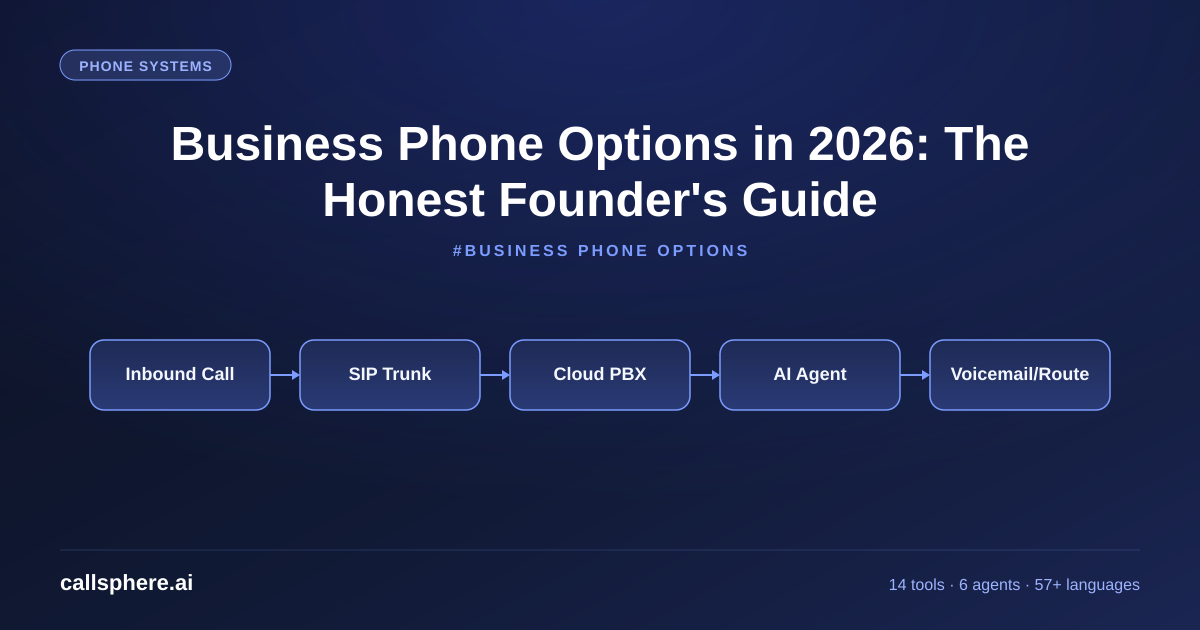
Business Phone Options in 2026: The Honest Founder's Guide
I run a voice AI company. Here are the real business phone options in 2026 — VoIP, virtual numbers, AI agents — with pricing, tradeoffs, and what I actually recommend.
TL;DR
- Business phone options in 2026 split into four real buckets: free virtual numbers, paid VoIP, mobile-first apps, and AI voice agents.
- "Free phone number for business" usually means Google Voice or a free tier on a VoIP app — fine for solo, weak for teams.
- For most small businesses, $20–$30/user/mo on a VoIP service or $149/mo on CallSphere covers the same ground with very different outcomes.
- I built CallSphere to be the option you pick when "phone rings, human picks up" is not realistic anymore.
What business phone options actually exist in 2026
When someone searches "business phone options" they are usually trying to answer one question — how do I get incoming calls handled without paying for a desk phone in 2026? The real answers fall into four buckets I see every week from prospects.
First, free virtual numbers like Google Voice, TextNow, or the free tier of OpenPhone. You get a US or Canadian number, a softphone app, and basic call forwarding. Second, paid VoIP business phone services — RingCentral, Dialpad, Grasshopper, Nextiva, 8x8 — typically $20–$35 per user per month with desk-phone hardware optional. Third, business phone number apps that turn a personal cell into a business line (Line2, Sideline, OpenPhone mobile). Fourth, and the category I live in, AI voice agents that answer the phone, qualify, schedule, and escalate — CallSphere starts at $149/mo for 2,000 interactions.
I am Sagar, founder of CallSphere. We run 6 live AI voice and chat agents (healthcare, real estate, sales, salon, after-hours, hotel) across 14 function tools and 57+ languages. I have switched at least four of my own businesses across all four buckets above. This guide is the version I wish I had read in 2022.
Is a free phone number for business actually free?
Mostly, yes — and mostly, that is the problem. Google Voice gives you a US number, voicemail transcription, and call forwarding for free, but it is tied to a personal Google account and Google explicitly limits commercial use. TextNow gives you a free VoIP number but injects ads. The free tiers of OpenPhone, Sideline, or Line2 are 7-day trials, not real free tiers.
What does "free" actually cost in 2026? My honest math on a 1-person business: the free option saves $20/mo on phone service but costs ~8 hours of lost calls per month at a 30% answer rate. If your average converted call is worth $80 or more, a free number is the most expensive line item on your P&L. I have a deeper breakdown in the real cost of missed calls.
For a true zero-cost setup, Google Voice + a Gmail account works for under 50 calls/month. Past that, the math flips fast.
Is a free VoIP number good enough for a real small business?
A free VoIP number gives you a working phone line. It does not give you a phone system. The gap matters more than people realize.
Hear it before you finish reading
Talk to a live CallSphere AI voice agent in your browser — 60 seconds, no signup.
A real small business phone needs: shared inbox so multiple people see voicemails, a way to route calls by time of day or topic, an after-hours plan, SMS support for two-way customer texts, integration with your CRM, and call recording for training and compliance. Free VoIP phone numbers usually ship 1 or 2 of those 6. Paid VoIP business services ship 4 or 5. AI voice agents like CallSphere ship all 6 plus the actual person who answers.
I tell two-person teams to start on a $15/mo OpenPhone or Grasshopper plan rather than a free VoIP number. The $15 buys you team inbox, business-hours rules, and a real SMS number. The free tier costs you the missed lead, every time.
What is the cheapest small business phone solution that does not embarrass you?
For solo founders pre-revenue, Google Voice plus a calendar booking link covers most days. For 2–10 person teams the sweet spot is OpenPhone, Grasshopper, or Dialpad at $20–$30 per user per month — you get team inboxes, mobile apps, and a real US business phone for small business operations.
If you handle more than ~200 inbound calls per month and you are missing a meaningful fraction of them, the math shifts to an AI voice agent. CallSphere Starter is $149/mo for 2,000 interactions — that is roughly 7 cents per call answered, 24/7, in 57+ languages. The economics work the moment one extra captured lead per month is worth more than the subscription.
For VoIP business plans with PSTN replacement (your existing 555 number ported in, desk phones, conference rooms), expect $25–$45 per user per month at RingCentral, Nextiva, or 8x8 once you add the integrations most businesses actually need.
How CallSphere does this in production
CallSphere is a managed AI voice and chat platform — VoIP for small business operations that have outgrown "send it to voicemail." Customers connect their existing number (or get one provisioned through our SIP trunk in any of 50 US states plus 30+ countries) and pick one of 6 live agents: healthcare, real estate, sales, salon, after-hours, or hotel concierge.
The technical surface: WebRTC + SIP/VoIP signaling, GPT-Realtime-2 with 128K context for conversation, pgvector RAG for per-customer knowledge, 14 function tools (calendar, CRM lookup, SMS send, payment link, escalation, voicemail transcription, lead scoring, ticket creation, and more), 20+ Postgres tables for call records and audit logs, and a single Next.js dashboard for transcripts, analytics, and prompt edits. The healthcare agent runs HIPAA + BAA-ready. The whole stack answers in roughly 600ms.
Setup time is 3–5 business days. You hand us your business hours, your top 10 FAQs, your appointment system, and your escalation phone number. We hand back a fully running voice agent that books appointments at 2am.
Start your 14-day free trial →
Still reading? Stop comparing — try CallSphere live.
CallSphere ships complete AI voice agents per industry — 14 tools for healthcare, 10 agents for real estate, 4 specialists for salons. See how it actually handles a call before you book a demo.
A real example walk-through
A 4-location dermatology group in Westchester County, NY, switched from a $230/mo Nextiva business phone plan plus a $1,400/mo overflow answering service to CallSphere Growth at $499/mo. Over the first 30 days the AI healthcare agent answered 1,847 inbound calls in English and Spanish, booked 612 appointments directly into their EHR via our calendar function tool, escalated 184 to the front-desk staff for clinical questions, and transcribed every call into their patient record. Their answer rate went from 71% to 99.4%. The captured new patients in month one paid for the full year of CallSphere.
Pricing & how to try it
CallSphere has three tiers: Starter $149/mo (2,000 interactions, 1 agent), Growth $499/mo (10,000 interactions, 3 agents — most popular), and Scale $1,499/mo (50,000 interactions, unlimited agents). Annual billing saves ~15%. Every plan includes 57+ languages, 14 function tools, and the full dashboard. The 14-day free trial does not require a credit card, and most customers go live in 3–5 business days.
Frequently asked questions
What is the best business phone option for a 1-person business in 2026? For solo founders under 50 calls/month, Google Voice plus a Calendly link is genuinely fine. Past 50 calls/month, OpenPhone or Grasshopper at $15–$20/mo gives you a real business phone number app with team-ready features. Past 200 calls/month, an AI voice agent like CallSphere at $149/mo is usually cheaper than the missed-call cost. The rule I give friends: pick the cheapest option that answers more than 95% of your calls.
Is a free phone number for business safe to use commercially? Google Voice's terms explicitly restrict heavy commercial use, and free VoIP numbers often have no SLA, no number portability, and no support. They are fine for testing or for a side project. For a real business, spend the $15–$30/mo. The day you need to port your number to a real system, you will be glad it is on a paid plan.
What is the difference between a VoIP business service and an AI voice agent? A VoIP business service routes calls — your phone rings, a human picks up. An AI voice agent answers calls — the agent itself takes the call, qualifies the caller, books appointments, and only escalates to a human when needed. VoIP is plumbing. AI agents are staff. Most small businesses need both: VoIP for the calls humans should take, AI for the 80% they should not.
Can I keep my existing business phone number if I switch to CallSphere? Yes. We support full number porting from any major US, Canadian, UK, or AU carrier, plus 25+ other countries. Porting typically takes 5–10 business days and we run a forwarding bridge in the interim so you do not lose calls. If you are not ready to port, we can provision a new local or toll-free number for you on day one.
Do I need a desk phone to use a VoIP service for small business? No. In 2026 about 80% of VoIP small business setups are mobile-app + desktop-app only. Desk phones are useful for receptionists, call centers, and people on calls 6+ hours a day. Everyone else is better off with a softphone on their laptop and an app on their cell. CallSphere does not require any phone hardware at all — the AI takes the call.
What free VoIP phone numbers actually work in 2026? Google Voice is the only mainstream free VoIP option with a real US number, free SMS, and free domestic calls. TextNow, TextFree, and Sideline have free tiers but include ads or trial limits. None of them are suitable for high-volume commercial use. If you need a free voip number to test something, Google Voice. If you need to run a business, budget $15+ per month.
Related reading
Try CallSphere AI Voice Agents
See how AI voice agents work for your industry. Live demo available -- no signup required.