
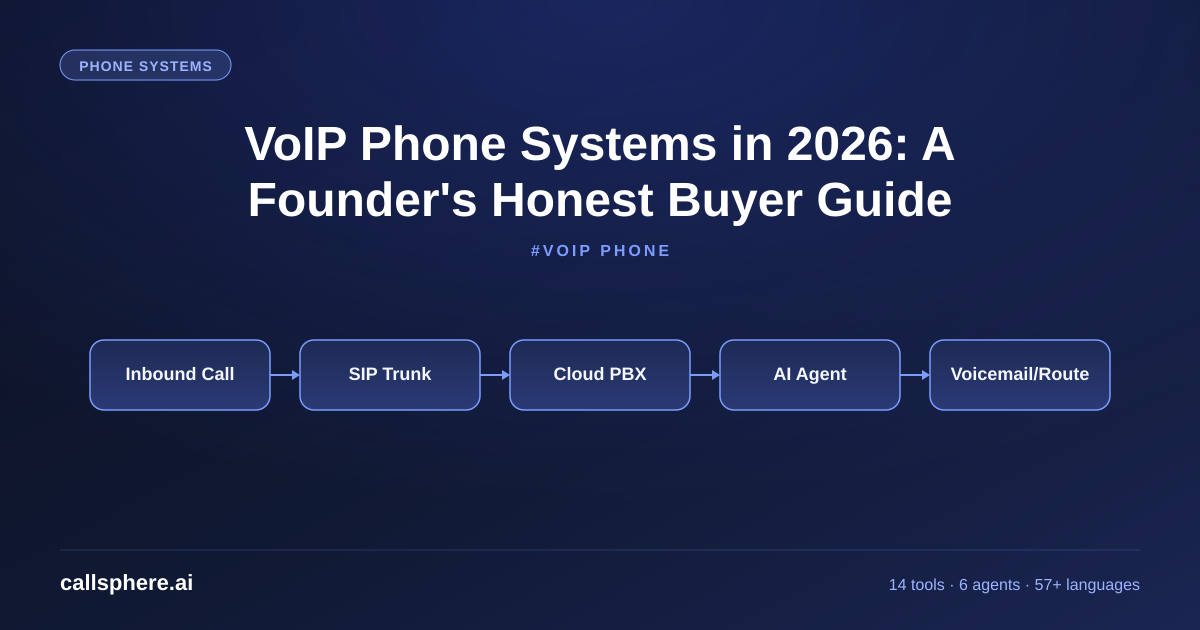
VoIP Phone Systems in 2026: A Founder's Honest Buyer Guide
I run a VoIP-native AI voice platform. Here is what a VoIP phone really is in 2026, what to pay, and how to avoid the four traps that burn buyers.
TL;DR
- A VoIP phone routes voice over the public internet using SIP/RTP instead of copper or cellular.
- For most US small businesses, a hosted VoIP phone service runs $20-$45 per seat per month plus a one-time number port.
- "Free VoIP phone number" offers exist, but they almost always cap minutes, lock outbound caller ID, or resell your call metadata.
- At CallSphere we layer a 24/7 AI voice agent on top of a SIP trunk so a 4-person clinic can answer 100% of inbound calls for $149/mo.
This is part of our Business Phone Systems pillar guide.
What a VoIP phone actually is
A VoIP phone is any endpoint - desk handset, softphone app, or browser tab - that places and receives calls over an IP network. The audio gets packetized into RTP, the call control runs over SIP (or WebRTC for browsers), and a SIP trunk hands it off to the PSTN when the other end is still a traditional number. I have shipped VoIP phone deployments since 2019, and the punchline has not changed: VoIP wins on price, on number portability, and on how easily it slots into AI workflows. The thing it loses on is local power resilience - if your fiber drops, your phones drop unless you have a 4G failover.
In 2026 the buying question is rarely "should I switch to VoIP." Almost everyone already has. The real question is whether you buy a plain VoIP phone service, a unified cloud phone service with messaging and meetings, or an AI-native VoIP layer that answers calls for you. Our CallSphere healthcare agent answers in roughly 600ms and is built on the same SIP infrastructure as a traditional VoIP phone - the difference is that the "extension" is a GPT-Realtime-2 model with 14 function tools.
How do I get a VoIP phone number (and what about a free VoIP phone number)?
A VoIP phone number is a DID (direct inward dial) provisioned by a carrier that supports SIP termination. You either bring an existing number via LNP port (5-10 business days for US, 2-3 weeks for toll-free) or buy a new one from your provider, typically $1-$3 per month per DID. Toll-free numbers cost more ($2-$5/mo plus per-minute usage) but signal more legitimacy on caller ID for B2B sales.
The "free VoIP phone number" category is real but narrow. Google Voice gives a free personal US number with outbound to US/Canada at no per-minute cost, but it is explicitly not a business product, has no SLA, and you cannot port a true 10DLC business number out of carriers like Twilio into it. Most "free voip phone numbers" sit behind ad-supported softphone apps, cap you at 100-300 free minutes a month, or strip your outbound caller ID so the receiving phone shows "private number." For a salon, restaurant, or clinic that needs CNAM (the name that appears on caller ID) to read your business name, free does not work.
If your goal is to test before you commit, a 14-day free trial on a real SIP carrier (we do this on CallSphere with no card required) is more honest than a permanent free VoIP service tier that monetizes your data.
What is the difference between VoIP phone service and a cloud phone service?
A plain VoIP phone service gets you dial tone over the internet: DIDs, SIP trunks, voicemail, basic call routing, maybe an auto-attendant. A cloud phone service (sometimes branded "phone in the cloud" or "cloud based phone service") bundles the same VoIP backbone with team messaging, video meetings, presence, mobile apps, integrations into your CRM, and a hosted PBX UI. Think of it as VoIP plus a workspace.
Hear it before you finish reading
Talk to a live CallSphere AI voice agent in your browser — 60 seconds, no signup.
The decision matrix for most teams under 50 seats:
- Pure VoIP phone service ($15-$25/seat): you already have Slack, Zoom, and a CRM. You just need dial tone.
- Cloud phone service / UCaaS ($25-$45/seat): you want one bill, one admin, one app.
- AI-native VoIP (CallSphere $149-$1,499/mo flat): you do not want humans answering inbound at all - or you want humans to only catch the warm 20%.
In production we route the AI VoIP layer in front of the cloud phone service. The agent answers, qualifies, books, and only warm-transfers to a human extension when a function tool returns "needs_human=true."
Is an office phone service the same as a cloud based phone service?
In 2026, basically yes - "office phone service" used to imply on-prem PBX hardware in a closet, but ~90% of US small offices have migrated to a cloud based phone service. The handset on the desk is just an IP phone (Polycom, Yealink, Cisco) registering to a hosted PBX over the internet. The PBX, voicemail, IVR, and call recording all live in the provider's cloud. The "office" part is purely a marketing label for VoIP packaged with a few SMB features: receptionist console, hunt groups, business-hours routing, e911 address management.
The two things that still matter operationally even after the move to the cloud: e911 address registration for every desk phone (regulatory) and QoS on your LAN switch (so a Teams call does not eat the receptionist's voice quality). Everything else - the auto-attendant, the IVR menu, the on-hold music - is a config screen.
How CallSphere does VoIP voice agents in production
CallSphere is a managed AI voice + chat agent platform built on top of VoIP. The stack:
- SIP/VoIP carrier layer: we terminate inbound calls over SIP from any major carrier (Twilio, Telnyx, Bandwidth, Vonage). Customers either port their existing VoIP phone number to us or forward their main line to a CallSphere DID.
- WebRTC for browser-to-agent: for our demo widget and admin console, the same agent answers a WebRTC session in under 600ms first-audio.
- 6 live agent verticals: healthcare (HIPAA + BAA-ready), real estate, outbound sales, salon booking, after-hours escalation, hotel concierge. Each ships with vertical-specific function tools.
- 14 function tools: book_appointment, lookup_patient, check_inventory, transfer_to_human, schedule_callback, send_sms, and others - wired to 20+ Postgres tables.
- 57+ languages: caller language is auto-detected on the first utterance; the agent flips voice and locale mid-call.
- Observability: every call writes a Call, Transcript, Turn, and ToolCall row to Postgres for replay and QA.
Setup is 3-5 business days end to end - port the number or forward it, point us at your calendar/CRM, train the agent on your FAQ, ship.
A real example walk-through
A 4-location pediatric dental group ported their main VoIP phone number to CallSphere on a Monday. Tuesday I imported their NexHealth schedule, mapped 9 visit types to function tools, and seeded the FAQ with 38 of their existing tickets. Wednesday at 8am the healthcare agent took its first live call.
Within 14 days: 71% of inbound calls answered fully by the agent without human handoff, 22% warm-transferred to the front desk with a structured summary, 7% routed to voicemail (mostly insurance edge cases we explicitly flagged for human handling). After-hours bookings - calls between 6pm and 8am that previously hit voicemail and died - grew from ~3 a week to 41 a week. Net: same VoIP phone bill, plus $499/mo Growth tier, replacing one and a half FTE receptionists.
Pricing and how to try it
CallSphere pricing is flat, no per-minute, no per-seat:
Still reading? Stop comparing — try CallSphere live.
CallSphere ships complete AI voice agents per industry — 14 tools for healthcare, 10 agents for real estate, 4 specialists for salons. See how it actually handles a call before you book a demo.
- Starter $149/mo - 2,000 interactions, 1 agent, 1 number
- Growth $499/mo - 10,000 interactions, 3 agents, multiple numbers (most popular)
- Scale $1,499/mo - 50,000 interactions, unlimited agents, dedicated support
- Annual saves about 15%
- Affiliate program pays 22% rev share in year one
Start your 14-day free trial - no card required →
Frequently asked questions
What is a VoIP phone in simple terms? A VoIP phone is a phone that places and receives calls over the internet instead of over copper wires or cellular. It can be a physical desk phone that plugs into ethernet, a softphone app on your laptop, or a browser tab. The audio is encoded into IP packets and routed through a SIP trunk to a carrier, who hands it off to the public phone network when the other end is still a regular number. Most US small businesses are already on VoIP without realizing it - if your phone says "Polycom" or "Yealink" on the front and connects to ethernet, it is a VoIP phone.
Is there a truly free VoIP phone service I can use for my business? Google Voice is the closest thing to a free VoIP phone service for US users, and it works fine for solopreneurs. But for any business that needs CNAM (your business name on caller ID), call recording, e911 with a multi-desk address, or porting from a carrier like Twilio - free does not cover it. A more honest path is a 14-day free trial on a real provider. CallSphere offers a 14-day free trial with no card required.
Can I get a free VoIP phone number for my business? You can get a free VoIP phone number from Google Voice (personal), TextNow, or a handful of ad-supported softphone apps. The catch is almost always one of three: capped minutes (usually 100-300/month), no number portability out, or shared caller ID that hides your business name. For any business taking real customer calls, budget $1-$3/mo per DID through a real SIP carrier - it is cheaper than the time you waste on the limits of a free tier.
What does cloud based phone service typically cost in 2026? US cloud phone service pricing in 2026 ranges from about $15/seat/mo at the low end (basic VoIP only) to $45-$55/seat/mo for full UCaaS bundles with video, messaging, and integrations. Add $1-$3 per DID per month and around $0.01-$0.02 per outbound minute to the PSTN. Toll-free numbers cost more (typically $2-$5/mo plus inbound per-minute). AI-native voice platforms like CallSphere break this model - we charge flat $149-$1,499/mo regardless of seat count because the agent does the answering, not a human.
What is the difference between a VoIP phone number and a cell phone number? A VoIP phone number is provisioned by a SIP/VoIP carrier and tied to an internet endpoint - you can use it from a desk phone, a laptop, or a browser, anywhere with internet. A cell phone number is provisioned by a wireless carrier and tied to a SIM card and the cellular network. Both can send and receive SMS in the US, both can be ported between carriers, but only the VoIP number can be answered by an AI agent or by a human in a browser tab without a phone in hand. Most business numbers in 2026 are VoIP numbers.
Will my VoIP phone work during an internet outage? No - if your internet drops, your VoIP phone drops. That is the single biggest tradeoff versus copper landlines. The standard mitigation is a 4G/5G failover router (Cradlepoint, Peplink) that flips your office to cellular within seconds, plus a "failover number" in your provider that forwards inbound calls to a mobile in a true outage. For our healthcare and emergency-escalation customers we set the after-hours agent's fallback DID to a manager's cell so calls never die at the door.
Can I keep my existing phone number when I switch to VoIP? Yes, this is called Local Number Portability (LNP) and it is a legal right in the US. The process: sign an LOA (letter of authorization) with the new VoIP provider, they file the port with your old carrier, the old carrier validates against your most recent bill, and the number moves over - usually 5-10 business days for local US numbers, 2-3 weeks for toll-free. Important: do not cancel your old service before the port completes, or you lose the number.
Is a VoIP contact center the same as VoIP phone service? No. A VoIP phone service gives you dial tone, DIDs, and basic routing. A VoIP contact center layers on agent queues, skill-based routing, IVR with conditional logic, real-time supervisor dashboards, call recording compliance, and CRM integrations. Most businesses under 20 inbound calls a day do not need a contact center - they need either VoIP phone service or, if they want the calls answered automatically, an AI voice agent like CallSphere.
Related reading
Try CallSphere AI Voice Agents
See how AI voice agents work for your industry. Live demo available -- no signup required.