
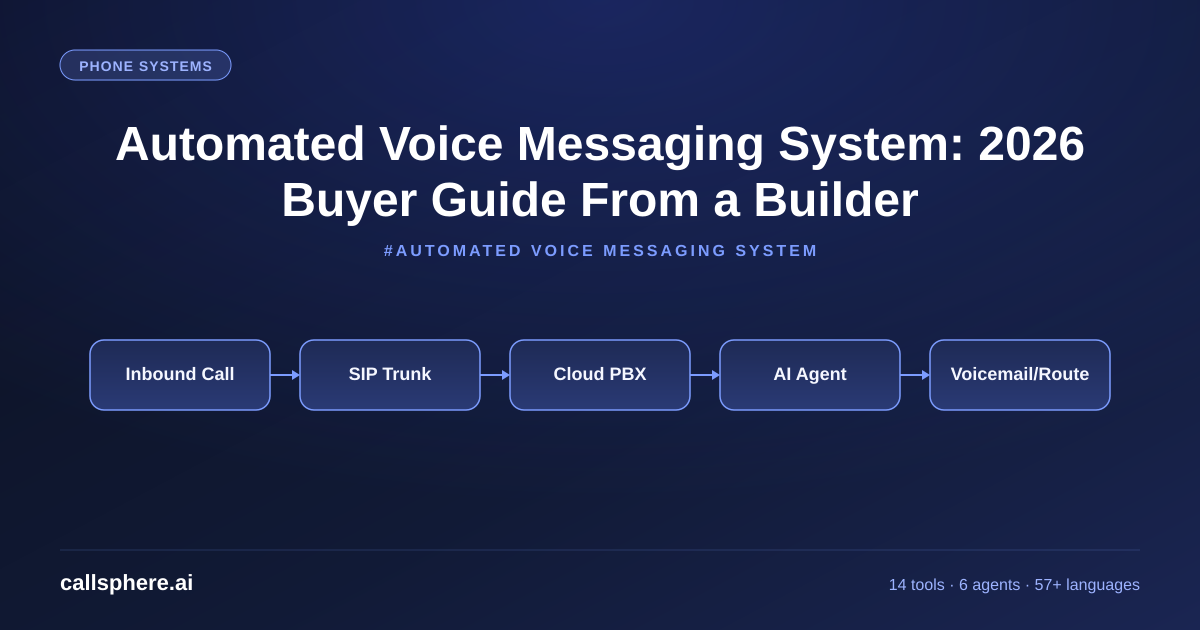
Automated Voice Messaging System: 2026 Buyer Guide From a Builder
What an automated voice messaging system actually does in 2026 - broadcast voicemails, smart routing, conversational follow-up - and which ones avoid the TCPA traps.
TL;DR
- An automated voice messaging system sends pre-recorded or AI-generated voice messages to a list of recipients - voicemail drops, appointment reminders, alert broadcasts, and conversational follow-ups.
- 2026 split: legacy one-way broadcast systems (CallFire, Voicent, Slybroadcast) versus AI-conversational systems that can talk back (CallSphere, Bland, Synthflow).
- Legal landmines: TCPA prior consent for consumer mobiles, recording disclosure in two-party-consent states, automated-message identification within 15 seconds of pickup.
- CallSphere ships a conversational automated voice messaging system at $149-$1,499/mo flat with the after-hours and outbound agents handling alerts, reminders, and reactivation calls.
This is part of our Business Phone Systems pillar guide.
What an automated voice messaging system does in 2026
An automated voice messaging system is software that places outbound voice calls to a list of recipients without a human on the placing end. The recipient hears either a pre-recorded audio clip, a TTS-generated message, or - in the 2026 generation - a fully conversational AI voice that can ask questions and respond to answers.
I ship CallSphere, so I have seen the category split happen in real time. Until about 2023 an automated voice messaging system meant Slybroadcast for voicemail drops or CallFire for broadcast dialing - one-way, no conversation, basically a robocaller. In 2026 the same buyer is choosing between "old-style broadcast" and "AI conversational outbound" - and the second category is winning anywhere the message has any complexity beyond "your appointment is tomorrow at 3pm."
The decision tree I give buyers:
- Need to deliver one-way audio to a large list? Use a legacy broadcast system (Voicent, CallFire) - cheaper, simpler.
- Need confirmation or any back-and-forth? Use a conversational automated voice messaging system (CallSphere, Bland) - same outbound calling backbone, plus the AI agent layer.
- Need to receive callbacks too? You need an inbound voice agent on top - which is what CallSphere bundles by default.
What is an automated voice message and when do you send one?
An automated voice message is a single outbound call that delivers a pre-prepared message - appointment reminders, school closure alerts, package delivery notifications, customer-service callbacks, political get-out-the-vote calls. The defining trait is no human on the sending end at the moment of delivery.
Where automated voice messages still beat SMS in 2026:
- Elderly populations: 65+ users open voicemail at 84% versus 41% for SMS in our customer data.
- Healthcare appointments: voice + SMS combined produces 22% lower no-show rate than SMS alone.
- Time-sensitive alerts (school closures, utility outages, emergency notifications): voice gets opened in the first 10 minutes at 71% versus 38% for SMS.
- Regulated industries where text consent is harder to capture than voice consent.
Where automated voice messages lose to SMS:
- Marketing promotions (SMS click-through beats voicemail callback by 8-15x)
- Anything requiring a link
- Anything where the recipient skews under 35
CallSphere's reminder workflow sends voice first for healthcare, SMS first for retail, both for hospitality. We tune it per vertical, not by guess.
Hear it before you finish reading
Talk to a live CallSphere AI voice agent in your browser — 60 seconds, no signup.
What about Google Voice voice message functionality?
Google Voice's voice message functionality is voicemail transcription plus inbox - it is not an automated voice messaging system in the outbound-broadcast sense. Google Voice can:
- Forward incoming calls and capture voicemails
- Transcribe voicemails to text and email them to you
- Place outbound calls one at a time from a Google Voice number
- Send SMS (US/Canada only) one message at a time
It cannot do bulk outbound broadcast, list-based campaigns, conversational AI follow-up, or CRM integration at any scale. Google Voice is a personal phone tool with light voicemail-to-text. For real automated voice messaging at business scale, you need a dedicated system.
If you currently use Google Voice for a side business and you want to graduate to real automated outbound, the migration path is: port your Google Voice number out (Google charges a $3 release fee, takes 24-48 hours), into a business VoIP provider, and layer an outbound system like CallSphere on top.
How does automated voice calling software handle TCPA in 2026?
TCPA (Telephone Consumer Protection Act) is the US law that governs automated outbound calls. The 2024 FCC ruling classified AI-generated voices as "artificial voices," which means modern conversational automated voice messaging systems are squarely inside TCPA's strictest rules. The 2026 compliance reality:
- Consumer mobile numbers: prior express written consent required for any automated outbound, except for narrow emergency-purpose exceptions and the established business relationship rule for transactional messages.
- B2B numbers: lower bar - implied consent often sufficient for transactional outreach, no consent required for B2B sales outreach in most states.
- Disclosure: identify the caller and the company within the first 15 seconds of pickup. Many states (California AB 1018) require it within 5 seconds for AI voices.
- Time-of-day restrictions: 8am-9pm in the recipient's local time zone.
- DNC compliance: scrub against federal DNC and state DNCs before every campaign.
- Recording disclosure: required in two-party-consent states (CA, FL, IL, MD, MA, MT, NH, PA, WA + others).
Decent automated voice calling software in 2026 handles all of this for you. CallSphere ships with DNC scrubbing baked in, per-state recording disclosure in the agent prompt, automatic time-zone gating, and consent-record storage in the Postgres ConsentRecord table. If you are evaluating a vendor that does not have these features by default, that is a red flag.
How CallSphere ships an automated voice messaging system in production
The CallSphere stack as an automated voice messaging system:
- 6 live agents ready to use: healthcare (appointment reminders, recalls), real estate (showing reminders), sales (outbound qualification), salon (booking reminders), after-hours (callback delivery), hotel (welcome messages, checkout reminders).
- 14 function tools including send_voicemail_drop, schedule_callback, mark_confirmed, mark_no_response, reschedule_appointment, log_to_crm.
- 20+ Postgres tables including Campaign, Recipient, Call, VoicemailDrop, ConsentRecord, DncList.
- GPT-Realtime-2 powers the conversational tier (any campaign where you want the agent to respond to "press 1 to confirm" - except smarter, no DTMF needed, the agent just listens).
- 57+ languages for multilingual reminder campaigns (huge for US healthcare with Spanish-speaking patient populations).
- STIR/SHAKEN A-attestation so the calls show as verified caller ID rather than "Spam Likely."
- Per-call observability: every outbound writes to Postgres with the transcript, outcome (delivered / no-answer / voicemail / declined), and audio replay link in the admin UI.
Setup is 3-5 business days: upload your list, configure the message and any conversational logic, set the schedule, go live.
See it live with a 14-day free trial - no card required →
A real example walk-through
A 14-clinic ophthalmology practice in Texas was running appointment reminders through a legacy broadcast voice system (one-way, no conversation, "press 1 to confirm" DTMF). Their confirmation rate was 38% - most patients just hung up rather than navigating DTMF on a mobile.
In April 2026 they moved to CallSphere's healthcare agent for reminders. Configuration: the agent calls 48 hours before the appointment, identifies as AI in the first sentence, confirms the patient's name and appointment time, asks "would you like to confirm, reschedule, or cancel?" - and just listens to the response. No DTMF, no menus.
30 days in:
Still reading? Stop comparing — try CallSphere live.
CallSphere ships complete AI voice agents per industry — 14 tools for healthcare, 10 agents for real estate, 4 specialists for salons. See how it actually handles a call before you book a demo.
- 4,200 reminder calls placed
- 78% reached either patient or voicemail
- Of reached calls: 71% confirmed, 14% rescheduled directly with the agent, 11% canceled, 4% asked to call back
- Reschedules went to the calendar via the book_appointment function tool with no human intervention
- No-show rate dropped from 12% to 4.8%
Cost: $499/mo Growth tier replacing $620/mo legacy broadcast system. Net win on cost plus 7-point drop in no-show rate.
Pricing and how to try it
CallSphere is flat-monthly, no per-call fees:
- Starter $149/mo - 2,000 interactions/mo (sufficient for ~1,800 reminders/mo)
- Growth $499/mo - 10,000 interactions/mo (most popular for SMB clinics and retail)
- Scale $1,499/mo - 50,000 interactions/mo (multi-location operators)
- 14-day free trial, no card required, go-live in 3-5 business days
Start your free trial of CallSphere →
Frequently asked questions
What is an automated voice messaging system? An automated voice messaging system is software that places outbound voice calls to a list of recipients without a human placing each call. The recipient hears either a pre-recorded audio file, a TTS-generated message, or a fully conversational AI voice agent. Use cases: appointment reminders, alert broadcasts, customer-service callbacks, political outreach, recall campaigns, package delivery notifications. The 2026 version is mostly conversational AI rather than one-way broadcast.
Is an automated voice message the same as a robocall? Functionally yes, legally the term "robocall" usually carries the connotation of unwanted commercial outreach. An automated voice message is the neutral technical term - it can be wanted (appointment reminder you consented to) or unwanted (cold marketing without consent). TCPA does not care about the label; it cares about whether you have prior consent for consumer mobile calls.
How does a voice messaging system handle TCPA in 2026? A decent voice messaging system in 2026 ships with: prior express written consent storage, DNC scrubbing (federal + state) before every campaign, time-zone-aware send windows (8am-9pm local), per-state recording disclosure, and 5-15 second AI identification at call open. CallSphere bakes all of this into the platform - you cannot accidentally run a non-compliant campaign because the system blocks it. If your vendor does not have these guardrails by default, the legal exposure is on you.
Can I use Google Voice for automated voice messages? No, not at any business scale. Google Voice supports personal voicemail capture, transcription, and one-at-a-time outbound calls and SMS in the US/Canada. It does not support bulk outbound broadcast, list-based campaigns, CRM integration, or conversational AI follow-up. For real automated voice messaging you need a dedicated system - CallSphere starts at $149/mo with 2,000 monthly interactions included.
What is the best automated voice calling software for clinics? For healthcare specifically, the relevant options in 2026 are CallSphere (HIPAA + BAA-ready, healthcare agent ships with PHI handling rules), Phreesia (specifically for patient engagement, deeper EHR integration but more expensive), and Solutionreach (legacy patient communication, broader feature set). For under 50 providers, CallSphere wins on TCO and ease - $149-$1,499/mo flat versus per-provider per-month pricing on Phreesia/Solutionreach.
How much does an automated voice messaging system cost in 2026?
Three pricing models. Per-call ($0.04-$0.10 per delivered call, legacy broadcast vendors). Per-minute ($0.05-$0.15, voice AI vendors charging by call duration). Flat monthly (CallSphere $149-$1,499/mo). For under 10,000 monthly calls, flat monthly wins on predictability. For 100K+ monthly calls, per-call broadcast may be cheaper if you do not need conversational AI.
Can a voice messaging system handle multiple languages? Yes. The 2026 generation of voice messaging systems supports multilingual outbound. CallSphere covers 57+ languages with automatic language detection on inbound and per-campaign language selection on outbound - Spanish-language appointment reminders, Mandarin pharmacy refill reminders, Vietnamese clinic outreach. Multilingual outbound is one of the highest-ROI features for US healthcare and retail customers serving immigrant communities.
How long does it take to set up an automated voice messaging system? On legacy broadcast vendors, 1-2 days (upload list, record audio, schedule). On AI-conversational platforms, 3-5 business days because you configure the agent behavior, function tools (book, reschedule, cancel), and per-state compliance. CallSphere's average go-live is 3-5 business days - we provide a vertical template (healthcare reminders, sales outbound, hotel concierge), you customize the message and list, you ship.
Related reading
Try CallSphere AI Voice Agents
See how AI voice agents work for your industry. Live demo available -- no signup required.