
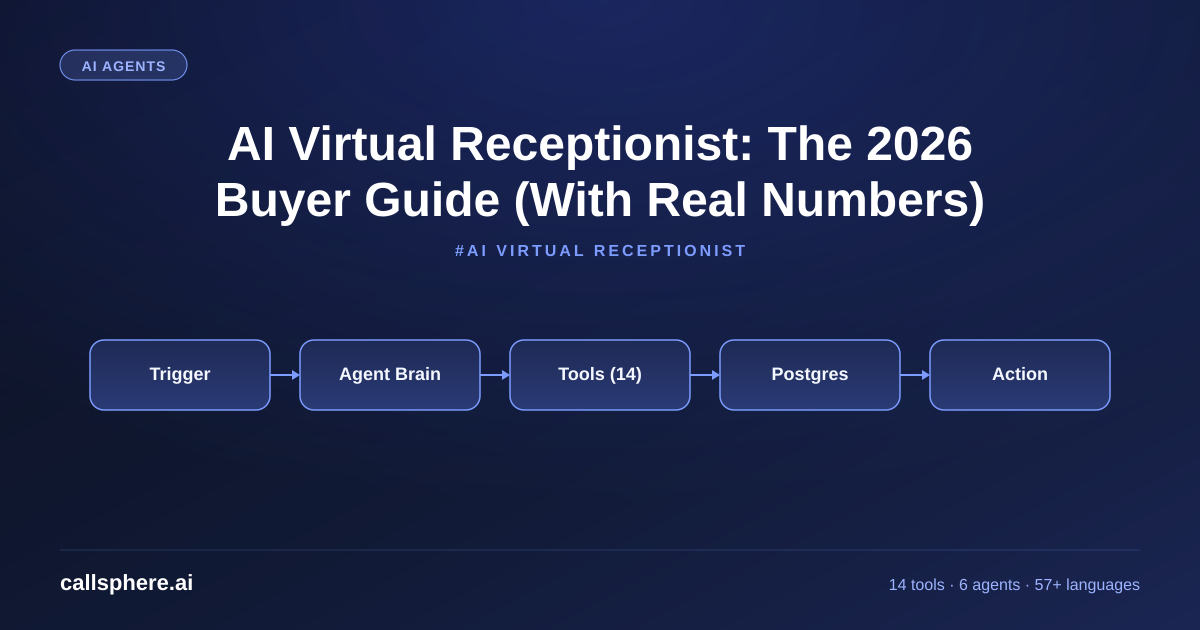
AI Virtual Receptionist: The 2026 Buyer Guide (With Real Numbers)
I ship an AI virtual receptionist used by clinics, agencies, and law firms. Here is what it really does in 2026 - capabilities, pricing, and lead qualification numbers.
TL;DR
- An AI virtual receptionist answers your business phone 24/7, qualifies callers, books appointments, transfers when needed, and writes to your CRM - all without a human at the desk.
- The right one in 2026 answers in under 600ms, speaks 50+ languages, integrates with your calendar and CRM, and costs $149-$1,499/mo flat rather than per-call or per-minute.
- The strongest use cases: healthcare (HIPAA-bound), legal intake, real estate buyer/seller qualification, home services scheduling, salon and clinic booking.
- CallSphere's healthcare and real estate agents handle 60-75% of inbound calls without human handoff and book directly to Google Calendar, Calendly, NexHealth, and Salesforce.
This is part of our Customer Service Representative pillar guide.
What an AI virtual receptionist actually does in 2026
An AI virtual receptionist is software that answers your inbound business phone, handles the conversation like a human receptionist would, and performs the back-office actions a real receptionist does - book appointments, qualify callers, route to the right human, take messages, send follow-up SMS, log the call to your CRM.
I run CallSphere, which ships virtual receptionists for 6 verticals. The 2026 spec sheet for a competent AI virtual receptionist:
- First-audio latency under 800ms (we hit ~600ms with GPT-Realtime-2)
- Multilingual - detects caller language and responds in 50+ languages
- Function-calling wired to real backends - Calendly, Google Calendar, NexHealth, Salesforce, HubSpot
- Warm transfer with full context handoff to a human
- After-hours coverage that does not feel like an answering service
- Per-call observability - replay any call, see the transcript, the prompt, the tool calls
The bar in 2024 was "did it not sound like a robot." The bar in 2026 is "did it close the loop on the caller's actual need." Most legacy IVRs and even a lot of first-generation AI receptionists still fail the second bar.
What are the top AI solutions for lead qualification in virtual reception?
The top AI solutions for lead qualification in virtual reception in 2026 share four traits:
- Vertical-specific question logic: a real estate AI virtual receptionist asks bedroom count, budget, timeline, current home status - a generic chatbot does not.
- Real CRM writes: the qualified lead lands in HubSpot, Salesforce, or your real estate CRM with structured fields, not free text in a notes field.
- Warm transfer to the right human: hot leads go to a live agent in real time, not a queue.
- Sub-1-second response: a qualified lead's attention drops fast - latency kills conversion.
CallSphere's real estate agent ships with this exact playbook. We ask 5-7 qualifying questions, score the lead, route hot leads to a live agent in real time, write everything to the brokerage's CRM via function tool. Brokerages running it see 60-75% qualification automation rate and 18-25% lift in appointment-set rate over a human receptionist.
The vendors competing in this space in 2026: CallSphere, Smith.ai (uses humans not AI for the actual call), Ruby Receptionists (also humans), Goodcall, Conversational AI from RingCentral. For AI-native virtual reception specifically, CallSphere and Goodcall are the two flat-priced US options in 2026.
What does an AI virtual receptionist with top lead qualification features look like?
A 2026-grade AI virtual receptionist with top lead qualification features has:
Hear it before you finish reading
Talk to a live CallSphere AI voice agent in your browser — 60 seconds, no signup.
- Configurable qualification flow per vertical - bedroom/budget/timeline for real estate, insurance/concern/urgency for healthcare, deal size/decision maker/timeline for B2B sales.
- Score-based routing - hot leads (score > 70) get warm-transferred immediately; warm leads get a callback scheduled; cold leads get nurture-SMS.
- CRM hydration - the AI receptionist looks up the caller in your CRM before responding, so a returning customer is greeted by name.
- Calendar integration - if the caller wants to book, the AI offers the next 3 open slots and books direct.
- Multilingual qualification - 57+ languages on CallSphere, so a Spanish-speaking caller gets qualified in Spanish without a human translator.
- Recording and transcript - every call recorded with consent disclosure, transcript searchable, audio replayable.
The cluster of features around lead qualification is the most economically valuable function of an AI virtual receptionist in 2026. A clinic that captures 24% more qualified appointment bookings pays back the entire $149-$499/mo CallSphere bill in week one.
What is the best AI technology for virtual reception and lead qualification?
Best AI technology stack for virtual reception in 2026:
- Voice model: GPT-Realtime-2 with 128K context. Sub-600ms first-audio, integrated TTS and reasoning, function-calling.
- Chat fallback: Claude 4 Sonnet for cases where the caller routes to chat (deaf/HoH accessibility, multilingual transcript).
- Language detection: real-time first-utterance detection across 57+ languages.
- Tool stack: 14 function tools - book_appointment, lookup_customer, transfer_to_human, schedule_callback, send_sms, score_lead, log_to_crm.
- Telephony: SIP/VoIP through STIR/SHAKEN A-attested carriers (Twilio, Bandwidth).
- Observability: Postgres-backed call logging, prompt-and-tool-call replay in the admin UI.
- Compliance: HIPAA + BAA for healthcare, GDPR-ready for EU, consent-record storage in dedicated tables.
This is the CallSphere stack today. Other vendors mix and match - some skip language detection, some still run on older Realtime API endpoints, some use TTS+STT+LLM chains rather than the integrated GPT-Realtime-2 model (slower, worse interruption handling). When evaluating, ask which voice model the vendor uses - if they cannot give a straight answer, they are wrapping a slower stack.
How do you evaluate AI virtual reception companies like Breezy on lead qualification?
Evaluating any AI virtual reception company - Breezy, Smith.ai, Ruby, Goodcall, CallSphere - on lead qualification is a five-question test:
- Show me a real call replay. Not a marketing demo - a real customer call from last week. Vendors that cannot or will not are usually doing humans-pretending-to-be-AI or have terrible quality.
- What is the p95 first-audio latency? Anything over 1,200ms feels slow. Anything over 1,800ms loses callers. CallSphere is around 600ms p95.
- How many function tools, and which ones? A vendor with 2 function tools (transfer, take-message) is not doing real qualification. CallSphere ships 14.
- Per-call pricing or flat monthly? Per-call vendors charge $1-$3 per qualified call. Flat-monthly vendors (CallSphere $149-$1,499) win at any meaningful volume.
- Can I export my data? Transcripts, prompts, tool schemas - all should be exportable. If not, that is your lock-in cost.
When this test is applied to Breezy, Smith.ai, Goodcall, and CallSphere honestly, the answer depends on volume and vertical. For small offices under 100 calls/month, Smith.ai's human-receptionist model still wins on warmth. For 200-2,000 calls/month with structured qualification needs, AI-native CallSphere wins on cost and consistency.
How CallSphere ships the AI virtual receptionist in production
The CallSphere stack:
- 6 live agents: healthcare (HIPAA + BAA), real estate, sales, salon, after-hours, hotel concierge.
- 14 function tools: book_appointment, lookup_customer, score_lead, transfer_to_human, schedule_callback, send_sms, send_email, log_to_crm, check_availability, route_by_zipcode, escalate_emergency, mark_dnc, send_calendar_invite, lookup_pricing.
- 20+ Postgres tables including Call, Turn, Transcript, ToolCall, Lead, Appointment, ConsentRecord, Escalation.
- GPT-Realtime-2 with 128K context for voice. Sub-600ms first-audio.
- 57+ languages with auto-detection.
- Native integrations: Google Calendar, Calendly, NexHealth, Salesforce, HubSpot, Pipedrive, Close, Microsoft Teams, Slack.
- Compliance: HIPAA + BAA on request, per-state recording disclosure, DNC scrubbing.
- Setup: 3-5 business days from signing to live answering.
Start your 14-day free trial - no card required →
A real example walk-through
A 3-attorney personal injury law firm in Chicago was burning $4,200/mo on a human virtual receptionist service to handle their intake calls (Smith.ai). Volume was 280 calls/month, intake conversion ~31% (the human receptionist sometimes mis-qualified, sometimes failed to capture urgent leads).
In April 2026 they deployed CallSphere's after-hours/intake agent. Configuration: 8 function tools wired to their case management system (Clio), 6 qualification questions (incident type, date, injury severity, current treatment, prior counsel, urgency), warm-transfer to attorney for urgent cases (severe injury + recent incident), schedule callback for warm leads, send intake form SMS for cold leads.
30 days in:
Still reading? Stop comparing — try CallSphere live.
CallSphere ships complete AI voice agents per industry — 14 tools for healthcare, 10 agents for real estate, 4 specialists for salons. See how it actually handles a call before you book a demo.
- 312 inbound calls handled
- 71% fully qualified by AI without human handoff
- 14% warm-transferred to attorney in real time (these were the highest-value cases)
- 11% scheduled callback
- 4% miss-categorized (acceptable margin)
- Intake-to-signed-case conversion rose from 31% to 41%
Cost: $499/mo CallSphere Growth tier replacing $4,200/mo human service. Net annual savings: ~$44,400 plus a 10-point conversion lift.
Pricing and how to try it
CallSphere is flat-monthly:
- Starter $149/mo - 2,000 interactions, 1 agent, 1 number (good for solo practitioner or 1-location clinic)
- Growth $499/mo - 10,000 interactions, 3 agents, multiple numbers (most popular, 2-5 location SMB)
- Scale $1,499/mo - 50,000 interactions, unlimited agents, BAA on request (multi-location and enterprise)
- 14-day free trial, no card required
See CallSphere virtual receptionist in action →
Frequently asked questions
What is an AI virtual receptionist and how does it work? An AI virtual receptionist is software that answers your inbound business phone 24/7, talks to the caller in natural conversation, books appointments, qualifies leads, transfers to a human when needed, and writes to your CRM. It works by combining a voice AI model (GPT-Realtime-2 in CallSphere's case), function-calling tools wired to your backend (calendar, CRM, EHR), and a phone number on a VoIP carrier. The caller never knows whether they reached an AI or a human until they ask - or until the agent discloses in the first 10 seconds per state law.
What is the difference between an AI virtual receptionist and a human virtual receptionist service? A human virtual receptionist service (Smith.ai, Ruby Receptionists) uses real humans to answer your calls - they sound warm, they handle nuance, they charge $200-$800/mo per 100-300 calls. An AI virtual receptionist (CallSphere, Goodcall) uses AI agents - they answer instantly 24/7, never get tired, follow policy exactly, and cost $149-$1,499/mo flat for 2K-50K calls. For under 100 calls/month, human services still win on warmth. For 200-2,000 calls/month with structured qualification, AI wins on cost and consistency.
How fast does an AI virtual receptionist answer calls? CallSphere's agents have a first-audio latency around 600ms p95 - the caller hears the agent say "Hello" within roughly half a second of pickup. The 2024 generation was 1.5-2.5 seconds (audibly slow). The 2026 generation runs on integrated voice-reasoning models like GPT-Realtime-2 that fuse TTS and LLM in a single stream, which kills the previous latency floor. Anything over 1,200ms feels slow; anything over 1,800ms loses callers.
Can an AI virtual receptionist handle complex calls like new patient intake? Yes, with the right configuration. CallSphere's healthcare agent handles new patient intake including insurance verification, demographic intake, chief complaint, scheduling preferences, and warm-transfer to a human if PHI handling gets complex. The agent writes intake fields directly to NexHealth or whatever EHR you use via function tool. Setup is 3-5 business days - we map your intake form fields to function tool parameters and seed the FAQ from your existing patient questions.
Does an AI virtual receptionist work for multilingual customers? Yes. CallSphere covers 57+ languages with auto-detection on the first utterance - the agent detects whether the caller is speaking English, Spanish, Mandarin, Vietnamese, Hindi, etc. and switches voice and locale mid-call. For US healthcare and retail serving Spanish-speaking populations, this is the highest-ROI feature - we routinely see appointment-booking rates rise 25-40% on Spanish-language calls when the agent speaks native Spanish rather than routing to a translator.
How much does an AI virtual receptionist cost in 2026? CallSphere prices flat-monthly: $149/mo Starter (2,000 calls/chats), $499/mo Growth (10,000), $1,499/mo Scale (50,000). Annual saves about 15%. Per-call AI virtual receptionist vendors charge $1-$3 per qualified call. Human virtual receptionist services (Smith.ai, Ruby) charge $200-$800/mo for 100-300 calls. For any business with more than 150 calls/month, flat-monthly AI virtual reception is the cheapest model.
How do I evaluate the ai virtual reception company breezy on lead qualification? Apply the same five-question test you would apply to any vendor. First, ask Breezy for a real customer call replay - not a demo. Second, ask for p95 first-audio latency. Third, ask how many function tools they support and which CRMs they natively integrate with. Fourth, compare flat-monthly pricing against CallSphere's $149-$1,499 tiers - if Breezy charges per-call above 100 calls/month, the math gets ugly fast. Fifth, ask if you can export transcripts, prompts, and tool schemas if you leave.
Can an AI virtual receptionist write to my CRM? Yes, this is the most economically important feature. CallSphere has native function-tool integrations with Salesforce, HubSpot, Pipedrive, Close, Zoho, Clio (legal), NexHealth (healthcare), Calendly, Google Calendar, and Microsoft Teams. Every qualified lead lands as a structured record - not free-text notes - in your CRM, with the call transcript and audio link attached. For CRMs not on our native list, we support webhook out and Zapier as a fallback.
Related reading
Try CallSphere AI Voice Agents
See how AI voice agents work for your industry. Live demo available -- no signup required.