
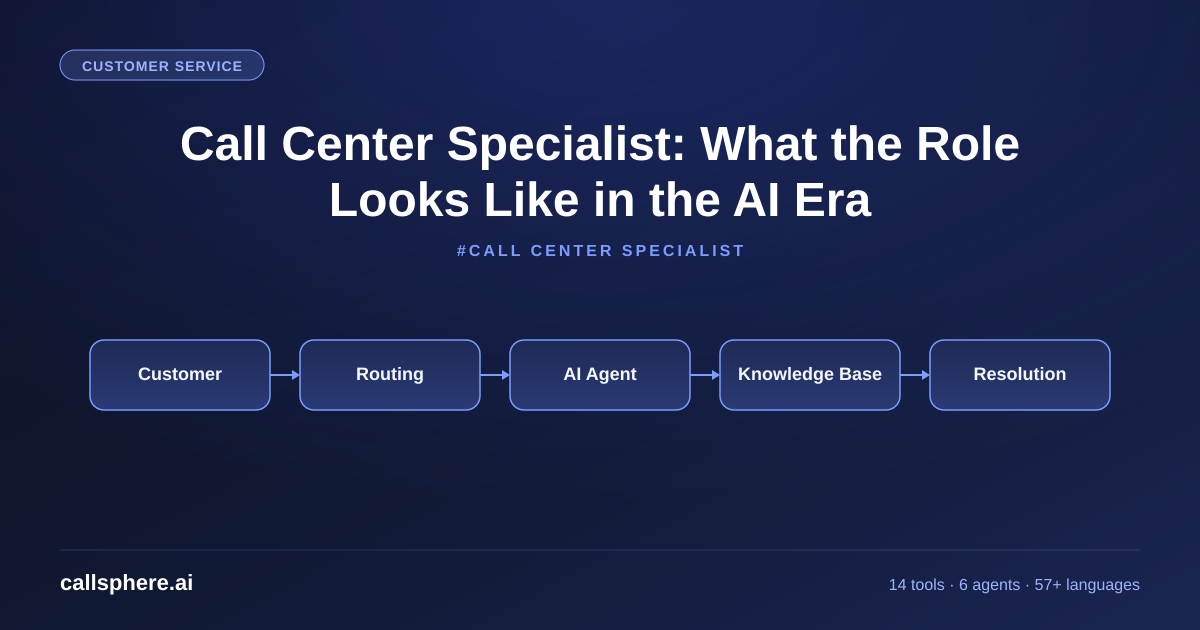
Call Center Specialist: What the Role Looks Like in the AI Era
Call center specialist roles are changing fast with AI agents handling routine calls. Here is the honest 2026 picture — and how I hire and structure teams.
TL;DR
- A call center specialist in 2026 spends less time on routine calls and more time on escalations, training AI, and judgment work.
- Call center chatbots and AI voice agents now handle 60 to 85 percent of inbound traffic in mature operations.
- Outsourcing companies are pivoting from labor arbitrage to "managed AI plus humans" models.
- CallSphere ships the AI layer that lets a smaller call center team handle higher volumes — $149/mo to $1,499/mo, 14-day trial.
This is part of our Customer Service Representative guide.
What does a call center specialist actually do in 2026
A call center specialist in 2026 is a hybrid role. The job description used to be "answer phones, follow scripts, log tickets." In 2026 it is:
- Handle the hard 15 to 40 percent of calls that AI agents escalate.
- Review AI transcripts for quality and edge cases.
- Update knowledge bases so the AI gets smarter over time.
- Handle high-empathy and high-stakes interactions that AI is not the right fit for.
- Coach AI prompts — surprisingly, the best new prompt-engineers in call centers come from the former specialist pool.
The mix varies by industry. In healthcare, the human is on more calls because PHI escalations are frequent. In retail support, the AI handles a larger share.
What are call center chatbots and where do they fit
Call center chatbots are AI conversation agents that operate on chat, SMS, or WhatsApp channels (and increasingly voice). In 2026 they are not the rule-based "press 1 for sales" bots of 2018 — they are AI-driven, tool-using, multilingual agents that read the CRM and write back to it.
The current generation handles:
- Account lookups and billing questions.
- Status checks and order tracking.
- Simple bookings and reschedules.
- FAQ and how-to questions.
- Initial triage for escalation to humans.
What they do not handle well: complex emotional escalations, novel compliance situations, and anything requiring judgment about the customer's lifetime value or strategic relationship. That is the call center specialist's territory.
Are call center outsourcing companies still relevant
Yes, but the model has shifted. A call center outsourcing company in 2020 sold labor arbitrage — cheaper agents in lower-cost geographies. In 2026 the best ones sell "managed AI plus humans" — they run the AI agent platform, manage the prompt engineering, and provide humans only where the math demands it.
Hear it before you finish reading
Talk to a live CallSphere AI voice agent in your browser — 60 seconds, no signup.
Some traditional BPOs are struggling with this transition; others have leaned in hard. The winners typically run a platform like CallSphere (or build their own) and price on outcomes (tickets resolved, calls handled) instead of agent-hours billed.
What does a call center manager remote role look like now
A call center manager remote in 2026 spends time on:
- Reviewing AI agent performance metrics and CSAT trends.
- Coaching the smaller human team on the hard escalations.
- Updating prompts, tools, and knowledge bases.
- Reporting on cost-per-ticket, resolution rate, and SLA compliance.
- Coordinating with the AI vendor or internal platform team.
It is a less-frantic role than 2018 — but more technical. The best managers I know now read AI agent transcripts the way an old-school manager listened to call recordings.
How CallSphere does this in production
CallSphere is a managed AI voice and chat agent platform that lets a smaller call center team handle higher volumes. The concrete shape:
- 6 live agents: healthcare, real estate, sales, salon, after-hours escalation, hotel concierge.
- 14 function tools — CRM lookup, ticket creation, escalation, SMS triggers, calendar read/write.
- 20+ Postgres tables — calls, transcripts, escalations, CSAT, cost ledger.
- 57+ languages with natural accents.
- GPT-Realtime-2 at the model layer with 128K context and $0.40 per 1M cached input.
- Manager dashboard: /admin/gtm exposes per-agent, per-language, per-hour analytics.
- Escalation flow: Structured handoff to humans with a 3-sentence context summary.
- Setup time: 3 to 5 business days.
Customers typically reduce their call center specialist headcount need by 40 to 70 percent in the first three months, redirecting the remaining team to higher-value work.
A real example walk-through
A 50-seat regional contact center for a utility company ran with 50 specialists across two shifts plus a manager. After turning on CallSphere on Scale tier ($1,499/mo) with the after-hours escalation agent and our IT helpdesk persona, AI took 68 percent of inbound calls to resolution within four months.
The headcount math: through attrition over six months, the team dropped from 50 to 19 specialists. Two former specialists moved into prompt-engineering roles managing the AI. The manager's role pivoted from staffing and scheduling to AI quality and analytics. Net annualized labor savings: roughly $1.9M against a platform cost of $18,000/year.
Pricing and how to try it
CallSphere is $149/mo Starter (2,000 interactions), $499/mo Growth (10,000 interactions, most popular), and $1,499/mo Scale (50,000 interactions). Annual saves roughly 15 percent. 14-day free trial, no card. Setup is 3 to 5 business days. For call center outsourcing partners, our affiliate program pays 22 percent rev share in year one.
Still reading? Stop comparing — try CallSphere live.
CallSphere ships complete AI voice agents per industry — 14 tools for healthcare, 10 agents for real estate, 4 specialists for salons. See how it actually handles a call before you book a demo.
Frequently asked questions
Is the call center specialist role going away? No — it is changing. The routine work is going to AI; the judgment work is going to humans. Headcount in routine-heavy operations is shrinking 40 to 70 percent over 2 to 3 years, but the specialists who remain are typically higher-paid and doing more interesting work.
How do call center chatbots handle multilingual traffic? Modern call center chatbots (CallSphere included) detect language on the first turn and respond in kind across 57+ languages with natural accents. The old "press 2 for Spanish" IVR pattern is gone — language is implicit. This alone often reduces abandon rate by 30 to 50 percent in multilingual markets.
Should I use a call center outsourcing company or build internally? For small to mid-size operations, outsourcing to a BPO that runs a modern AI platform underneath is usually cheaper and faster than building. For large operations with specific compliance constraints or differentiated processes, internal makes sense. The middle ground — running a platform like CallSphere yourself — works well for many teams.
Can a call center manager remote actually run a large team in 2026? Yes, more easily than ever. AI agent platforms produce structured analytics that make remote management easier than physical floor management ever was. The role looks more like a product manager and less like a shift supervisor.
Are call center chatbots reliable enough for high-stakes industries? For healthcare, finance, and legal, the pattern is "AI for routine, human for stakes." A well-built chatbot escalates anything sensitive with full context. CallSphere's healthcare agent is BAA-ready and tuned for this exact pattern.
What does a call center specialist need to learn to stay relevant? Three things in priority order: (1) reading AI transcripts critically, (2) writing structured feedback for prompt and tool improvements, (3) handling the high-empathy escalations that AI is not the right fit for. The best new specialists I see are former senior specialists who add AI literacy.
How much does an ai powered call center cost vs a traditional one? At equivalent volume, an AI-powered call center typically costs 40 to 70 percent less in year one and 60 to 80 percent less by year three. CallSphere itself is $149 to $1,499/mo. The labor savings dwarf the platform cost in any mature deployment.
Can I pilot AI in one queue before rolling out broadly? Yes — and I recommend it. Pick one queue (typically after-hours or a specific product line), run CallSphere or any competing platform for 30 days, measure resolution rate and CSAT vs the human baseline, then decide. A real pilot beats six months of internal debate.
Related reading
Try CallSphere AI Voice Agents
See how AI voice agents work for your industry. Live demo available -- no signup required.