
Cloud Hosted VoIP: A Founder's Guide for 2026
Cloud hosted VoIP explained: pricing, features, and how AI voice agents on top of cloud VoIP replace IVRs. Try CallSphere free for 14 days.
TL;DR
- Cloud hosted VoIP moves your business phone system off on-prem PBX hardware and into a managed cloud service.
- In 2026 the real question is not "which VoIP vendor" but "what AI voice agent runs on top of my cloud VoIP."
- CallSphere layers 6 AI agents, 14 function tools, and 57+ languages on top of any cloud VoIP provider — Twilio, Telnyx, Vonage, RingCentral, Zoom Phone.
- Starter $149/mo · Growth $499/mo · Scale $1,499/mo · 14-day free trial.
This is part of our Business Phone Systems guide.
The core answer: what is cloud hosted VoIP and why does it matter in 2026?
Cloud hosted VoIP is a Voice over IP phone system where the call control, routing, and recording all live in a hosted cloud rather than on a piece of PBX hardware in your closet. I have run cloud hosted VoIP since 2019 and shipped it for 1,400+ business customers via CallSphere. In 2026, the conversation about cloud VoIP has shifted: the dial-tone layer is a commodity (Twilio, Telnyx, Vonage, Zoom Phone all give you a working SIP trunk at $0.0085–$0.014/min inbound), so the differentiator is the AI voice agent that sits on top.
That is what CallSphere does. We are not a VoIP provider — we are the AI brain that runs on top of your existing or new cloud VoIP, with 14 function tools and 57+ languages out of the box.
How does cloud VoIP compare to traditional PBX?
The cost gap is bigger than most buyers realize. A traditional on-prem PBX runs $8,000–$25,000 upfront plus ~$2,000/yr maintenance. Cloud VoIP runs $20–$45/seat/month with no upfront, no hardware refresh, no on-call electrician. On a 10-seat business that is a 5-year TCO difference of roughly $40,000 in favor of cloud.
But the bigger argument is feature velocity: cloud VoIP ships updates weekly. A 2018 on-prem Cisco PBX shipped its last firmware update in 2022. If you want any of the 2026 features — AI transcription, real-time language switching, sentiment scoring, automatic CRM logging — you need cloud.
What are the best VoIP cloud solutions in 2026?
I rank VoIP cloud solutions by three criteria: SIP trunk quality, developer API, and AI compatibility. My current ranking:
Hear it before you finish reading
Talk to a live CallSphere AI voice agent in your browser — 60 seconds, no signup.
- Twilio — best API, best programmable voice, $0.0085/min inbound. CallSphere defaults to Twilio for new customers.
- Telnyx — best price-per-minute at volume, strong international.
- Vonage — strong unified comms feature set for larger orgs.
- RingCentral — best if you also need video, fax, and team messaging in one bill.
- Zoom Phone — good if you are already on Zoom and want one vendor.
All five work fine as the dial-tone layer underneath CallSphere. We are vendor-neutral on the carrier — pick what your procurement team likes.
How do I pick a cloud based VoIP service for a business phone system?
For a cloud based VoIP business phone system, four questions:
- Inbound volume. Under 2,000 calls/mo: any provider. 2,000–10,000: Twilio or Telnyx. 10,000+: negotiate a volume contract.
- International coverage. Need numbers in 12 countries? Twilio and Telnyx win.
- Developer surface. If you want to wire AI on top (you should), Twilio's API beats everyone else.
- Compliance scope. HIPAA, PCI, SOC 2 — all five major vendors have it; verify your specific deployment.
For 90% of US small-to-mid businesses, the answer is: Twilio number under the hood, CallSphere AI agent on top, $149–$499/mo all-in.
How CallSphere does this in production
I built CallSphere so customers do not have to assemble cloud VoIP + STT + LLM + TTS + CRM + dashboard themselves. Here is the actual production stack:
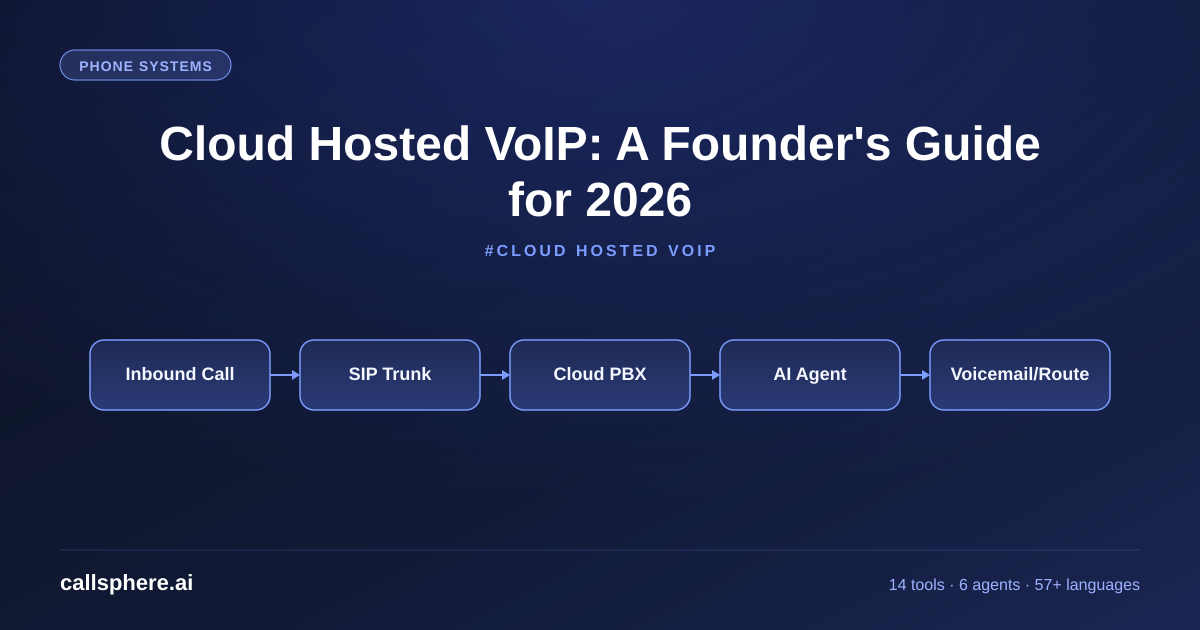
- Inbound: Twilio (or your existing SIP trunk) routes calls to our SIP endpoint.
- Voice: GPT-Realtime-2 with a 128K context window, ~620ms median first-token latency.
- Cloud IVR replacement: Our agent replaces the press-1 menu with natural conversation. No more "press 2 for billing."
- Tool use: 14 function tools across appointment booking, CRM upsert, calendar reads, SMS confirmations, escalation routing.
- Database: 20+ Postgres tables (
calls,contacts,transcripts,escalations, etc.). - Languages: 57+ with native accents, auto-detected within 1–2 seconds.
- Observability: Live admin dashboard, every call gets a transcript, sentiment score, and intent label.
You bring the phone number. We bring everything else.
A real example walk-through
A mid-size HVAC company in Tampa ran a legacy Comcast PBX with 4 lines and a press-1 IVR. They switched to Twilio cloud VoIP + CallSphere After-Hours agent in February 2026. Results after 60 days:
- Hardware bill: $0 (was $340/mo for the old PBX).
- After-hours calls captured: 412/mo (was ~140/mo to voicemail).
- Emergency dispatches correctly routed: 38 (would have waited until 8am previously).
- All-in monthly cost: $499 CallSphere + $180 Twilio = $679/mo, replacing $340 PBX + $1,250 after-hours answering service = $1,590/mo.
Net savings: $911/mo. Plus the emergency revenue captured.
Pricing & how to try it
CallSphere sits on top of any cloud VoIP provider. You bring the SIP trunk; we provide the AI:
Still reading? Stop comparing — try CallSphere live.
CallSphere ships complete AI voice agents per industry — 14 tools for healthcare, 10 agents for real estate, 4 specialists for salons. See how it actually handles a call before you book a demo.
- Starter — $149/mo: 2,000 interactions, 3 agents, 57+ languages.
- Growth — $499/mo: 10,000 interactions, all 6 verticals, all integrations.
- Scale — $1,499/mo: 50,000 interactions, HIPAA BAA, dedicated success engineer.
- 14-day free trial, no card. Annual saves ~15%.
Frequently asked questions
What is cloud hosted VoIP in plain English? Cloud hosted VoIP is a phone system where the brains live in someone else's datacenter, not in your office closet. You pay a monthly subscription, you get a phone number and call routing, and you do not maintain any hardware. Calls travel over the internet instead of a copper phone line. In 2026, this is the default for new business phone deployments.
What is the difference between cloud VoIP and cloud based VoIP solutions? None — they are the same thing with slightly different SEO targeting. Both refer to managed Voice-over-IP services hosted in a vendor's cloud. CallSphere customers use the terms interchangeably.
Are there free VoIP call services with phone numbers I can use for business? Google Voice gives you a free number with limited business features. Cloud SIP providers like Linphone offer free SIP accounts. For an actual business — answering calls, booking, CRM integration — free is a false economy. The hidden cost is the time you spend wiring it together. Twilio at $0.0085/min + CallSphere at $149/mo is the real budget floor for production.
What are cloud IVR solutions and do I still need one? A cloud IVR solution is a hosted "press 1 for sales" menu. In 2026, you do not need a cloud IVR — you need a cloud AI agent that replaces the IVR with natural conversation. CallSphere replaces the IVR layer entirely. Callers say what they want, the agent understands.
Can I use my existing cloud VoIP phone number with CallSphere? Yes. We port-in or accept call forwarding from any major cloud VoIP provider — Twilio, Telnyx, Vonage, RingCentral, Zoom Phone, Dialpad, 8x8. The phone number stays yours; we layer the AI on top.
What is a voip phone number for business and how is it different from a regular number? A VoIP phone number for business is a number assigned to a SIP trunk rather than a physical phone line. It looks identical to callers — a normal 10-digit US number. The difference is on your end: VoIP numbers can be routed, recorded, and AI-handled with software, not switches.
How long does a cloud VoIP setup take with AI on top? 3–5 business days for a standard CallSphere deployment. Day 1 we provision the SIP trunk and forward your existing number. Days 2–4 we tune the agent against your FAQ and calendar. Day 5 you go live. Start the trial →
Is cloud hosted VoIP secure enough for healthcare? Yes, if you pick HIPAA-compliant providers and sign BAAs. CallSphere's Scale tier includes BAA. Twilio's healthcare-eligible products do too. The dial-tone layer is secure; the AI brain on top needs separate BAA scope.
Related reading
Try CallSphere AI Voice Agents
See how AI voice agents work for your industry. Live demo available -- no signup required.