
Conversational IVR in 2026: The End of Press 1 for English
Conversational IVR replaces touch-tone menus with a natural-language voice agent. Here is how it works in 2026 and how CallSphere ships it in 3-5 days.
This is part of our Business Phone Systems guide.
TL;DR
- Conversational IVR replaces the legacy "press 1 for sales, press 2 for support" menu with a natural-language voice agent that asks the caller why they are calling.
- 2026 is the year conversational IVR became the default for new deployments — the touch-tone menu is on its way out.
- Conversational AI IVR is powered by realtime LLMs (GPT-Realtime-2 in May 2026) with function tools that hit your CRM, calendar, and ticketing systems.
- CallSphere ships conversational IVR as one of six vertical agents, from $149/mo Starter, with a 14-day free trial.
What is conversational IVR
Conversational IVR is the replacement for the legacy interactive voice response menu — the "press 1 for sales, press 2 for support, press 9 to repeat this menu" experience that has been making callers hang up since the 1990s. Instead of touch-tone menus, conversational IVR uses a natural-language voice agent that asks the caller "How can I help you?" and figures out the routing — or just handles the call directly — from there.
I am Sagar Shankaran, founder of CallSphere. We ship conversational IVR as part of six live vertical agents — healthcare, real estate, sales, salon, after-hours, and hotels — and the after-hours / escalation agent in particular is almost always deployed in conversational-IVR mode. So my view of what works is grounded in real call traffic.
Conversational AI IVR: what changed in 2026
The reason 2026 is the inflection year for conversational IVR — not 2024, not 2025 — is that the model layer finally caught up. Conversational ai ivr in 2024 was technically possible but practically frustrating: latency was around 1.5 seconds, transcription was glitchy on names and addresses, and tool execution was unreliable.
In May 2026, GPT-Realtime-2 launched with a 128K context window, sub-800ms end-to-end latency on the right stack, and reliable function-calling. That moved conversational IVR from "barely works" to "default for new deployments." Operators who launched touch-tone menus in 2022 are now ripping them out and replacing them with conversational agents.
Three concrete things changed in 2026:
- Latency under 800ms is now the baseline. Slower than that, callers notice and call quality drops.
- Tool execution at 99%+ reliability means the agent can book, qualify, refund, and transfer with confidence.
- 57+ language support out of the box means a single IVR can handle a multilingual customer base without per-language buildouts.
Why touch-tone menus are being deprecated
The honest reason touch-tone IVR is being deprecated, beyond "it is annoying": every metric that matters in 2026 is worse on touch-tone than on conversational.
Hear it before you finish reading
Talk to a live CallSphere AI voice agent in your browser — 60 seconds, no signup.
- Abandonment rate. Callers hang up on touch-tone menus 25 to 40% of the time before reaching the right department. On conversational IVR, that drops to under 5%.
- First-call resolution. Touch-tone routes; it does not resolve. Conversational IVR can actually answer the question.
- Wait time. Touch-tone routes to a human queue. Conversational IVR handles the call.
- Language coverage. Touch-tone menus are typically English plus one or two extras. Conversational IVR handles 57+ on CallSphere.
- Caller satisfaction. Survey data is unambiguous — callers prefer talking to a competent AI over pressing buttons.
The only argument left for touch-tone is "we already have one and it works." That argument loses to a 3 to 5 business-day setup on a conversational replacement.
What a conversational IVR looks like in production
Here is a typical conversational IVR flow on CallSphere for a multi-location dental group:
- Caller dials the main number.
- Agent answers in under 800ms: "Thanks for calling — how can I help you today?"
- Caller: "I need to reschedule my appointment for Thursday."
- Agent looks up the caller by phone number in the
contactstable, finds the Thursday appointment in theappointmentstable, and offers three new times. - Caller picks one. Agent calls the
update_appointmentfunction tool, which hits the EHR. - Agent confirms: "Done — you are now booked for Tuesday at 2pm. We sent a text to confirm."
- Call ends. Structured rows written to
calls,conversations,tool_calls,appointments, andcrm_events.
No menu. No "press 2 for scheduling." No 4-minute hold. The whole call is 90 seconds.
For calls the agent cannot handle, conversational IVR escalates to a human with full context — not a cold transfer, a warm one with the conversation history already loaded.
How CallSphere does this in production
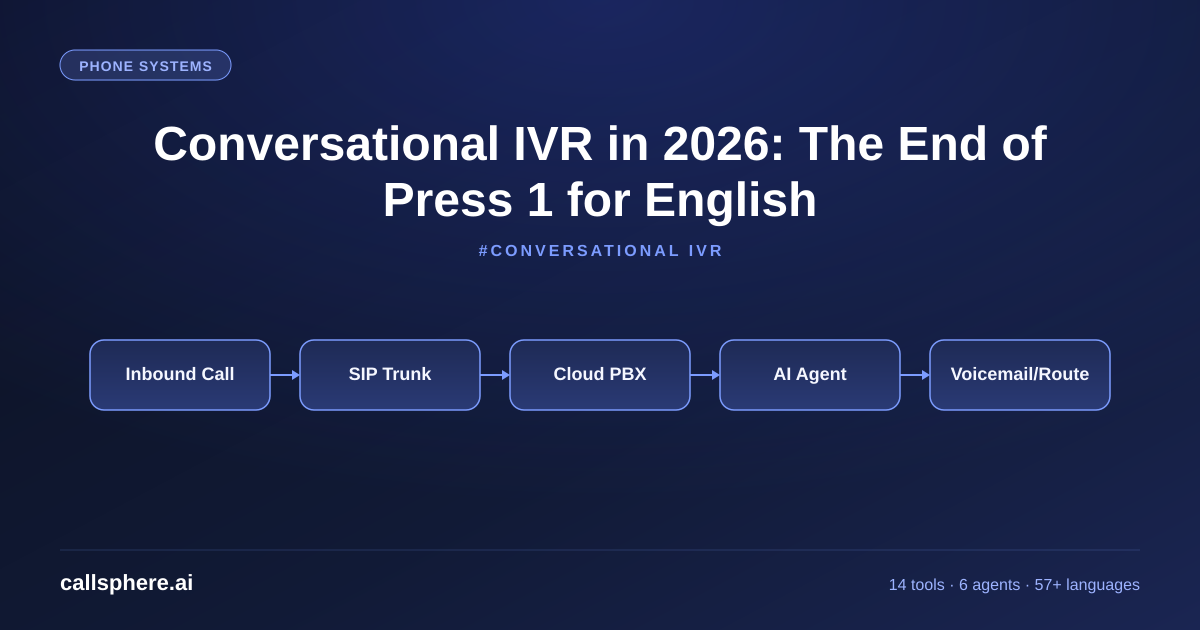
CallSphere's conversational IVR runs on GPT-Realtime-2 with 128K context, our managed TTS layer in 57+ languages, and 14 function tools across the six verticals. Inbound calls arrive over SIP from the customer's carrier of choice; we pick up in under 800ms and run the conversation.
The structured-data layer is what makes it production-grade: every call writes to calls, every turn to conversations, every tool call to tool_calls, every CRM event to crm_events. That gives operators full observability — they can see exactly which calls the agent handled, which it escalated, and why.
Setup time is 3 to 5 business days, mostly spent gathering the operator's data (FAQ, escalation rules, EHR or CRM credentials) rather than configuring software.
A real example walk-through
A mid-sized auto insurance carrier replaced their touch-tone IVR with a CallSphere conversational IVR in March. They had been routing 40,000 monthly calls through a touch-tone tree with 6 levels, an 32% abandonment rate, and an average time-to-human of 7 minutes.
Setup took five business days, mostly on integrating their policy-lookup tool. They went live on the $1,499 Scale tier. First 30 days: 41,200 calls handled, 28% resolved without human handoff, abandonment rate dropped to 4%, average time-to-human (for the cases that needed it) dropped to 90 seconds. Customer satisfaction scores on call experience jumped meaningfully in the first survey cycle.
Pricing and how to try it
CallSphere prices per interaction:
Still reading? Stop comparing — try CallSphere live.
CallSphere ships complete AI voice agents per industry — 14 tools for healthcare, 10 agents for real estate, 4 specialists for salons. See how it actually handles a call before you book a demo.
- Starter $149/mo — 2,000 interactions.
- Growth $499/mo — popular tier.
- Scale $1,499/mo — 50,000 interactions, priority support.
14-day free trial, no credit card. Setup 3 to 5 business days.
Frequently asked questions
What is conversational IVR? Conversational IVR replaces the legacy touch-tone "press 1 for sales, press 2 for support" menu with a natural-language voice agent. Instead of pressing buttons, callers say what they need, and the agent either handles the request directly or routes them to the right human with full conversation context. In 2026 conversational IVR has become the default for new deployments because the model layer (GPT-Realtime-2 with 128K context) finally supports sub-800ms latency and reliable function calling.
What is the difference between conversational IVR and conversational AI IVR? The two phrases are used interchangeably in 2026. "Conversational IVR" is the older term, going back to early speech-recognition systems in the 2010s. "Conversational AI IVR" emphasizes that the modern version is powered by LLMs with function tools, not just speech recognition with menu logic. Either way, it is the same product category — a natural-language voice agent at the front of your phone system. CallSphere ships it as one of six vertical agents.
How does conversational IVR work technically? Inbound calls arrive over SIP from your carrier, get routed to the conversational IVR platform, and are picked up by a realtime LLM (GPT-Realtime-2 in 2026) under 800ms. The model runs the conversation, calls function tools to hit your CRM, calendar, and ticketing systems, and escalates to a human when needed. On CallSphere everything is logged to Postgres tables — calls, conversations, tool_calls, crm_events — for full observability.
Is conversational IVR better than touch-tone IVR? On every metric that matters in 2026, yes. Abandonment rates drop from 25 to 40% to under 5%. First-call resolution improves dramatically because the agent can actually answer the question, not just route. Wait times drop because the agent handles the call. Language coverage expands from 1 to 2 languages to 57+ out of the box. Caller satisfaction is unambiguously higher on conversational. The only argument for touch-tone in 2026 is "we already have one."
How long does it take to deploy conversational IVR? On CallSphere, 3 to 5 business days for the first vertical. Most of that time is spent gathering the operator's data — FAQ, escalation rules, EHR or CRM credentials, voice and language preferences — rather than configuring software. The platform itself is configured in hours. Building conversational IVR in-house against raw APIs typically takes 3 to 6 months to reach feature parity with a managed product.
Can conversational IVR handle multiple languages? Yes — that is one of the biggest wins over touch-tone. CallSphere supports 57+ languages out of the box, with the agent detecting the caller's language in the first turn and switching automatically. A single conversational IVR can handle English, Spanish, Mandarin, French, German, and dozens more without per-language buildouts. For multilingual customer bases this is transformative.
Does conversational IVR replace human agents? No — it changes the shape of the work. Conversational IVR handles the 60 to 90% of calls that are routine (booking, qualification, FAQ, refund lookup, password reset). Human agents handle the 10 to 40% that need judgment, empathy, or escalation. The total team is usually 30 to 60% smaller for the same volume, but each role is more skilled. The teams that handle the transition well retrain Tier-1 staff into Tier-2 and quality-monitoring roles.
Does CallSphere conversational IVR integrate with my existing phone system? Yes. CallSphere is the AI agent layer; we sit on top of your existing VoIP or carrier setup. You forward calls (or port a number) to CallSphere over SIP, and the agent picks up. You keep your existing VoIP for internal calls, outbound, and human-handled lines. Most operators start by forwarding after-hours and overflow calls, then expand as they see the results. Setup is configuration, not migration.
Related reading
Try CallSphere AI Voice Agents
See how AI voice agents work for your industry. Live demo available -- no signup required.