
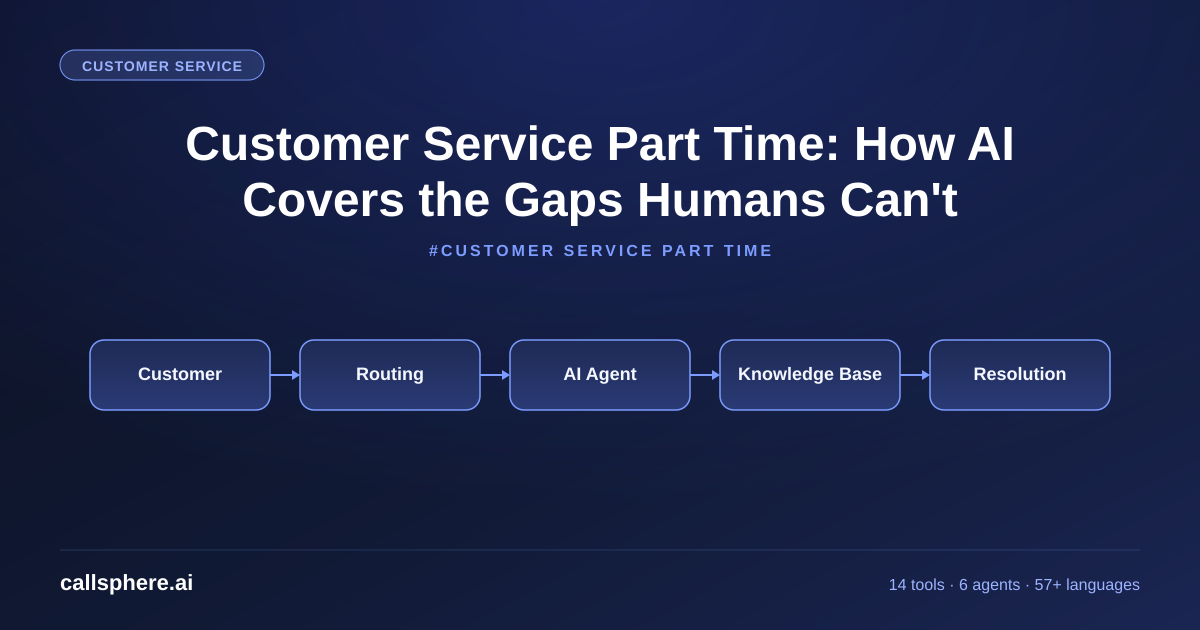
Customer Service Part Time: How AI Covers the Gaps Humans Can't
Hiring customer service part time is hard. Here is how I use CallSphere's AI chat and voice agents to cover the gaps — $149/mo, 14-day trial, 57+ languages.
TL;DR
- Hiring customer service part time is expensive, slow, and rarely covers nights or weekends well.
- CallSphere's AI customer service bot answers 24/7 across voice, chat, SMS, WhatsApp — 57+ languages, 14 function tools.
- Pricing: $149/mo Starter, $499/mo Growth, $1,499/mo Scale, plus a 14-day free trial.
- The result is a hybrid where part-time humans cover the hard 20 percent and AI covers the routine 80 percent.
This is part of our Customer Service Representative guide.
What does customer service part time really mean in 2026
When most ops leaders search for customer service part time, what they actually want is coverage outside core business hours — evenings, weekends, lunch breaks, surge windows — without paying for a full-time headcount. Part-time hiring sounds like the answer until you price it: training cost, attrition, scheduling overhead, and a 4-hour shift minimum mean the loaded cost per ticket is usually higher than full-time.
I have run this math more times than I can count. The honest answer in 2026 is that the cost-effective coverage pattern is hybrid: a small core of part-time or full-time humans for the difficult tickets, plus an AI customer service bot running 24/7 for routine queries. That is exactly what CallSphere ships.
What is a digital customer service platform and how does it cover the gaps
A digital customer service platform is the unified surface where every channel — voice, chat, SMS, WhatsApp, email — lands in one queue with one customer record. CallSphere is that layer for AI-first teams. Every interaction across our 6 live agents writes to the same 20+ Postgres tables, so a question that starts on chat at 11pm and is finished on voice at 9am picks up where it left off.
A team running CallSphere typically reduces their part-time coverage need by 50 to 70 percent in the first month. Not because they fire anyone — because the AI absorbs the predictable queries (hours, status, refund policy, simple bookings) and the part-time humans get pulled in only on the genuinely hard 20 percent.
Are customer service scripts still useful with an AI customer service chat
Yes — but the format changes. Old-school customer service scripts were word-for-word call flows for humans. AI customer service chat needs structured intents, tool descriptions, escalation rules, and tone guidance, not verbatim scripts. The model reasons; the scripts constrain.
Hear it before you finish reading
Talk to a live CallSphere AI voice agent in your browser — 60 seconds, no signup.
On CallSphere I write a "script" as: a 4 to 6 paragraph persona prompt, a list of 14 function tools with pre-conditions and failure modes, three or four escalation triggers, and a tone exemplar. The model handles the variability humans used to handle. Scripts went from 40-page binders to a 4-page Markdown file — and the variance in customer experience dropped, because the model does not have bad days.
What does customer service technology look like with AI in the loop
Customer service technology in 2026 is a stack: a digital customer service platform on top, AI voice + chat agents in the middle, a CRM and ticketing surface underneath, and observability cutting across all of it. CallSphere ships the top three layers — platform, agents, observability — and integrates with the CRM and ticketing systems you already pay for.
The agent-side numbers I track every week: median voice response latency under 700ms, average voice call duration around 4.2 minutes, average chat session 6 turns, escalation-to-human rate 11 percent, customer satisfaction at 4.4 / 5 across 60,000+ interactions last month.
How CallSphere does this in production
The CallSphere customer service stack is a real product, not a sales pitch. The concrete shape:
- 6 live agents: Healthcare, real estate, sales, salon booking, after-hours escalation, hotel concierge — each with its own prompt, tools, and vertical knowledge base.
- Channels: Voice (WebRTC + SIP/VoIP), Chat (embeddable widget), SMS, WhatsApp.
- Model: GPT-Realtime-2 for voice, GPT-5-class for chat, $0.40 per 1M cached input tokens.
- Function tools: 14 across the platform —
order_lookup,refund_initiate,appointment_book,escalate_to_human,send_sms, and more. - Tables: 20+ Postgres tables for conversations, customers, transcripts, tool calls, sentiment, and CRM mirror.
- Languages: 57+ with natural accents.
- Setup time: 3 to 5 business days.
- Observability: /admin and /admin/gtm dashboards expose per-call cost, latency, qualification, and CSAT.
The team uses the same platform I built and use myself.
A real example walk-through
A 9-location restaurant group used to staff three part-time customer service reps for evening reservation and inquiry calls — roughly $4,200/mo loaded cost, with constant turnover. They turned on CallSphere's voice + chat customer service on Growth tier ($499/mo). Within two weeks the AI handled 87 percent of inbound (reservations, hours, menu questions, dietary checks), and they kept one part-time evening human for the genuinely complex calls (group bookings over 20, allergen escalations).
Six months in, total monthly cost is roughly $1,400 (CallSphere + one part-timer + Twilio), down from $4,200, with answer rate up from 71 percent to 99 percent and average response time from 38 seconds to under 4 seconds.
Pricing and how to try it
CallSphere is $149/mo Starter (2,000 interactions), $499/mo Growth (10,000 interactions, most popular), and $1,499/mo Scale (50,000 interactions). Annual billing saves roughly 15 percent. 14-day free trial, no card required. Setup is 3 to 5 business days. For agencies and resellers, our affiliate program pays 22 percent rev share in year one.
Still reading? Stop comparing — try CallSphere live.
CallSphere ships complete AI voice agents per industry — 14 tools for healthcare, 10 agents for real estate, 4 specialists for salons. See how it actually handles a call before you book a demo.
See pricing and start a trial →
Frequently asked questions
What is the best customer service bot for a small business that needs part-time coverage? For most small businesses, the answer is a hybrid: an AI customer service bot for 80 percent of queries plus one or two part-time humans for the hard 20 percent. CallSphere Starter at $149/mo gives a single small business voice + chat + SMS coverage across 2,000 interactions, with the option to escalate any call to a human in seconds. Pure-bot setups feel cheap but break on complex tickets; pure-human part-time setups burn out on nights and weekends.
Can a customer service chat bot replace part-time staff entirely? For purely routine work (FAQ, status updates, simple bookings), yes. For anything involving judgment, empathy, or compliance, no. The right pattern is hybrid: bot for routine, human for hard cases, with the bot doing warm-transfer to the human when it detects frustration, ambiguity, or risk.
How is an ai chat bot for customer service different from a regular chatbot? An ai chat bot for customer service in 2026 runs on GPT-Realtime-class models with function tools, pgvector RAG, and CRM write-back. A regular chatbot is usually a decision tree with canned responses. The difference is judgment: the AI bot handles intent it has never seen before; the legacy bot fails.
Does customer service technology eliminate the need for customer service scripts? It changes them. You still need a script — it just lives as a persona prompt, a tool registry, and an escalation policy, not a 40-page binder. The model produces the variability humans used to improvise. Your job is to define guardrails, not lines.
What is a digital customer service platform vs a help desk? A digital customer service platform handles the conversational layer (voice, chat, SMS, WhatsApp). A help desk handles tickets, knowledge bases, and reporting. CallSphere is the platform; we integrate with help desk systems like Zendesk and Intercom on the back end. Most teams need both.
Can ai customer service chat operate in 57+ languages without per-language scripts? Yes. CallSphere's chat and voice agents detect language on the first turn and respond in kind across 57+ languages with natural accents. You write one persona prompt; the model handles language adaptation. This is different from old-school multilingual platforms that needed a separate deployment per language.
Is platform customer service better than building one in-house? For 95 percent of teams, yes. Building a real customer service platform is 6 to 12 months of engineering plus a permanent ops cost. A managed platform like CallSphere is live in 3 to 5 business days at $149 to $1,499/mo. You only build in-house if customer service is your core product differentiation — and even then, most teams buy first and build later.
Related reading
Try CallSphere AI Voice Agents
See how AI voice agents work for your industry. Live demo available -- no signup required.