
HubSpot Chatbot in 2026: What It Does, Limits, and Alternatives
HubSpot's chatbot got better in 2026 but still has clear limits. Here is what it does well, where it falls short, and which alternatives fit which businesses.
TL;DR
- HubSpot's chatbot (now under the Breeze AI umbrella) is good for HubSpot-native customers running simple flows.
- The built-in chatbot builder is rule-based by default; the AI features sit in higher tiers.
- For complex chat, multilingual, or voice + chat together, dedicated platforms outperform HubSpot.
- I run CallSphere; we integrate with HubSpot via API while doing the heavy chat lifting outside the CRM.
What HubSpot's chatbot does in 2026
Pillar guide: this is part of our best AI chatbot free guide.
HubSpot's chatbot in 2026 lives inside HubSpot Conversations, the inbox product, with the AI layer branded as Breeze AI. The chatbot builder is a visual flow editor where you drag and drop conditions, questions, and actions — qualifying leads, booking meetings, routing to a team inbox, or escalating to a human. The newer Breeze AI Agent can answer free-text questions using your HubSpot knowledge base, your published website content, and a few connected data sources.
HubSpot's pitch is integration depth: every chat, every form submission, every meeting booking flows straight into the same contact record. If your sales, marketing, and service teams already live in HubSpot, the chatbot earns its keep by removing one more handoff. The downside is that everything outside HubSpot's universe — non-HubSpot CRMs, complex multi-step workflows, voice channels, deep custom integrations — gets harder.
I am Sagar, founder of CallSphere. We integrate with HubSpot via API for hundreds of customers; about a third of our chat-and-voice deployments push contact records into HubSpot directly. This post is a fair look at where HubSpot's native chatbot wins and where it does not.
What can you actually build in the HubSpot chatbot builder?
The HubSpot chatbot builder is a node-based visual editor where each node is a question, condition, action, or message. You can ask a multi-choice question, route based on the answer, look up a contact, book a meeting on a team calendar, send a confirmation email, and escalate to live chat. Conditions support contact-property checks, score thresholds, and basic time-of-day routing.
What the builder cannot do natively: handle open-ended free-text questions well (Breeze AI helps but it is a separate layer), invoke custom backend functions without a webhook hack, run multi-language conversations with proper language detection, integrate non-HubSpot data sources without manual fetching, or scale to handle voice calls. For these jobs, a purpose-built AI agent platform is the better fit.
HubSpot's chatbot builder is excellent for the basics: lead capture forms turned into chat, simple booking flows, ticket creation, and FAQ deflection. Past that, you are stretching the tool.
Hear it before you finish reading
Talk to a live CallSphere AI voice agent in your browser — 60 seconds, no signup.
Does the HubSpot AI chatbot (Breeze) actually work?
Breeze AI Agent — HubSpot's generative AI chat layer launched in 2024 and matured through 2025 — can answer free-text questions by retrieving from your HubSpot knowledge base and published site content. It works. It is not Intercom Fin or CallSphere in terms of conversational depth, but it works for HubSpot-native FAQ deflection and basic lead qualification.
Where Breeze AI falls short: it does not natively make complex function calls, the language coverage is shallow compared to dedicated AI platforms (CallSphere supports 57+ languages with natural accents; Breeze covers the major commercial languages but with less depth), and the prompting surface is limited — you adjust persona and guardrails but you do not have deep prompt control.
For a small business running a HubSpot-only stack, Breeze is enough. For mid-market with complex flows, multi-language requirements, voice + chat together, or non-HubSpot integrations, you outgrow it.
What are the best HubSpot chatbot alternatives in 2026?
Three categories matter. AI-first chat platforms (CallSphere, Intercom Fin, Ada, Forethought) — better at open-ended conversation, deeper function-calling, broader language support, but require API integration with HubSpot rather than living inside it. Rule-based builders with AI add-ons (Tidio, Drift, ManyChat) — cheaper than HubSpot but less integrated with HubSpot's CRM. Voice + chat unified platforms (CallSphere) — covers chat and voice as one product, useful if you want consistent customer experience across channels.
CallSphere specifically: $149–$1,499/mo flat for chat + voice + SMS + WhatsApp combined, with the AI agent shared across channels. We integrate with HubSpot via API — contacts, meetings, tickets, deals all sync. You get the AI depth of a dedicated platform plus the CRM unification HubSpot customers want.
For HubSpot-native businesses doing under 500 chats/month with simple flows, Breeze + the native builder is the right call. Above that volume or with any complexity, a dedicated platform usually wins.
How CallSphere does this in production
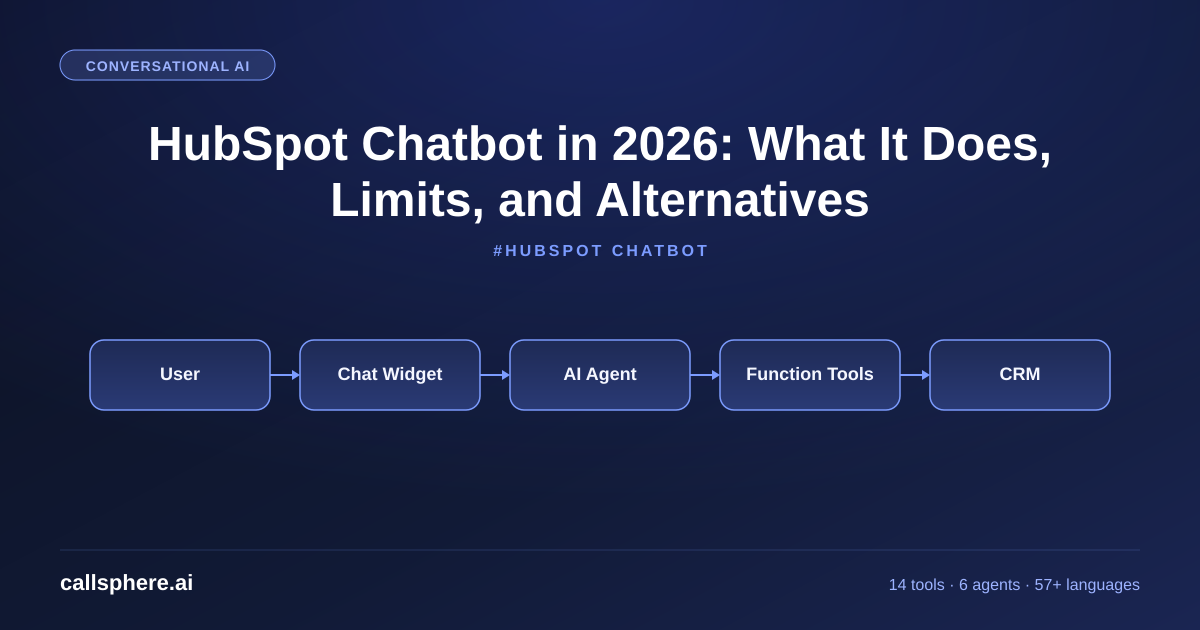
CallSphere ships a chat widget that drops into any HubSpot-tracked site. The AI chat agent uses the same GPT-Realtime-2 backend as our voice agents — 14 function tools, 20+ Postgres tables, pgvector RAG over your knowledge base, 57+ languages. The HubSpot integration pushes every conversation into the contact timeline, syncs deals when the agent qualifies a lead, books meetings on team calendars via the HubSpot Meetings API, and creates tickets when the agent escalates.
The architecture: customer message hits our Next.js API, GPT-Realtime-2 processes the turn with 128K context (full history plus retrieved snippets from your knowledge base), the response streams back at 700–900ms, and any function tool calls fire in parallel — HubSpot lookup, meeting booking, ticket creation, SMS send. The transcript lives in our database with PII redaction; a structured summary syncs to HubSpot.
See the CallSphere chat agent integrated with HubSpot →
Still reading? Stop comparing — try CallSphere live.
CallSphere ships complete AI voice agents per industry — 14 tools for healthcare, 10 agents for real estate, 4 specialists for salons. See how it actually handles a call before you book a demo.
A real example walk-through
A B2B SaaS company doing $8M ARR was running HubSpot's native chatbot with 11 flow nodes. It qualified about 24% of inbound chats correctly and routed 31% of chats to live humans even when the answer was in the knowledge base. They switched the front door of their chat to CallSphere Growth at $499/mo while keeping HubSpot as the source of truth for contacts. The AI agent now resolves 86% of inbound chats fully, books qualified demos directly into the HubSpot Meetings round-robin, and pushes the full transcript to the HubSpot contact timeline. Their human chat team went from 4 reps to 1 (handling escalations only) and their qualified-pipeline rose 28%.
Pricing & how to try it
CallSphere pricing: Starter $149/mo (2,000 interactions), Growth $499/mo (10,000 interactions, most popular), Scale $1,499/mo (50,000 interactions). The 14-day free trial does not require a credit card. HubSpot integration is included on all tiers and takes 1–2 hours to configure during the 3–5 business day setup window.
Start your 14-day free trial →
Frequently asked questions
Is the HubSpot chatbot free? HubSpot's basic chatbot builder is included in the free CRM tier with limited features. The full chatbot builder (advanced flows, multiple bots, advanced routing) requires Marketing Hub Professional or Service Hub Professional, starting at $800–$900/mo. Breeze AI features sit in higher tiers. For "truly free" you get a basic FAQ deflection bot on the free plan and not much else.
Can the HubSpot chatbot builder handle complex sales qualification? Up to a point. The visual builder handles structured BANT-style qualification well — multi-choice questions, conditional routing, scoring. Where it breaks: open-ended discovery questions, complex disqualification logic, dynamic objection handling, and multi-language qualification. For complex sales qualification at scale, a dedicated AI sales agent platform like CallSphere outperforms the HubSpot native builder.
Does HubSpot's chatbot work in multiple languages? Breeze AI supports the major commercial languages (English, Spanish, French, German, Portuguese, etc.) but with shallower depth than dedicated AI platforms. CallSphere supports 57+ languages with natural accents, including Vietnamese, Tagalog, Arabic, Hindi, and many less common languages. For mid-market businesses with significant non-English chat volume, HubSpot's native solution is often not enough.
Should I use HubSpot's chatbot or a dedicated AI chat platform? Rule of thumb: under 500 chats/month and HubSpot-native operations, use HubSpot's native chatbot. Above that volume, with complex flows, or with multi-channel needs (chat + voice), use a dedicated platform like CallSphere and integrate with HubSpot via API. The integration is clean — every conversation still lives in HubSpot — but the AI depth is dramatically better.
Does CallSphere integrate with HubSpot's contact records and deals? Yes. CallSphere syncs contacts (create/update on every interaction), deals (push qualified leads to specific pipelines and stages), meetings (book directly into team round-robins), tickets (open on every escalation), and engagement records (every call and chat appears in the contact timeline). The integration uses HubSpot's standard private app API.
Can the HubSpot chatbot builder make custom function calls? Only via webhooks. The native builder does not have a function-calling primitive in the way modern AI agents do. You can fire a webhook to a custom endpoint and parse the response, but it is a workaround. CallSphere ships 14 function tools natively — calendar booking, CRM lookup, SMS send, payment link, ticket creation, escalation, lead scoring, and more — all callable inline by the AI without webhook glue.
Related reading
Try CallSphere AI Voice Agents
See how AI voice agents work for your industry. Live demo available -- no signup required.