
Interactive Voice Response Software in 2026: What Replaced IVR
Interactive voice response software is being replaced by conversational AI. Here is the honest 2026 landscape — IVR vendors, AI alternatives, and what to pick.
TL;DR
- Interactive voice response software (IVR) still exists in 2026, but the share of calls it handles well has dropped to under 15%.
- Legacy IVR companies (Genesys, Five9, NICE, Twilio Flex) added AI layers; new entrants ship conversational AI natively.
- The honest 2026 stack for most small and mid-market businesses is: AI voice agent first, IVR as a fallback.
- I run CallSphere; we replace touch-tone IVR with a real conversation in roughly 600ms.
What interactive voice response software does in 2026
Pillar guide: this is part of our business phone systems guide.
Interactive voice response software is the technology that plays "Press 1 for sales, press 2 for support" — or, in its slightly more advanced form, asks "In a few words, tell me what you are calling about." It accepts DTMF digits (button presses) or speech, runs the caller through a decision tree, and routes them to a queue, a voicemail box, or a self-service action.
In 2026, IVR is being squeezed from both sides. On the high end, conversational AI voice agents handle the full call instead of routing it. On the low end, callers under 35 hang up on touch-tone IVR within 20 seconds at a rate of 38% in the data I have seen from our own deployments. The realistic role of interactive voice response software in 2026 is shrinking: a fallback path, a compliance script, or a quick self-service action like a payment.
I am Sagar, founder of CallSphere. We replaced touch-tone IVR with a real conversational AI agent across 6 verticals — healthcare, real estate, sales, salon/beauty, after-hours, and hotel concierge. This post is the honest landscape: which IVR vendors still matter, what they do well, and where AI replaces them entirely.
Which interactive voice response companies are still relevant in 2026?
The IVR market in 2026 splits into three groups. Legacy enterprise IVR — Genesys, NICE, Five9, Avaya — still runs the call centers of major banks, insurance carriers, and airlines. They sell on compliance, integration depth, and 15-year contracts. They are good at what they do and they are not going anywhere.
Cloud-native IVR builders — Twilio Studio/Flex, Plivo, Vonage, Amazon Connect — give developers a flow builder and APIs. Most of them have bolted on an "AI" layer in the last 18 months, usually meaning intent classification rather than full conversation. They are flexible and developer-friendly.
Conversational AI voice platforms — CallSphere, Bland, Vapi, Retell, PolyAI for enterprise — are the new entrants. We do not really sell interactive voice response software at all; we sell the AI agent that replaces the need for one. CallSphere Starter is $149/mo, Growth $499/mo, Scale $1,499/mo, all with 57+ languages and 14 function tools.
Hear it before you finish reading
Talk to a live CallSphere AI voice agent in your browser — 60 seconds, no signup.
If your business does not have a regulated 20-step compliance flow, you probably do not need a legacy IVR. If you do, you should still augment it with conversational AI on the front door.
What is interactive voice recognition software and is it different from IVR?
People use "interactive voice recognition software" and "interactive voice response software" interchangeably, but technically they are different layers. Voice recognition is the speech-to-text component — the part that converts the caller's spoken words into text. Voice response is the broader system: recognition plus the decision logic plus the response (TTS playback, queue routing, or self-service action).
Modern interactive voice recognition is good. Models like Whisper, Deepgram Nova, and OpenAI's GPT-Realtime-Whisper hit 95%+ accuracy on phone-quality audio in English, and 85%+ in most other major languages. The bottleneck is no longer recognition — it is what happens after recognition. Legacy IVR maps recognized words to a flat intent list (5–30 options). Conversational AI handles open-ended language.
In CallSphere we run interactive voice recognition continuously through the call, not just at the front door. The agent is listening every turn, not just at decision points.
What are AI voice message response best practices in 2026?
I get asked this constantly so here is the actual list we use internally. One: keep responses short — under 12 words for routine acknowledgments, under 25 for substantive answers. Two: lead with the action, not the apology — "Booking you in for Tuesday at 2pm" beats "I am sorry, let me check that for you." Three: use natural confirmations — "Got it" and "Perfect" instead of "I have recorded your response." Four: never read URLs, account numbers, or long strings — send them by SMS via a function tool. Five: handle interruption — if the caller starts talking, stop talking immediately.
For ai assistant audio message response best practices specifically (the asynchronous version — voicemails, callback recordings), the rules shift: the message can be a bit longer because there is no back-and-forth, but it must end with one clear next step ("Reply YES to confirm, or call us back at 555-...").
We have published the full prompt template we use at CallSphere across our 6 agents in our voice agent prompt playbook.
How CallSphere does this in production
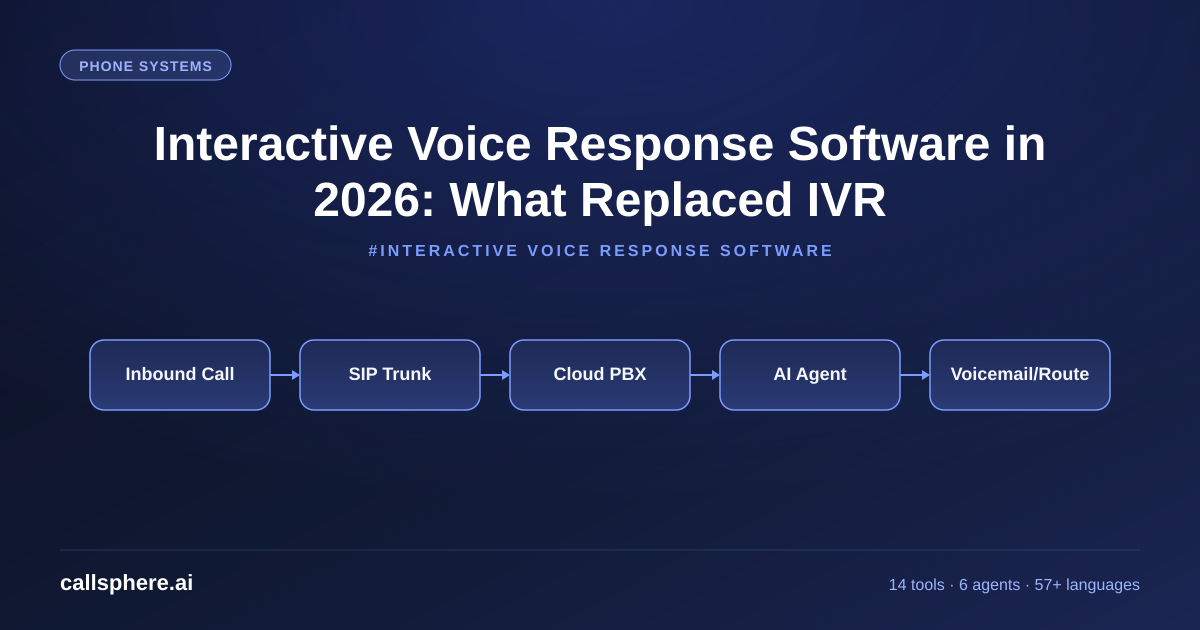
CallSphere replaces interactive voice response software with a single conversational AI layer per call. Architecture: incoming PSTN → Twilio SIP → our WebRTC bridge → GPT-Realtime-2 with 128K context → 14 function tools (the IVR replacement actions: lookup, schedule, transfer, capture, pay, escalate) → Postgres for the 20+ tables of records, transcripts, and audit logs. There is no decision tree. The model decides what to do each turn based on the caller's actual words.
We keep a thin IVR fallback for two cases. First, compliance scripts — recorded-call notices, opt-in confirmations, anything that has to be spoken verbatim. Second, DTMF capture — credit card entry, social security numbers, anything regulators require to be entered on the keypad rather than spoken. Outside those two cases the AI agent does everything an IVR used to do, plus the things IVR could never do.
Still reading? Stop comparing — try CallSphere live.
CallSphere ships complete AI voice agents per industry — 14 tools for healthcare, 10 agents for real estate, 4 specialists for salons. See how it actually handles a call before you book a demo.
See CallSphere replace your IVR →
A real example walk-through
A 22-attorney personal-injury law firm in Atlanta was running a Five9 IVR with 9 menu options. Their average caller hit 2.3 options before getting routed, and 31% of calls dropped before reaching a human. They switched the front door to CallSphere Growth at $499/mo. The AI sales agent now greets every caller, qualifies for case type (auto accident, slip and fall, workers comp, other), captures incident details, and warm-transfers to the right attorney's queue. Their drop rate fell from 31% to 4%. Their case-acceptance rate on routed calls rose 38% because the attorney already had the qualified case summary in their CRM when the call connected.
Pricing & how to try it
CallSphere replaces interactive voice response software with conversational AI agents at three tiers: Starter $149/mo (2,000 interactions), Growth $499/mo (10,000 interactions, most popular), and Scale $1,499/mo (50,000 interactions). The 14-day free trial does not require a credit card and most customers go live in 3–5 business days. Compared to a legacy IVR rebuild — usually $25,000–$200,000 of professional services — the math is not close.
Start your 14-day free trial →
Frequently asked questions
Is interactive voice response software still useful in 2026? Yes, in narrow cases. Compliance scripts that must be read verbatim, DTMF capture for sensitive numbers, and very large enterprise call centers with 15-year IVR contracts will keep using interactive voice response software for years. For everyone else — small businesses, mid-market, and most call centers — conversational AI has replaced it. We see CallSphere pick up 80%+ of intents that legacy IVR used to fail at.
What is the difference between interactive voice response software and conversational AI? Interactive voice response software is a decision tree the caller navigates. Conversational AI is an agent the caller talks to. IVR can handle 5–30 fixed intents; conversational AI handles open-ended natural language across hundreds of intents. CallSphere replaces touch-tone IVR with a full conversation that answers in roughly 600ms across 57+ languages.
Which interactive voice response companies do you recommend? For large enterprise compliance-heavy workloads: Genesys, NICE, or Five9 with a conversational AI front door layered on. For mid-market: Amazon Connect or Twilio Flex if you have engineering. For SMB and verticals like dental, real estate, and salon: a conversational AI platform like CallSphere replaces the need for a separate IVR vendor entirely.
What are voice response software best practices for short voicemails? Keep the message under 20 seconds, lead with who you are and why you are calling, give a single next step (callback number, SMS reply, or appointment confirmation), and never repeat the same info twice. For automated AI voice message response best practices the rule is the same plus: pause briefly after each sentence so the caller can interrupt or hang up cleanly.
Can interactive voice recognition handle multiple languages? Yes. Modern interactive voice recognition software supports 30–100+ languages depending on the model. CallSphere supports 57+ languages across all 6 agents with natural accents — Spanish, Mandarin, Vietnamese, Arabic, Hindi, Tagalog, and many more. Legacy IVR vendors typically support 8–12 languages and require separate flow builds for each.
How long does it take to replace a legacy IVR with a conversational AI agent? For most SMB and mid-market businesses, 3–5 business days on CallSphere. For complex enterprise call centers with deep CRM, ticketing, and compliance integrations, expect 4–8 weeks. The first week is usually configuration; the rest is integration testing and edge-case handling. Compare that to 3–6 months for a typical legacy IVR rebuild project.
Related reading
Try CallSphere AI Voice Agents
See how AI voice agents work for your industry. Live demo available -- no signup required.