
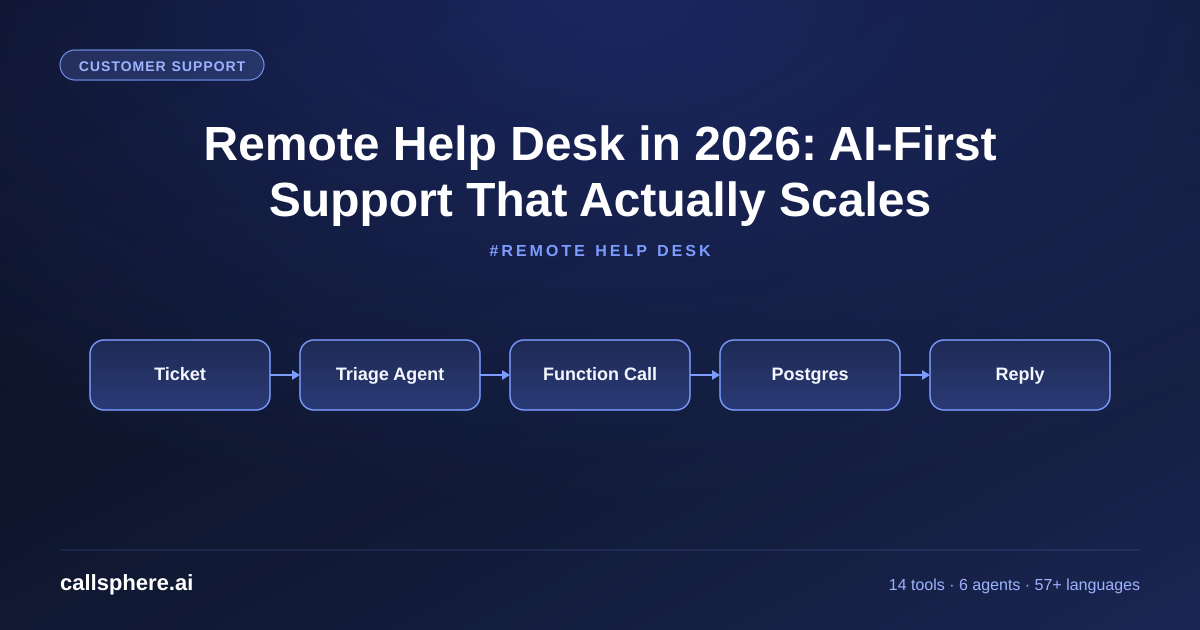
Remote Help Desk in 2026: AI-First Support That Actually Scales
Remote help desk in 2026 means AI handling tier-1 tickets, remote humans handling escalations, and a unified inbox across voice, chat, and email.
TL;DR
- Remote help desk in 2026 is an AI-first front line with remote humans handling escalations and complex cases.
- The right architecture cuts ticket cost by 60-80% versus traditional outsourced help desk.
- AI handles password resets, status checks, and routine tickets in under a minute.
- CallSphere ships a help-desk-ready agent across voice, chat, SMS, and email. Starts at $149/mo.
This is part of our customer-service-representative guide.
What a remote help desk looks like in 2026
A remote help desk in 2026 (880 searches/mo) is a distributed customer or IT support operation with no physical contact center. The architecture has three layers:
- AI front line: takes the first contact across voice, chat, email, and ticket. Resolves tier-1 issues.
- Remote human escalation team: handles the 20-30% of contacts that need judgment, empathy, or complex troubleshooting.
- Optional outsourced overflow: covers peak volume and after-hours.
I run CallSphere. We deploy this stack across our 6 verticals (healthcare, real estate, sales, salon, after-hours, hotel) and the IT-helpdesk variant is one of the most common use cases. The math is straightforward: AI deflects 60-80% of tickets, remote humans handle the rest, and total cost per ticket drops from $8-$15 (traditional outsourced) to $1-$4 (AI-first hybrid).
Why traditional help desk models are losing share
Three structural issues with the legacy help desk model:
- Cost per ticket. A traditional outsourced help desk runs $8-$15 per ticket fully loaded. AI handles the same tier-1 ticket for $0.20-$1.00 in model spend.
- Time-to-resolution. AI agents resolve tier-1 tickets in under 2 minutes. Traditional help desk averages 12-25 minutes wait + 8 minutes handle time.
- Coverage. A 9-to-5 help desk leaves 60% of the week uncovered. AI runs 24/7 with no marginal cost for off-hours.
The trade is that AI does not handle every ticket. The 20-30% of contacts that need a human still need a human. The remote help desk model is the hybrid that wins on cost, speed, and coverage.
How CallSphere does this in production
A CallSphere remote help desk deployment is concrete:
Hear it before you finish reading
Talk to a live CallSphere AI voice agent in your browser — 60 seconds, no signup.
- One AI agent (typically the after-hours/escalation agent, tuned for IT-helpdesk) takes all inbound contacts.
- The agent runs across voice (sub-second answer), chat widget (on your support site), email (parsed into structured intent), and SMS.
- 14 function tools wire the agent into your stack: ticket creation (Jira, Zendesk, Linear), password reset (Okta, JumpCloud), status check (Statuspage), knowledge search (pgvector RAG over your docs), transfer-to-human, calendar booking for tech callbacks.
- Every interaction logs to one of 20+ Postgres tables with transcript and outcome.
- 57+ languages with natural accents. Global teams get language coverage out of the box.
Setup is 3 to 5 business days. The agent typically deflects 60-80% of tier-1 tickets in the first month.
A real example walk-through
A SaaS company with ~9,000 customers ran a remote help desk staffed by 6 contractors in two time zones. They handled roughly 3,400 tickets a month, with average resolution time of 18 hours and CSAT of 78%. We deployed CallSphere's helpdesk-tuned agent on Growth at $499/mo.
Within 60 days:
- 71% of tickets resolved without a human (password resets, billing questions, status checks, "where is my report" questions).
- Average resolution time on AI-handled tickets: 2 minutes.
- Average resolution time on human-escalated tickets dropped from 18 hours to 4 hours (because tier-1 was handled and the human only saw real issues).
- CSAT rose to 91%.
- They reduced contractor headcount from 6 to 3 through normal attrition; total help desk cost dropped roughly 55%.
This is what a remote help desk looks like in 2026.
Try the remote help desk agent free for 14 days.
Pricing & how to try it
CallSphere remote help desk is available on all plans:
- Starter: $149/mo, 2,000 interactions, 1 agent, single channel
- Growth: $499/mo, 10,000 interactions, multi-channel, 14 function tools (most common for SMB help desks)
- Scale: $1,499/mo, 50,000 interactions, dedicated infra, BAA on request
The 14-day free trial does not need a credit card. Annual plans save roughly 15%.
Still reading? Stop comparing — try CallSphere live.
CallSphere ships complete AI voice agents per industry — 14 tools for healthcare, 10 agents for real estate, 4 specialists for salons. See how it actually handles a call before you book a demo.
Frequently asked questions
What is a remote help desk? A remote help desk is a distributed customer or IT support operation with no physical contact center. Support staff (humans, AI agents, or both) work from anywhere and handle inbound contacts across voice, chat, email, and ticket queues. In 2026, the typical remote help desk is AI-first, with humans handling escalations.
How does AI fit in a remote help desk? AI handles tier-1 tickets: password resets, status checks, billing questions, routine troubleshooting. The AI agent takes the contact, resolves what it can, and escalates the rest with full context. Typical deflection rate is 60-80% of tickets in the first month. Cost per AI-handled ticket is $0.20-$1.00 versus $8-$15 for traditional outsourced help desk.
Can a remote help desk handle 24/7 support? Yes, and AI is what makes 24/7 affordable. A traditional 24/7 help desk needs 3-shift coverage, which is expensive at any volume. AI runs 24/7 at zero marginal cost. Humans staff a single primary time zone and handle escalations during business hours; the AI covers everything else.
What tools should a remote help desk agent integrate with? Ticketing (Jira, Zendesk, Linear, Freshdesk), identity (Okta, JumpCloud, Azure AD), status pages (Statuspage, Status.io), knowledge base (Notion, Confluence, Document360), and CRM (Salesforce, HubSpot). CallSphere ships 14 function tools that cover all these categories.
How much does a remote help desk cost in 2026? Traditional outsourced remote help desk: $1,500-$8,000/mo per FTE depending on geography and skill. AI-first remote help desk: $149-$1,499/mo for the AI plus 2-4 part-time human escalation specialists. Total cost is typically 50-75% lower than the traditional model at the same volume.
Is remote help desk less reliable than a physical contact center? No, often the opposite. Physical contact centers have single points of failure (power, internet, weather, lockouts). Remote help desks with AI front lines have higher uptime because the AI is in cloud infrastructure with 99.95-99.99% SLA, and human staff are distributed.
What is the difference between remote help desk and remote customer service? "Remote help desk" usually implies IT support or technical product support. "Remote customer service" is broader, covering any customer-facing support function. The architectures are very similar in 2026: AI front line, remote human escalations, optional outsourced overflow.
Related reading
Try CallSphere AI Voice Agents
See how AI voice agents work for your industry. Live demo available -- no signup required.