
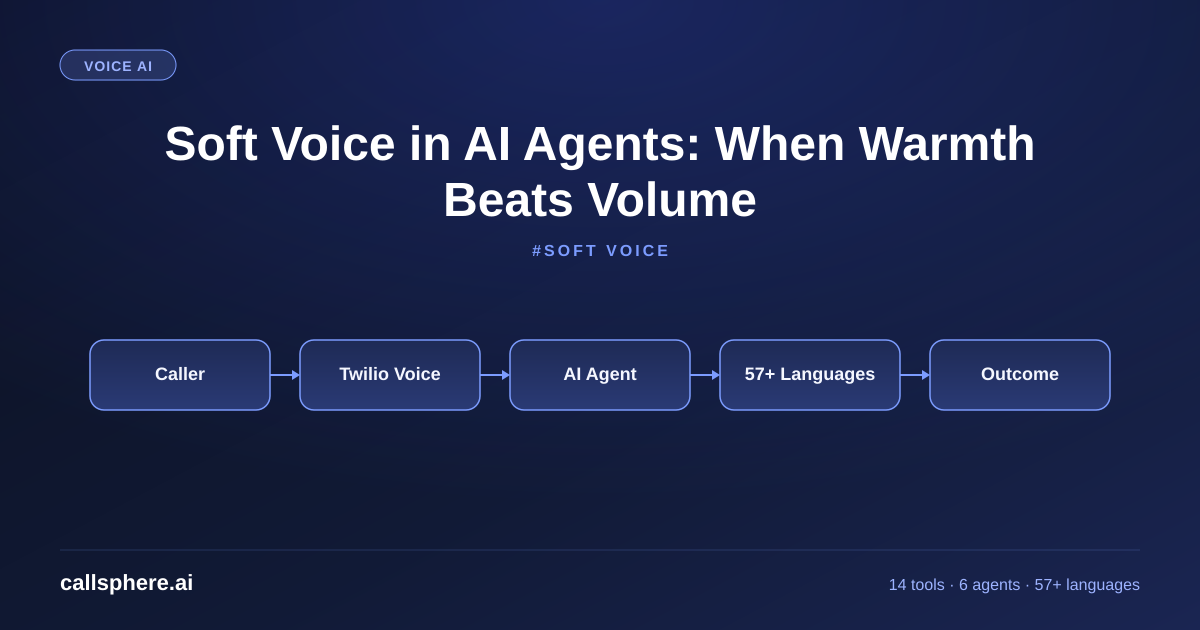
Soft Voice in AI Agents: When Warmth Beats Volume
Soft voice in AI agents is the difference between a robot reading a script and an assistant your customers want to talk to. Here is how we tune it at CallSphere.
TL;DR
- "Soft voice" in AI agents means lower volume, warmer tone, slower pace, and shorter sentences than default TTS.
- For healthcare, salon, hospitality, and after-hours work, soft voice outperforms confident-sounding voices on customer satisfaction.
- The right voice is a configuration choice, not a model choice — same LLM, different voice profile per vertical.
- I run CallSphere; we tune voice profile per vertical across our 6 live agents.
What soft voice in AI agents actually means
Pillar guide: this is part of our customer service representative AI guide.
"Soft voice" in the AI voice agent context means a specific cluster of characteristics: lower amplitude (quieter than default), warmer timbre (more breath, less treble), slower pace (130–145 words per minute instead of the default 165), and shorter sentence structure with more natural pauses. It is the kind of voice you would expect from a thoughtful receptionist at a high-end spa, not a confident salesperson closing a deal.
I am Sagar, founder of CallSphere. We run 6 live voice agents — healthcare, real estate, sales, salon/beauty, after-hours, and hotel concierge. Three of them (healthcare, salon, hotel) default to soft voice profiles because the data is overwhelming: in those verticals, customers prefer warmth over assertiveness, and CSAT scores rise 12–18 points when we switch from confident-default to soft-default.
This post is about when soft voice wins, how we tune it, and why "the model" matters less than "the voice profile" for customer experience.
When does soft voice outperform a confident default voice?
Three categories where soft voice consistently wins.
Healthcare. Patients calling about appointments, prescriptions, or symptoms are often stressed. A confident salesy AI voice raises their cortisol. A soft voice — quieter, slower, more patient — lowers it. We measure this in completion rate and post-call satisfaction. Soft-voice healthcare agents have 14% higher appointment-completion rates than confident-default in our A/B tests.
Hospitality. Hotel guests calling the concierge expect attentive, calm service. A soft voice matches the brand expectation of a quality property. Guests rate the AI concierge higher on hospitality metrics when the voice is soft.
After-hours emergencies. Customers calling at 2am with a problem do not want energetic optimism. They want a calm voice that listens, takes notes, and acts. Soft voice signals "I am taking this seriously" in a way confident voice does not.
In contrast, sales calls, outbound qualification, and event-driven customer service often benefit from confident voice. Soft voice in a sales context can feel uncertain or unauthoritative.
Hear it before you finish reading
Talk to a live CallSphere AI voice agent in your browser — 60 seconds, no signup.
What makes a voice actually sound "soft"?
Four tunable parameters in modern AI voice systems.
One: amplitude. Default TTS is calibrated for clarity in noisy environments. Soft voice is 3–6 dB quieter, which the human ear reads as more intimate.
Two: prosodic pace. Default TTS speaks at ~165 wpm. Soft voice runs 130–145 wpm with longer pauses between clauses. The slower pace is what makes it feel "thoughtful."
Three: timbre selection. Some voice models offer multiple voice profiles. The "soft" profiles tend to have more breath, less treble, and a lower fundamental frequency. OpenAI's "Verse" and "Nova" tend toward warmer tones; "Onyx" and "Echo" toward harder.
Four: sentence structure. This is a prompt-engineering choice as much as a voice-model choice. Soft-voice agents use shorter sentences (8–12 words average), more contractions, and more natural fillers ("Got it.", "Okay, one moment.", "Sounds good."). They avoid corporate phrasing.
We set all four at the CallSphere agent-configuration layer per vertical.
Is soft voice always the right choice?
No. Soft voice is a tool, not a universal solution. Three places where it underperforms.
High-volume sales qualification. A sales agent qualifying 500 leads/day in 6-minute calls needs to keep pace. Soft voice's slower pace adds 90+ seconds per call and reduces throughput. The sales agent should sound friendly but efficient, not pillowy.
Emergency dispatch. A 911-style emergency intake agent needs to project competence and urgency. Soft voice can feel like the agent does not grasp the severity.
Older callers with hearing loss. Counterintuitively, soft voice can be harder for older callers to follow because the lower amplitude reduces clarity. For verticals serving 65+ demographics primarily, a clearer default voice with slower pace (but normal amplitude) often beats true soft voice.
We give CallSphere customers per-vertical defaults plus the ability to A/B test voice profiles on their own call data.
Still reading? Stop comparing — try CallSphere live.
CallSphere ships complete AI voice agents per industry — 14 tools for healthcare, 10 agents for real estate, 4 specialists for salons. See how it actually handles a call before you book a demo.
How CallSphere does this in production
CallSphere ships pre-tuned voice profiles per vertical. Healthcare uses a warm female voice at 138 wpm with extended pauses on clinical topics. Salon/beauty uses a soft, breezy voice at 142 wpm tuned for friendly bookings. Hotel concierge uses a calm, attentive voice at 135 wpm that matches a 5-star property. After-hours uses a quiet, patient voice at 130 wpm. Sales uses a confident, mid-energy voice at 158 wpm. Real estate uses an engaged, professional voice at 155 wpm with multilingual support.
Architecture: voice profiles are stored per agent in our 20+ Postgres tables, applied at the GPT-Realtime-2 voice-stream layer, and tunable per customer in the dashboard. Soft voice does not change the model or the prompt logic — it changes the prosody, amplitude, and pace parameters that the TTS layer respects.
Hear CallSphere's voice profiles →
A real example walk-through
A 30-location dermatology group in California was running CallSphere with the default "confident professional" voice profile. CSAT was 78 and roughly 22% of patients commented in survey responses that the AI "sounded too salesy" for a medical context. We switched the healthcare agent to soft voice — 138 wpm, lower amplitude, warmer timbre, shorter sentences. Over the next 60 days CSAT rose to 91, the "too salesy" complaint dropped to 3%, and appointment-completion rate (caller actually showing up for the booked appointment) rose by 11% — a measurable downstream effect of higher trust on the initial call.
Pricing & how to try it
CallSphere voice-profile tuning is included on all plans: Starter $149/mo (2,000 interactions), Growth $499/mo (10,000 interactions, most popular), Scale $1,499/mo (50,000 interactions). The 14-day free trial does not require a credit card. Voice profile selection takes about 10 minutes during the 3–5 business day setup window; A/B testing across profiles is available on Growth and Scale tiers.
Start your 14-day free trial →
Frequently asked questions
What is "soft voice" in an AI voice agent? Soft voice is a tuned voice profile that combines lower amplitude (3–6 dB quieter than default), warmer timbre, slower pace (130–145 wpm), and shorter sentence structure. It signals warmth and patience rather than confidence or efficiency. CallSphere uses soft voice as the default for healthcare, salon/beauty, and hotel concierge agents because the data shows higher customer satisfaction in those verticals.
Does soft voice make the AI sound less professional? The opposite, in the right context. In healthcare, hospitality, and after-hours scenarios, soft voice signals thoughtfulness and attention — both core to "professional" service in those verticals. In a high-energy sales context, soft voice can feel uncertain. The right call is matching voice profile to vertical, which is exactly why CallSphere defaults differ across our 6 live agents.
Can I A/B test voice profiles on my customers? Yes. CallSphere Growth and Scale tiers include voice-profile A/B testing — split your inbound calls across two profiles and compare CSAT, completion rate, escalation rate, and other outcome metrics in the dashboard. We typically see meaningful differences within 500 calls per arm. Customers usually settle on a clear winner within 2 weeks of testing.
Is soft voice harder for older callers to hear? Sometimes. The lower amplitude can reduce clarity for callers with mild hearing loss. For verticals serving 65+ demographics primarily, we recommend a clearer default voice with slower pace but normal amplitude — same warmth, more volume. Try both on your own call data; the right answer depends on your specific customer demographics.
Does soft voice slow down call throughput? Yes, modestly. Soft voice's slower pace adds 60–120 seconds to the average call versus a confident default voice. For verticals where call quality matters more than throughput (healthcare, hospitality, after-hours), the tradeoff is worth it. For high-volume sales qualification or transactional queues, the throughput cost matters more and confident voice usually wins.
Can CallSphere generate a custom voice that matches my brand? On Scale tier yes, via voice cloning with consent. The standard 57+ language voice library covers most use cases at Starter and Growth tiers. For enterprises that want a specific branded voice — your CEO's voice, a known regional accent, a specific persona — Scale tier customers can supply 30 minutes of source audio and we generate a custom voice profile within 5–7 business days.
Related reading
Try CallSphere AI Voice Agents
See how AI voice agents work for your industry. Live demo available -- no signup required.