
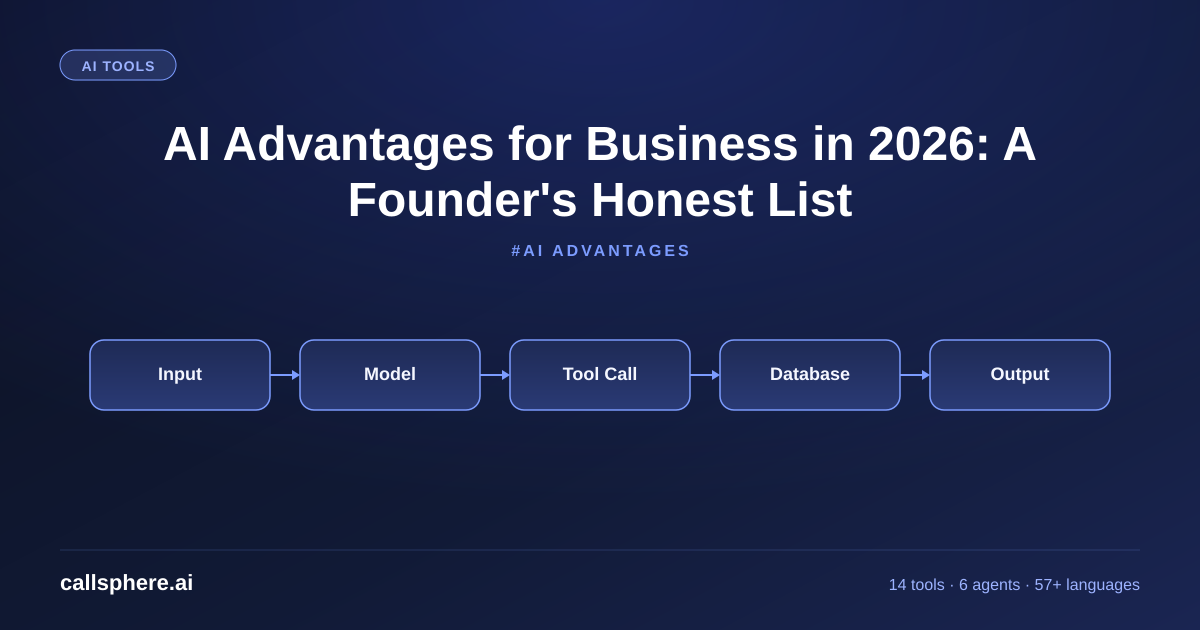
AI Advantages for Business in 2026: A Founder's Honest List
AI advantages for business in 2026 are real but specific. Here is the honest list — cost, speed, languages, scale — with the math and the caveats.
TL;DR
- AI advantages for business in 2026 are real but specific — and exaggerated in marketing.
- Concrete wins: 24/7 coverage, 57+ language support, 80–95% per-call cost reduction, sub-second response.
- Honest caveats: integration time, escalation rates, prompt drift, data governance.
- I built CallSphere to deliver these advantages in 3–5 business days for 6 verticals.
This is part of our AI Business Solutions pillar guide.
The real AI advantages for business in 2026
AI advantages for business in 2026 are not "10x productivity" or "AGI is here." They are specific, measurable, and bounded. Here is the honest list, from a founder who ships AI for a living:
- 24/7 coverage at near-zero marginal cost. AI agents take calls and chats at 3am for $0.05–$0.15 per interaction. A human team running 24/7 costs $40k+/mo at minimum.
- Instant response time. Sub-second on voice and chat, vs 30+ seconds for the average human-staffed support queue.
- Multilingual support without proportional hiring. CallSphere ships 57+ languages with natural accents. Hiring 57 language specialists is impossible for most businesses; the AI is one switch.
- Linear scale. Going from 100 calls/day to 10,000 calls/day requires no additional hiring — just a pricing tier change.
- Consistent quality. AI agents do not have bad days, do not get distracted, and follow the prompt every time.
- Measurable performance. Every call has a transcript, every transcript is queryable, every prompt change is versioned.
Those are the six concrete advantages. Everything else in AI marketing is either downstream of these six or speculative.
Where AI does not have an advantage (yet)
Three categories where AI is still behind humans in 2026:
- Truly novel judgment. Complex political, ethical, or relationship-laden decisions still need humans.
- Trust-establishing first contact. For high-stakes deals (legal, M&A, enterprise sales), early conversations work better human-to-human.
- Edge cases in regulated industries. Healthcare clinical advice, legal counsel, financial planning — AI assists, humans decide.
The right way to think about it: AI handles the high-volume, repeatable 70–85% of the work; humans handle the judgment-heavy 15–30%. Trying to push that ratio further in either direction usually hurts.
What are the cost advantages of AI in business?
The biggest, most-measurable advantage. Concrete numbers I see across CallSphere's book of business:
- Per-call cost drops from $1.50–$3.00 (human answering service) to $0.05–$0.15 (AI agent). Savings: 80–95%.
- 24/7 staffing cost drops from $40k+/mo (3 human shifts) to $149–$1,499/mo (CallSphere tier).
- Multilingual support cost drops from $5k–$20k/mo per language (hiring specialists) to $0 incremental (already included).
- Time-to-launch drops from 4–12 weeks (hiring, training) to 3–5 business days (configure and go live).
These are not theoretical numbers. They are line items on our customers' invoices. The math is brutal for legacy answering services and call centers, which is why the category is consolidating.
Hear it before you finish reading
Talk to a live CallSphere AI voice agent in your browser — 60 seconds, no signup.
How CallSphere does this in production
CallSphere is a managed AI voice and chat agent platform built to deliver these advantages without an engineering team:
- 6 live verticals — healthcare, real estate, sales, salon, after-hours, hotel.
- ~14 function tools wired to common business systems — appointment booking, CRM lookup, payment hand-off, ticket creation, SMS triggers, calendar reads, escalation routing, address verification, insurance lookup, lead scoring, callback scheduling, language detection, transcript redaction, ticket dispatch.
- 20+ Postgres tables for persistent state.
- 57+ languages with natural accents.
- GPT-Realtime-2 (128K context) with prompt caching for sub-second response.
- WebRTC + SIP/VoIP for real telephony.
- 3–5 business day deployment.
The "advantage" we sell is not the AI — it is the time you do not spend wiring it up. Building the same surface from raw OpenAI APIs would take a 2-engineer team 4–6 months. We did the building so customers do not have to.
A real example walk-through
A 6-location regional veterinary chain was running a $7,200/mo human answering service for after-hours and overflow. The service answered in 42 seconds on average, abandoned 19% of calls, and could only handle English.
The chain switched to CallSphere Growth ($499/mo) in 4 business days. Configured the healthcare agent for veterinary intake (verifying pet owner, looking up pet records, booking appointments, escalating urgent symptoms to the on-call vet).
Month one results:
- 24/7 coverage at $499/mo vs $7,200/mo — 93% cost reduction.
- Average response time: 600ms vs 42 seconds.
- Abandon rate: 4.8% vs 19%.
- Multilingual: Spanish support added (about 28% of the patient base in this market).
- Net savings: $6,701/mo, plus a 14-point abandon-rate improvement.
That is the typical pattern. The cost advantage is the biggest single line item, but the response-time and multilingual lifts add their own revenue impact.
Pricing and how to try it
CallSphere pricing to capture these AI advantages for your business:
- Starter — $149/mo, 2,000 interactions. Solo practices and small shops.
- Growth — $499/mo, 10,000 interactions. Multi-location SMB.
- Scale — $1,499/mo, 50,000 interactions. Mid-market.
- Free trial — 14 days, no card. Annual saves ~15%.
The 14-day trial is the fastest way to measure the AI advantage against your actual call data. Most customers see meaningful savings within the first week.
Still reading? Stop comparing — try CallSphere live.
CallSphere ships complete AI voice agents per industry — 14 tools for healthcare, 10 agents for real estate, 4 specialists for salons. See how it actually handles a call before you book a demo.
Start your 14-day free trial →
Frequently asked questions
What are the biggest AI advantages for small business in 2026? The biggest AI advantages for small business in 2026 are 24/7 coverage, sub-second response time, 57+ language support, and 80–95% per-interaction cost reduction compared to human-staffed equivalents. For a small business doing 1,000–2,000 calls/mo, switching from a human answering service to CallSphere Starter ($149/mo) typically saves $1,500–$5,000/mo on phone operations alone.
Is AI actually cheaper than hiring more people? For high-volume, repeatable work — yes, by a wide margin. AI handles inbound calls at $0.05–$0.15 per interaction; human-staffed equivalents are $1.50–$3.00. For judgment-heavy work where each task is unique — no, not yet. The right model is hybrid: AI for the volume, humans for the edge cases. Most companies under-allocate to AI and over-allocate to humans on the volume side.
How does AI scale compared to hiring? Linearly with zero hiring overhead. Going from 100 calls/day to 10,000 calls/day on CallSphere is a pricing tier change — Starter to Growth to Scale. Going from 100 calls/day to 10,000 calls/day with humans requires hiring 30–50 people, 3–6 months of training, and 6–12 months of management overhead. The scaling advantage is the second-biggest after pure cost.
What are the response time advantages of AI? AI agents respond in 600ms or less on voice and under 1 second on chat. Human-staffed phone queues average 30+ seconds to answer, and human chat typically lags by minutes. For high-stakes inbound (urgent customer issues, sales leads in active research), response time is directly linked to conversion. Cutting from 30s to under 1s typically lifts conversion 15–25 points on outbound-initiated channels and reduces abandonment by 60–80% on inbound.
Can AI really speak 57+ languages well? Yes, in 2026. CallSphere ships 57+ languages with natural conversational quality on voice, chat, SMS, and WhatsApp. The underlying models (GPT-Realtime-2 and its translation siblings) handle high-resource languages (English, Spanish, French, German, Mandarin, Hindi, Arabic) at near-native quality. Lower-resource languages are good but not perfect — test on your actual call data before depending on a niche language for high-stakes use.
What are the data governance advantages of AI? Every AI interaction generates a transcript, which is queryable, analyzable, and exportable. Every prompt change is versioned. Every escalation is logged. This is a major upgrade over human-staffed support, where call quality is sampled rather than universally measured. The caveat is data scope — be explicit about what the AI sees, what it logs, and what is in BAA or other regulatory scope.
Where does AI still fall short in business? Three places: novel judgment, trust-establishing first contact for high-stakes deals, and edge cases in regulated industries. AI does not replace humans for nuanced political work, executive coaching, complex M&A negotiation, or clinical diagnosis. The right pattern is AI handles the 70–85% repeatable work, humans handle the 15–30% judgment-heavy work. Trying to push past this ratio usually hurts.
How fast can I capture AI advantages in my business? On a managed platform like CallSphere: 3–5 business days to live customer calls. On a self-built stack from raw model APIs: 4–6 months for a 2-engineer team. The "managed vs build" decision is the biggest factor in time-to-value. For most small and mid-size businesses, managed wins because the integration work is the slow part, not the AI itself.
Related reading
Try CallSphere AI Voice Agents
See how AI voice agents work for your industry. Live demo available -- no signup required.