
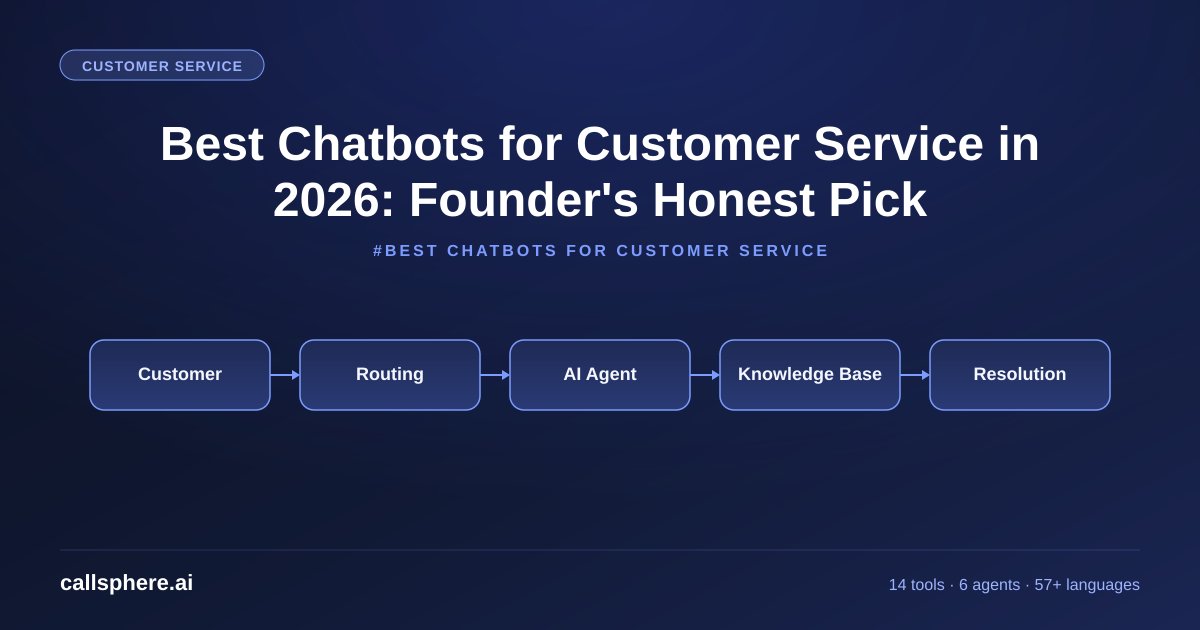
Best Chatbots for Customer Service in 2026: Founder's Honest Pick
I built one. Here are the best chatbots for customer service in 2026 — what they actually ship, how they price, and how to pick across channels.
TL;DR
- The best chatbots for customer service in 2026 are real AI agents — not 2018-style decision-tree bots.
- Top picks by use case: CallSphere (voice + chat, 6 verticals), Decagon (mid-market chat), Intercom Fin (existing Intercom shops), Sierra (enterprise CX).
- Pick on resolution rate, language coverage, and per-interaction cost. Ignore the bot-builder UI.
- Setup is 3–5 days for CallSphere, 4–8 weeks for enterprise platforms.
This is part of our Build Your Own Generative AI Chatbot pillar guide.
What the best chatbots for customer service look like in 2026
The best chatbots for customer service in 2026 are LLM-driven agents that resolve customer issues end-to-end, not menu-tree bots that route to a human after three questions. The distinction matters because "chatbot" still evokes the bad 2018 experience for many buyers.
A modern customer service chatbot:
- Understands intent in natural language across 50+ languages.
- Calls tools to look up orders, accounts, tickets, and inventory.
- Resolves the issue end-to-end in 65–85% of conversations.
- Escalates with full context for the remaining 15–35%.
- Writes back to the CRM so the human picks up where the bot left off.
CallSphere is in this category. So are Decagon, Sierra, Intercom Fin, and a handful of others. The dividing line between "modern" and "legacy" is whether the bot can actually take action on your systems, not just answer FAQs.
Why "chat with customer service" expectations have changed
In 2024, the typical "chat with customer service" experience was a chatbot that asked 3 menu-driven questions, gave up, and routed to a human in 12 minutes. By 2026, customer expectations are:
- Instant response. Sub-second on text, sub-1-second on voice.
- Issue resolution on the first contact. Not just "I'll route you."
- Memory across channels. If I started in chat yesterday, the bot should know.
- Language match. I should be able to chat in my language, not yours.
A best chat application for customer service in 2026 hits all four. Most legacy "chatbots" hit one or two. This is why customer satisfaction with AI customer service is now higher than with human-only support in several published benchmarks — the AI is faster, more consistent, and resolves more.
What is the best chat application for customer support across channels?
Channel mix matters more than you think. The best chat application for your customer support depends on where your customers actually reach you:
Hear it before you finish reading
Talk to a live CallSphere AI voice agent in your browser — 60 seconds, no signup.
- Web chat only — Decagon, Intercom Fin, Ada are all credible.
- WhatsApp + SMS + web chat — CallSphere covers all three plus voice on one platform.
- Voice-heavy + chat — CallSphere or Sierra (Sierra is enterprise-only).
- In-app chat in a mobile app — Intercom or a custom integration on a horizontal AI agent platform.
- Multi-language priority — CallSphere (57+ languages) leads.
The mistake to avoid: picking a chat-only vendor and then realizing 40% of your customer service volume is voice. You will end up running two vendors and two prompt sets, which costs more and produces worse handoffs.
Why "ChatGPT customer service phone number" keeps trending
The search "chat gpt customer service phone number" gets ~210 monthly searches. Here is the honest answer: OpenAI does not publish a customer service phone number for ChatGPT consumer users. Support is via help.openai.com for chat-based tickets.
For ChatGPT Enterprise, support is via dedicated account managers, not a public phone number. The interesting tangent is that customers want to talk to AI for their own customer service — they want a phone number that AI answers, which is exactly what CallSphere ships. We assign a phone number, our AI answers, and customers get the voice experience they were looking for from OpenAI.
If you are a business trying to give your customers an AI phone number to call, CallSphere is purpose-built for that. Pick a vertical, port a number (or use ours), and you are live in 3–5 business days.
How CallSphere does this in production
CallSphere is a managed AI voice and chat agent platform. The chat surface specifically:
- Web chat widget that drops into any website via JS.
- WhatsApp integration via Meta Business API.
- SMS via direct carrier integration.
- 6 vertical agents — healthcare, real estate, sales, salon, after-hours, hotel.
- ~14 function tools — appointment booking, CRM lookup, payment hand-off, ticket creation, SMS triggers, calendar reads, escalation routing, address verification, insurance lookup, lead scoring, callback scheduling, language detection, transcript redaction, ticket dispatch.
- 57+ languages with natural conversational quality.
- 20+ Postgres tables for persistent customer state across channels and sessions.
- 3–5 business day deployment.
The same agent handles voice and chat — same prompt, same tools, same data. That means a customer who calls in the morning and chats in the afternoon gets continuity. Most chat-only vendors cannot offer that.
A real example walk-through
A 22-location dental services organization (DSO) was running Intercom for web chat ($499/mo) and a separate human answering service for voice ($5,400/mo). The two had no shared state — a customer who started a chat would have to repeat everything when they called.
The DSO switched to CallSphere Growth ($499/mo) and decommissioned both:
Still reading? Stop comparing — try CallSphere live.
CallSphere ships complete AI voice agents per industry — 14 tools for healthcare, 10 agents for real estate, 4 specialists for salons. See how it actually handles a call before you book a demo.
- One agent handles web chat, WhatsApp (used by the Spanish-speaking patient base), SMS, and voice.
- Patient lookup, appointment booking, and insurance verification share the same tool registry across channels.
- A patient who starts a chat at 8pm and calls in the morning has full context preserved.
Month one: $5,400/mo savings, plus a 19-point lift in cross-channel CSAT scores. The DSO moved to Scale tier ($1,499/mo) in month four after expanding to 38 locations.
Pricing and how to try it
- Starter — $149/mo, 2,000 interactions, 1 agent.
- Growth — $499/mo, 10,000 interactions, all 6 agents, full multilingual, all channels.
- Scale — $1,499/mo, 50,000 interactions, HIPAA-friendly, custom integrations.
- Free trial — 14 days, no card. Annual saves ~15%.
Frequently asked questions
What are the best chatbots for customer service in 2026? The best chatbots for customer service in 2026 are AI agents that resolve issues end-to-end across channels. Top picks: CallSphere (voice + chat + SMS + WhatsApp, 6 verticals, 57+ languages, $149–$1,499/mo), Decagon (mid-market chat), Sierra (enterprise CX), Intercom Fin (Intercom shops), and Zendesk AI Agents (Zendesk shops). Pick based on your channel mix, vertical, and existing stack.
How do I let customers chat with customer service via AI? You need a customer service AI agent platform with a chat widget. The two-day version: pick a managed platform (CallSphere takes 3–5 business days), drop the JS widget on your site, configure your business hours and FAQ, and go live. The two-month version: build your own on LangGraph or OpenAI Agents SDK plus a custom UI. For most companies under 1M conversations per year, the managed path saves an order of magnitude on engineering time.
What is the best chat application for small business customer support? For small business (under 2,000 conversations/mo), CallSphere Starter at $149/mo includes chat, voice, and SMS in one product. The closest single-channel competitors are Intercom (web chat focused, more expensive at this volume) and Tidio (cheaper but less capable AI). For multilingual or voice-heavy use cases, CallSphere is the right pick.
Does CallSphere have a customer service phone number that AI answers? Yes — that is literally the product. You sign up, configure your agent, and we provision a phone number (or port your existing one). The CallSphere AI then answers calls to that number with sub-second response time in 57+ languages. This is exactly what people are searching for when they query "chat gpt customer service phone number" — they want AI on the phone, and that is what CallSphere ships.
How do modern customer service chatbots handle complex queries? Modern customer service chatbots in 2026 use LLMs with 128K context (CallSphere runs GPT-Realtime-2) and tool use (function calls to look up records, take actions). For complex queries, they decompose the request into steps, execute each, and synthesize the result. When a query exceeds the agent's scope, they escalate to a human with the full conversation history — not the legacy "let me transfer you" with no context.
What is the typical resolution rate for AI customer service chatbots? Across CallSphere's 6 verticals, our chat agents resolve 65–85% of customer service issues end-to-end without human escalation. Healthcare is at the lower end (more triage that requires clinical judgment). Retail and salon are at the higher end. The industry average across modern AI chatbots in 2026 is roughly 70% — well above the 25–40% range that legacy decision-tree chatbots achieved in 2022.
Can a chatbot replace human customer service entirely? For most small and mid-size businesses, no — and you should not try. The right model is AI-first with human escalation for the 15–35% of complex cases. The economics still favor a hybrid stack: AI handles the volume, humans handle the edge cases. Pure-human is too expensive; pure-AI misses too many edge cases.
How fast can I deploy a customer service chatbot? On a managed platform like CallSphere, 3–5 business days to live conversations. On Intercom Fin (if you already have Intercom), 1–2 weeks. On a custom build, 6–16 weeks. The longest variable is almost always CRM integration, not the bot itself.
Related reading
Try CallSphere AI Voice Agents
See how AI voice agents work for your industry. Live demo available -- no signup required.