
AI Business Solutions in 2026: A Founder's Practical Guide
AI business solutions in 2026 are not a category, they are a stack. Here is what actually works for SMB and mid-market, with real numbers and a 3-5 day path.
TL;DR
- AI business solutions in 2026 are not a single product, they are a stack: voice agents, chat agents, RAG, CRM integration, and observability.
- The best AI for business in 2026 is the one that ships in 3-5 business days and runs in your real workflows, not the one with the most demos.
- CallSphere ships 6 live AI agents, 14 function tools, and 57+ languages across voice, chat, SMS, and WhatsApp.
- Plans start at $149/mo Starter with a 14-day free trial, no card required.
What AI business solutions actually mean in 2026
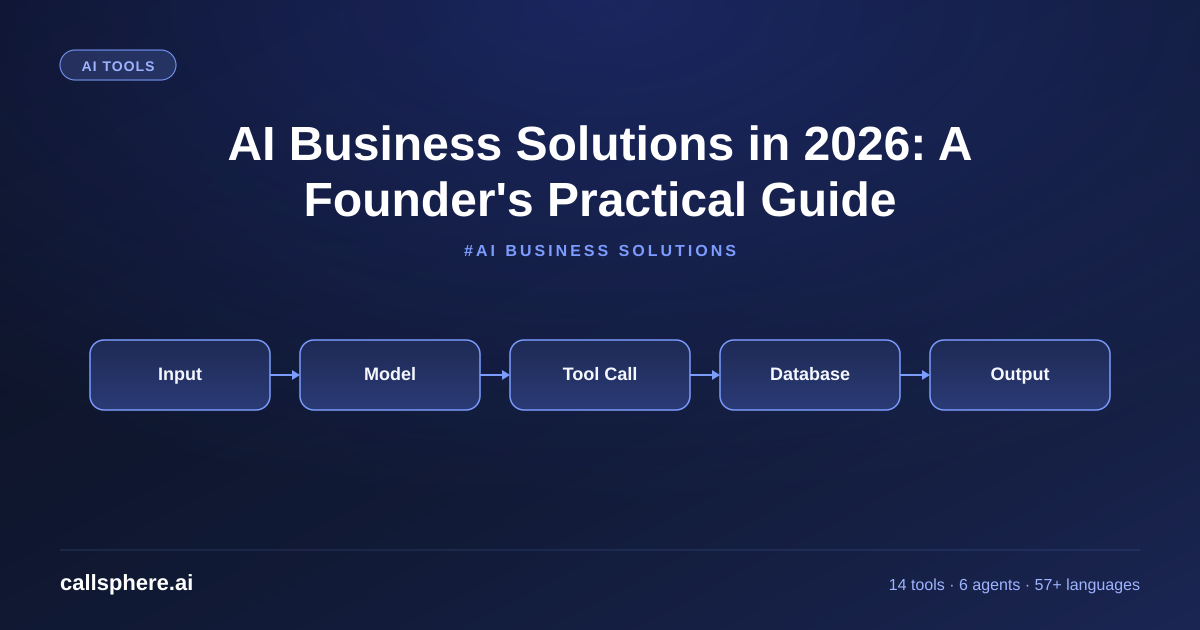
I run CallSphere, and "AI business solutions" is one of the lazier phrases in the 2026 vendor vocabulary. It usually means "we have an LLM and we will sell it to you." A real AI business solution in 2026 is a stack: an AI voice or chat agent that takes the contact, a tool registry of 8 to 14 functions that connects to your real systems (CRM, calendar, payments, ticketing), a memory layer that persists across sessions, RAG over your knowledge base, and observability so you can see what the agent is actually doing.
We built CallSphere as that stack. 6 live AI agents (healthcare, real estate, sales, salon, after-hours, hotel), 14 function tools, 20+ Postgres tables, 57+ languages, GPT-Realtime-2 with 128K context, pgvector RAG. The platform ships in 3 to 5 business days, which is the right unit of measure for "AI business solutions" in 2026. If a vendor cannot tell you the days-to-live number, they do not have a solution, they have a slide.
The right way to read the "AI business solutions" category is by the job it does in your business. Front-line customer contact (voice, chat, SMS, WhatsApp) is the highest-ROI cluster. Internal workflow automation (RAG over docs, agent-driven research) is second. Predictive analytics is a distant third for most SMB and mid-market companies. Pick the cluster with the most contact volume and start there.
What is the best AI for business in 2026?
The "best ai for business" query (1,000 a month) pulls a buyer who is overwhelmed. There is no single "best AI for business" because the right answer depends on what job you are hiring AI for. Three honest categories with concrete defaults:
- Customer contact: voice and chat agents with tool calls. CallSphere covers this across 6 verticals.
- Document workflows: RAG over knowledge bases, agent-driven research, internal copilot. Notion AI, Glean, and several open-source stacks cover this.
- General-purpose work: ChatGPT Enterprise, Claude for Work, Gemini for Workspace. Per-seat AI for white-collar productivity.
A typical SMB or mid-market deployment in 2026 uses all three categories: a CallSphere voice agent for the front line, Glean or similar for internal RAG, and ChatGPT or Claude on per-seat for general work. The mistake is buying a single "AI platform" and expecting it to do all three. The category does not work that way yet.
What are the real benefits of AI in business in 2026?
The "benefits of ai in business" keyword (480 a month) gets a lot of vague answers. Here is the concrete list, with numbers from our actual customer base:
- 24/7 availability on the front line. A CallSphere voice agent answers in 600ms at 3am the same as 3pm.
- 57+ language coverage without per-language hiring. A SMB serving a multilingual region instantly addresses 95% of inbound language mix.
- 3 to 5 business days time to value. Most legacy "digital transformation" programs do not deliver in that window.
- Cost compression on tier-1 contact. Our typical customer replaces $8K-$30K/mo in fully-loaded contact-center labor with $499-$1,499/mo in platform fees.
- Audit trails and observability that legacy contact centers did not have. Every interaction logs to 20+ Postgres tables with PII redaction.
- Deflection rates of 60-75% on tier-1 contacts within the first 30 days.
These are not "AI capabilities," they are operational outcomes. The benefits of AI in business in 2026 are measured in deflection rate, response latency, language count, and cost per contact, not in vague productivity gains.
Hear it before you finish reading
Talk to a live CallSphere AI voice agent in your browser — 60 seconds, no signup.
What does AI for business operations look like in practice?
"AI for business operations" (260 a month) and "using ai to enhance business operations" (170 a month) both ask the same question: where does AI actually plug into the daily work? Six concrete plug points we see across our customer base:
- Inbound phone: a CallSphere voice agent handles scheduling, qualification, FAQs, and routes complex calls to humans.
- Outbound sales: a sales agent qualifies leads from a CRM list, books demos, and drops structured notes into the CRM.
- After-hours coverage: an after-hours agent triages emergencies, escalates to on-call staff via SMS, and logs everything.
- Chat on the website: a chat widget powered by the same agent, with shared memory across channels.
- SMS and WhatsApp follow-up: the same agent sends confirmations, reminders, and follow-ups.
- Internal knowledge search: RAG over docs so reps and managers can find policy answers in 2 seconds, not 20 minutes.
The pattern is one agent across multiple channels with one memory layer, not one product per channel. That is what AI for business operations looks like when it is done right.
How CallSphere does this in production
A CallSphere deployment that functions as an AI business solution uses:
- One of 6 live agents (healthcare, real estate, sales, salon, after-hours, hotel) tuned for your vertical
- 14 function tools wired into your CRM, calendar, payments, and ticketing
- 20+ Postgres tables holding interactions, customers, transcripts, escalations, tool calls, and audit trails
- 57+ languages with natural accents for voice and chat
- GPT-Realtime-2 (128K context) for the conversation layer
- pgvector RAG over your company knowledge base
- WebRTC + SIP/VoIP for voice plus chat widget, SMS, and WhatsApp surfaces
- A dashboard with per-call cost, latency, deflection rate, and transcript review
Setup is 3 to 5 business days. The agent answers in roughly 600ms on voice. Deflection on tier-1 contacts averages 60-75% within 30 days.
A real example walk-through
A 40-person regional real estate brokerage in Texas had 5 receptionists handling roughly 2,600 inbound calls a month plus a separate chatbot vendor for the website. Their pain: after-hours leads bounced, weekend coverage was thin, and the Spanish-speaking 31% of their inbound traffic was always routed to one of two bilingual reps.
We deployed CallSphere's real estate voice agent in 4 business days. The agent handled lead qualification, property availability questions, showing scheduling, and language routing. The chat widget on their site got the same agent. SMS follow-up went out automatically. Within 45 days:
- After-hours lead capture went from ~12% to 89% (the agent answers 24/7)
- Spanish-language conversion went from 7% to 19% (the agent is natively bilingual)
- Two of five receptionist roles converted to inside-sales work; total receptionist headcount stayed at three
- The brokerage moved to Growth tier at $499/mo, replacing roughly $12,000/mo in receptionist labor and a $480/mo chatbot vendor
The point is not that AI replaces humans. The point is that AI business solutions, when they are real, change the unit economics of the front line.
Start your 14-day free trial, no card required.
Pricing & how to try it
CallSphere ships three plans:
Still reading? Stop comparing — try CallSphere live.
CallSphere ships complete AI voice agents per industry — 14 tools for healthcare, 10 agents for real estate, 4 specialists for salons. See how it actually handles a call before you book a demo.
- Starter: $149/mo, 2,000 interactions, voice + chat, single agent
- Growth: $499/mo, 10,000 interactions, multi-channel, 14 function tools (most popular)
- Scale: $1,499/mo, 50,000 interactions, dedicated infra, BAA on request
Annual billing saves roughly 15%. The 14-day free trial does not require a credit card. Setup is 3 to 5 business days.
See the full pricing breakdown.
Topics covered in depth
- Best AI for business in 2026 by use case
- AI-powered solutions for SMB and mid-market
- The real benefits of AI in business in 2026
- AI for business operations: the six plug points
- Using AI to enhance business operations the right way
- AI business solutions comparison guide
Frequently asked questions
What are AI business solutions in 2026? AI business solutions in 2026 are a stack of AI agents, function tools, memory, RAG, and observability that plugs into your real workflows. The highest-ROI category is customer contact (voice, chat, SMS, WhatsApp) handled by AI agents. Internal workflow automation and per-seat productivity are secondary categories. A real AI business solution ships in 3 to 5 business days; if a vendor cannot quote a days-to-live number, they do not have a solution.
What is the best AI for business in 2026? There is no single best AI for business because the right answer depends on the job. For customer contact, a managed voice and chat agent platform like CallSphere is the standard. For internal document workflows, Glean and similar tools win. For per-seat productivity, ChatGPT Enterprise, Claude for Work, or Gemini for Workspace. Most companies use all three; the mistake is expecting one platform to do everything.
What are AI-powered solutions for SMB? AI-powered solutions for SMB in 2026 mean managed platforms (CallSphere starts at $149/mo) that handle voice, chat, SMS, and WhatsApp out of one agent. They include CRM integration, calendar sync, payment hand-off, and 57+ language coverage. The alternative is a custom build, which runs 3 to 6 months and $60K-$150K for v1. SMBs should buy.
What are the benefits of AI in business? Concrete benefits in 2026: 24/7 availability on the front line, 57+ language coverage, 3-5 day time to value, 60-75% deflection on tier-1 contacts, audit trails and observability legacy contact centers did not have, and cost compression that replaces $8K-$30K/mo in contact-center labor with $499-$1,499/mo in platform fees. The benefits are measured in deflection rate, latency, language count, and cost per contact, not in vague productivity claims.
How does AI for business operations work in practice? AI for business operations plugs into six points: inbound phone, outbound sales, after-hours coverage, website chat, SMS and WhatsApp follow-up, and internal knowledge search. The pattern is one agent across multiple channels with one shared memory layer, not one product per channel. CallSphere ships this pattern out of the box across 6 verticals.
Can I use AI to enhance business operations without an engineering team? Yes. Managed platforms exist precisely for this case. CallSphere ships 14 function tools wired into common CRMs, calendars, payments, and ticketing systems. Setup is 3 to 5 business days with a calibration call, not an engineering project. The free trial is 14 days, no card. If you have engineers and want to build, you can; if you do not, you should buy.
How fast can I deploy AI business solutions? On a managed platform, 3 to 5 business days. On a custom build, 3 to 6 months for production-grade. The bottleneck is rarely the model; it is the tool registry, memory layer, RAG, multi-channel surfaces, and ops. Managed platforms ship all of those pre-built, which is why they are faster.
How much do AI business solutions cost in 2026? On CallSphere: $149/mo Starter for 2,000 interactions, $499/mo Growth for 10,000, $1,499/mo Scale for 50,000. Annual billing saves ~15%. Custom builds run $60K-$150K for v1 plus 15-25% per year in maintenance. The break-even line for build-vs-buy is around $5,000/mo in model spend; below that, buy.
Related reading
Try CallSphere AI Voice Agents
See how AI voice agents work for your industry. Live demo available -- no signup required.