
Automated Calls: How They Work In 2026 (And Where AI Replaced Them)
Automated calls in 2026: outbound dialers, automated phone responses, and the AI agents that replaced robocalls. Try CallSphere free for 14 days.
TL;DR
- Automated calls used to mean robocalls and press-1 IVRs. In 2026 they mean AI voice agents that hold real conversations.
- CallSphere replaces the old automated-call stack with 6 live AI agents, 14 function tools, 57+ languages, and ~620ms latency.
- Outbound + inbound automated calling, both compliant (TCPA, DNC, A2P 10DLC).
- Starter $149/mo · Growth $499/mo · Scale $1,499/mo · 14-day free trial.
This is part of our Automated Phone System guide.
The core answer: what are automated calls in 2026?
Automated calls are phone calls that are placed, answered, or both — by software rather than a human. The 2018 version was the spam robocall that played a recording. The 2026 version is an AI voice agent that holds a multi-turn conversation, books appointments, qualifies leads, escalates emergencies, and writes to your CRM. I built CallSphere because the "automated calls" market was stuck in 2018, and SMBs deserve the 2026 stack.
CallSphere automates both outbound calls (sales qualification, appointment reminders, payment reminders) and inbound calls (after-hours answering, healthcare triage, hotel concierge). 14 function tools, 20+ Postgres tables, 57+ languages.
How do automated phone calls work today?
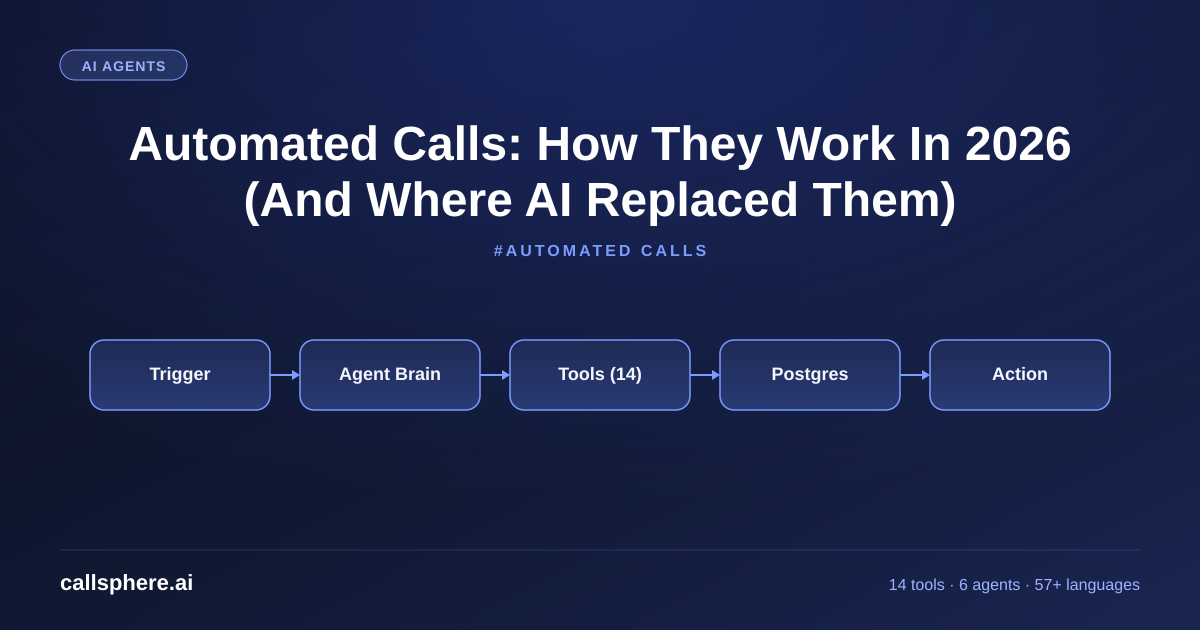
Automated phone calls in 2026 go through this flow:
- A trigger fires — a webhook, a CRM event, a scheduled batch, or an inbound call.
- The dialer or ingress passes the call to an AI agent loaded with the right vertical prompt.
- The agent speaks naturally, uses 14 function tools as needed, and handles interruptions.
- The call writes to 20+ Postgres tables —
calls,contacts,transcripts,outcomes. - Post-call automations fire: SMS confirmation, CRM upsert, calendar booking, manager alert.
Latency under 800ms is the modern bar. CallSphere runs at ~620ms first-token median.
What are automated phone responses and how do I set them up?
Automated phone responses is the SEO term for what most buyers actually want: an AI agent that picks up the phone and responds with a real conversation, not a recording. Setting one up on CallSphere takes ~30 minutes for the first version:
Hear it before you finish reading
Talk to a live CallSphere AI voice agent in your browser — 60 seconds, no signup.
- Sign up, port or forward a phone number.
- Pick one of 6 verticals (healthcare, real estate, sales, salon, after-hours, hotel) — or build custom.
- Upload your FAQ document.
- Connect your calendar (Cal.com, Google, Outlook).
- Test on a real call. Iterate. Go live.
Full production launches in 3–5 business days with FAQ tuning and CRM integration.
Is an automated phone number the same as a regular business number?
An automated phone number is a regular phone number routed to AI software instead of a human. From the caller's perspective it is identical to dialing any other business — same area code, same dial tone, same ring. The difference is on your end: every call gets answered, logged, transcribed, and acted on automatically. CallSphere's customers run 10-digit US numbers, toll-free numbers, and international numbers all as "automated numbers" — the number itself is just a number.
How CallSphere does this in production
The automated-call stack at CallSphere:
- Outbound: Predictive dialer with TCPA/DNC compliance, Twilio backend, retry logic.
- Inbound: SIP/WebRTC bridge to GPT-Realtime-2 with 128K context.
- Agent layer: 6 vertical agents (healthcare, real estate, sales, salon, after-hours, hotel) with vertical-tuned system prompts loaded from
vertical_promptsPostgres table. - Tool calls: 14 function tools —
appointment_lookup,patient_verify,slot_book,crm_upsert,payment_link,escalate_to_human, and 8 more. - Compliance: A2P 10DLC registered for SMS, DNC scrubbing on outbound, recorded-call disclosures in 57+ languages.
- Observability: Live admin dashboard, every call gets transcript, sentiment, intent, and outcome tags.
This is what replaced the 2018 robocall stack.
A real example walk-through
A solar installer in Phoenix wanted automated outbound qualification calls to 3,200 cold leads. Their previous attempt was a Spanish robocall vendor that got 0.4% engagement and 11 FCC complaints. They moved to CallSphere's sales agent in March 2026:
- 3,200 cold leads called over 2 weeks, 9am–6pm local, TCPA-compliant.
- 1,184 (37%) had a real conversation lasting 90+ seconds.
- 287 qualified leads booked into the rep calendar via
slot_book. - 0 FCC complaints (compliant disclosure on every call).
- Cost: $499/mo Growth tier + $640 Twilio outbound minutes = $1,139 total.
- Their prior robocall spend was $2,400/mo for worse results.
The "automated calls" got real engagement because they were actually conversations, not recordings.
Pricing & how to try it
- Starter — $149/mo: 2,000 interactions, 3 agents, 57+ languages.
- Growth — $499/mo: 10,000 interactions, all 6 verticals, outbound dialer included.
- Scale — $1,499/mo: 50,000 interactions, HIPAA BAA, custom verticals.
- 14-day free trial, no card.
Start your 14-day free trial →
Still reading? Stop comparing — try CallSphere live.
CallSphere ships complete AI voice agents per industry — 14 tools for healthcare, 10 agents for real estate, 4 specialists for salons. See how it actually handles a call before you book a demo.
Frequently asked questions
Are automated calls legal in 2026? Yes, with compliance. TCPA still applies (consent required for non-emergency automated marketing calls to mobile), DNC list scrubbing is mandatory for cold outbound, and A2P 10DLC is required for outbound SMS. CallSphere handles all three automatically on Growth and Scale tiers.
What is the difference between automated calls and robocalls? Robocalls play a pre-recorded message and usually skip TCPA compliance. Automated calls on a modern AI platform hold a real conversation, identify themselves as AI, honor DNC requests in real time, and are TCPA-compliant. The legal and customer-experience gap is enormous.
How do automated phone responses handle real questions?
Our agents use GPT-Realtime-2 with 128K context, vertical-tuned prompts, and pgvector RAG over your FAQ and knowledge base. If a caller asks something the agent does not know, it either escalates to a human via the escalate_to_human tool or schedules a callback.
Can I get an automated phone number for outbound and inbound on the same line? Yes — every CallSphere number is bi-directional by default. Inbound calls hit your AI agent; outbound campaigns dial from the same number with the same caller-ID. Customers see consistent identity.
Is automated phone different from auto-attendant? Yes. Auto-attendant is the press-1 menu from the 1990s. Modern automated phone is conversational AI — the caller talks naturally and the agent responds without menus. We replaced our customers' auto-attendants on day one.
How do I prevent automated calls from sounding robotic? GPT-Realtime-2 with the right voice persona is the technical answer. The product answer is: we have tuned 6 vertical voices for warmth, pace, and clarity. Customers regularly tell us their callers do not realize it is AI until told.
Can automated calls book appointments directly?
Yes — appointment_lookup and slot_book are two of our 14 function tools. We integrate with Cal.com, Google Calendar, Outlook, Athenahealth, and 9 more. The booking lands in your calendar before the call ends.
What is an automated number's caller ID like for the recipient? Standard 10-digit US number, your business name in CNAM if you have it registered. Recipients see exactly what they would see if a human at your business called them. See the demo →
Related reading
Try CallSphere AI Voice Agents
See how AI voice agents work for your industry. Live demo available -- no signup required.