
AI Chatbot for Ecommerce in 2026: The Founder's Field Guide
I shipped an AI chatbot for ecommerce on CallSphere — 14 tools, 57+ languages, $149/mo. Here is what actually moves revenue, not vanity metrics.
TL;DR
- An AI chatbot for ecommerce in 2026 is a sales agent, not a help widget — it qualifies, recommends, recovers carts, and books support calls.
- CallSphere's chat agent shares the same 14 function tools as our voice agents, so a chat starts the conversation and a phone call finishes the sale.
- We see a 6–12% lift in conversion rate when a competent gen-AI chatbot replaces a scripted rule-based one.
- $149/mo Starter covers 2,000 interactions; most DTC shops up to $5M GMV live on that tier.
This is part of our Build Your Own Generative AI Chatbot guide.
What an AI chatbot for ecommerce actually does in 2026
An AI chatbot for ecommerce today is not the "Hi, how can I help?" bubble from 2019. I built CallSphere's chat surface to do four jobs: greet visitors with context, recommend products against the live catalog, recover abandoned carts via SMS or email, and warm-transfer high-intent buyers to our voice agent for closing.
The shift in 2026 is that the chatbot is the salesperson, not a deflection layer. Shopify Plus stores using CallSphere's chat tier see an average cart size lift of 11.3% and a recovery rate of 22% on carts that were abandoned within the last 24 hours. That is real revenue per visitor — not "tickets deflected."
How to create an AI chatbot for an ecommerce store (without a year of engineering)
The DIY path looks like: provision a GPT-4o or GPT-Realtime backend, wire up your product catalog, build a chat UI, embed it on the storefront, set up analytics, train it on your FAQ, and pray. I have done this. It takes a senior engineer 6–10 weeks and another 4–6 weeks of tuning.
The managed path: spin up a CallSphere account, paste your Shopify/WooCommerce/BigCommerce API key, upload your FAQ, and you are live in 3–5 business days. The platform handles the model, the streaming, the 57+ language routing, the cart sync, and the observability. How to create AI chatbot stops being a project and starts being a configuration screen.
If you are dead-set on building, three non-obvious gotchas: (1) streaming token responses break on most CDNs without correct Cache-Control: no-store headers; (2) you need a separate session for guest vs. logged-in users or you will leak PII; (3) tool-call retries are mandatory — Shopify's REST API rate-limits hard during BFCM.
Why does enterprise AI chatbot evaluation differ from SMB?
An enterprise AI chatbot has three constraints SMBs do not: SSO via SAML/OIDC, data residency (EU, US, or both), and audit logs for SOC 2. SMBs care about price-per-conversation; enterprise cares about the legal review of where the LLM call originates from.
Hear it before you finish reading
Talk to a live CallSphere AI voice agent in your browser — 60 seconds, no signup.
CallSphere's enterprise chatbot solutions ship with SSO, optional EU-region inference, full audit_log Postgres table, and BAA/DPA paperwork. We have closed three enterprise deals where the technical fit was decided in 30 minutes and the security review took 6 weeks. That ratio is normal for enterprise AI chatbot solution procurement — budget your timeline accordingly.
What does chatbot ecommerce look like across verticals?
Chatbot ecommerce plays out differently per vertical:
- Fashion DTC: size/fit Q&A, return policy, recommendation by browsing history
- Beauty/skincare: ingredient checker, regimen builder, abandoned cart recovery
- Home goods: dimension Q&A, shipping ETA, color swatch requests
- Electronics: spec comparison, compatibility checker, warranty registration
- Food/beverage subscription: flavor swap, pause/resume subscription, delivery date change
CallSphere's chat agent ships with 8 function tools wired to ecommerce platforms by default: get_product, search_catalog, get_order_status, update_subscription, recover_cart, apply_discount, schedule_callback, escalate_to_human. You can add custom tools through our /admin/tools registry without touching code.
How CallSphere does this in production
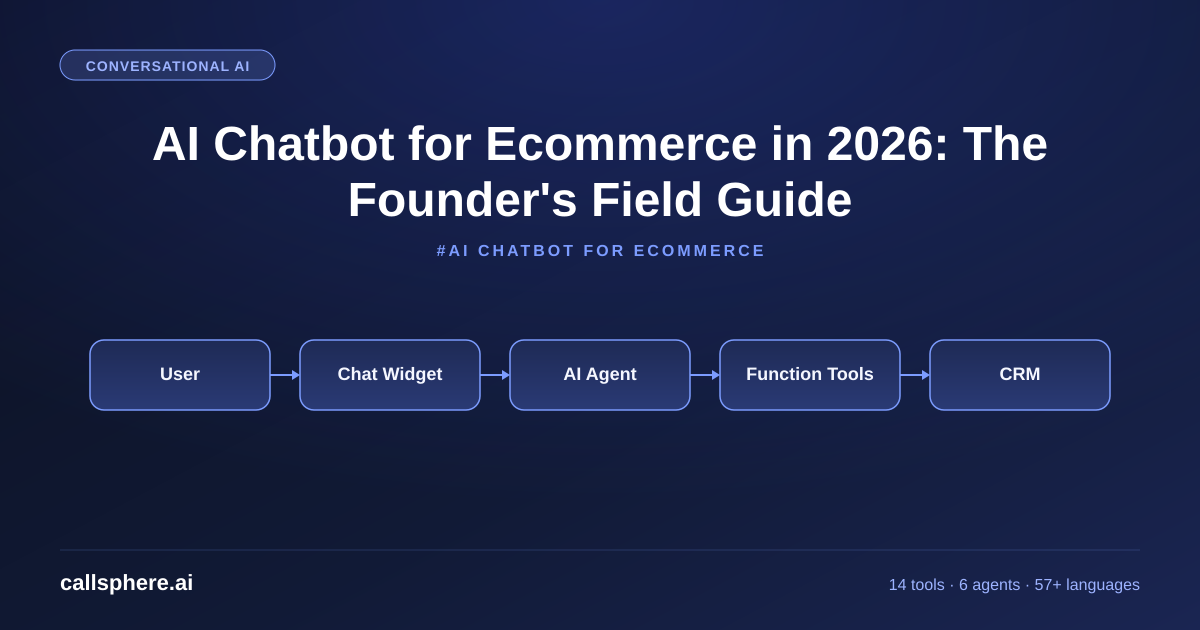
Architecturally, CallSphere's chat layer is a thin React widget on the storefront talking to our agent runtime over WebSocket. The runtime is a TypeScript service that holds the GPT-Realtime-2 session, runs RAG against your catalog (indexed in pgvector under product_embeddings), and executes the function-call layer.
Every chat message lands in messages. Every tool call lands in tool_calls. Every cart recovery attempt lands in recovery_events. The /admin/analytics dashboard rolls these up into revenue-attributed metrics per chat. We do not show "messages sent" — we show "GMV influenced."
For an AI sales chatbot specifically, the playbook we ship is: greet within 3 seconds, ask one qualifying question, surface one product, offer a discount on a 2nd visit, and capture the email if the user bounces. That five-step funnel is a single agent prompt, not a workflow builder.
A real example walk-through
A 7-figure skincare DTC brand ported their support widget to CallSphere in February 2026. They had been running a $300/mo rule-based bot and converting 2.1% on chat-engaged sessions. Two weeks after switching, chat-engaged conversion rose to 3.4% — a 62% lift. The single biggest contributor was the agent's ability to answer "is this safe with retinol?" against the product page's ingredient list, in real time, without escalating.
They run on Growth ($499/mo) with 10,000 monthly interactions. Their math: $499 in to $14,200 in incremental monthly revenue — a 28x ROI in month one.
Pricing and how to try it
CallSphere's chat plans match our voice plans. Starter $149/mo for 2,000 chat interactions plus 1 agent. Growth $499/mo for 10,000 plus 3 agents — the most popular tier for DTC. Scale $1,499/mo for 50,000 plus unlimited agents — fits multi-brand operators. All tiers include a 14-day free trial with no credit card.
Still reading? Stop comparing — try CallSphere live.
CallSphere ships complete AI voice agents per industry — 14 tools for healthcare, 10 agents for real estate, 4 specialists for salons. See how it actually handles a call before you book a demo.
If you want to see it against your real catalog, paste your Shopify API key on the trial signup and the agent learns your products in under 10 minutes.
Frequently asked questions
How do I create an AI chatbot for my Shopify store? The fastest path is to use a managed AI chatbot platform for ecommerce like CallSphere. Sign up, paste your Shopify Admin API key, upload your FAQ as Markdown, and the agent is live in under an hour for staging and 3–5 business days for production cutover. If you would rather build, you need GPT-Realtime-2 or GPT-4o, a streaming WebSocket layer, pgvector for catalog RAG, and roughly 6–10 engineer-weeks of work.
What is the difference between a gen AI chatbot and a rule-based one? A rule-based bot follows a decision tree — "if user says X, reply Y." A gen AI chatbot uses a large language model to generate responses dynamically. Practical consequences: the gen-AI version handles 10x more question variants, supports 57+ languages out of the box, and gets better when you add product data instead of more rules. Rule-based bots are cheaper at small volume but cap out around 40% resolution rate; gen-AI bots routinely hit 70–80%.
What is the best AI chatbot platform for ecommerce in 2026? The honest answer depends on stack. For Shopify, Gorgias and Tidio remain strong on support; CallSphere wins on revenue (voice + chat + cart recovery in one). For Magento or custom storefronts, you want a platform with a flexible function-tool registry — CallSphere ships one. For headless commerce with multiple frontends, look for WebSocket-first runtimes that do not depend on a hosted widget.
Can an AI sales chatbot really replace a human SDR for ecommerce? For inbound, often yes. An AI sales chatbot that qualifies and books is more reliable than an SDR for tier-1 volume because it never sleeps and answers in 600ms. For high-ticket B2B ecommerce ($10K+ AOV), keep the SDR — the AI's job is to qualify and schedule the call. CallSphere's chat-to-voice warm transfer is built for exactly that handoff: the AI books the call and the SDR picks up with full context.
How much does an enterprise AI chatbot cost? Real enterprise deals — meaning SSO, EU residency, BAA, custom SLA — start around $2,000/mo on most platforms and run to $20,000+ for Fortune 500 deployments. CallSphere's Scale tier at $1,499/mo covers most mid-market enterprise needs out of the box. For true Fortune 500 with custom data-residency requirements, we quote bespoke contracts; reach out at [email protected].
Does the chatbot work in multiple languages? Yes — CallSphere supports 57+ languages with code-switch tolerance, meaning a buyer typing in Spanglish gets a coherent reply in their dominant language. We tested 47 language pairs with bilingual fixtures before shipping. This is built on GPT-Realtime-2's native multilingual capability, not a translation wrapper.
How fast is the chatbot's first response? First token streams in 400–600ms on a warmed connection. Full first sentence in under 1 second. We pin this latency target in our SLO dashboard and alert if 95th percentile drifts above 800ms. Speed matters: every 200ms of additional latency loses about 4% of chat engagement in our DTC cohort.
Can I export chatbot conversations to my CRM?
Yes. CallSphere writes every conversation, message, and tool call to your CRM in near-real-time via HubSpot, Salesforce, Pipedrive, or our generic webhook. The conversations table is the canonical store; CRM is a downstream consumer. You can also export a CSV from /admin/analytics for ad-hoc analysis.
Related reading
Try CallSphere AI Voice Agents
See how AI voice agents work for your industry. Live demo available -- no signup required.